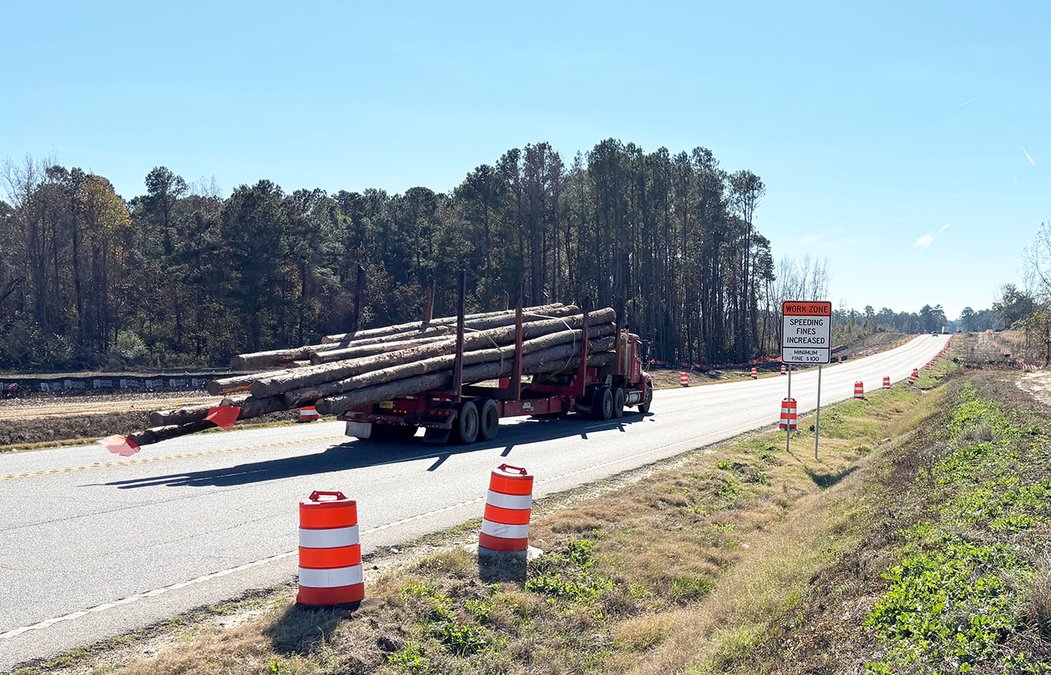
The city of Statesboro is spending $990,350 to reroute its six-inch high-pressure natural gas supply line and relocate some smaller service lines to make way for the Georgia Department of Transportation’s project to four-lane a 1.7-mile segment of U.S. Highway 301 North.
The state is funding the widening of the highway from two lanes to four lanes from 500 feet south of Randy Lowery Road (County Road 450) to 657 feet south of Clito Road (County Road 455). But Statesboro officials said the state spending doesn’t include any payment for moving the city-owned gas system lines.
Reeves Construction, as low bidder, was awarded the highway project construction contract for $6.58 million, reports GDOT District 5 Communications Officer Jill Nagel. An almost $7.15 million “construction” funding figure found on the department’s project database was a February 2024 estimate, she noted. So the construction bid came in under-budget.
The database listing indicates that the state previously had amounts of $586,000 and $1.8 million, in fiscal years 2018 and 2020 respectively, estimated for preliminary engineering work on this project, then $1.95 million for right of way in 2023. The construction funding was listed for the state’s fiscal 2026, which began last July 1.
“The construction kicked off on October 13, 2025,” Nagel said in an emailed response Friday. “Currently, the contractor is clearing the right-of-way. We anticipate the new travel lanes to be open to traffic by August 2027, offering a smoother and safer travel experience.”
A Georgia Department of Transportation summary describes the work as “extending the existing overlapping northbound and southbound passing lanes to the North along (State Route) 73/U.S. 301 to provide operational improvements to the corridor.” When finished, the “typical section” of roadway will consist of four 12-foot-wide lanes between eight-foot-wide shoulders, with a two-foot strip of each shoulder paved, according to the description.
Gas line relocation
Statesboro City Council on Dec. 2 unanimously awarded a contract to Southeast Connections LLC in the amount of $990,349.82 for relocation of natural gas system facilities to make way for the highway project. Southeast Connections had made the lower of two bids, the other being from Equix Energy Services for $1,075,175.
In his memo presented to the council, city Public Utilities Director Matt Aycock stated that the winning bid was well below the budgeted amount of $1.4 million and that the funding would come from gas system revenues and Special Purpose Local Option Sales Tax. He also included a recommendation from Jack Sapp of Sapp Engineering, consulting engineer for the natural gas system, to approve the Southeast Connections contract.
The detailed bid sheet shows that the largest portion of the cost, more than $630,000, will be for furnishing and installing 8,200 linear feet of six-inch diameter steel gas mains. The Statesboro natural gas system’s long-established main high-pressure supply line comes in along U.S. Highway 301 North. Other major components include 2,100 feet of four-inch gas main and 3,800 feet of two-inch mains. Some smaller lines, fittings and valves are also included.
“It’s mainly the high-pressure, and then a low-pressure line and some services (branch lines to customers) that will have to be relocated,” Aycock said in a follow-up interview last week.
Long expected move
His memo indicated that the city funds were approved in the fiscal year 2024 capital improvements budget and that the earmarked SPLOST revenue dates back to the 2019 referendum.
“This was originally brought up years ago, and it kind of got put on the back burner, and we didn’t hear from it for a long time, and then all of a sudden it came up and they’re ready to do it today,” Aycock said.
SPLOST will provide most of the funds, with a smaller share coming from the Natural Gas Department’s service fees income. He confirmed that the state is not reimbursing the city for this expense.
“I wish there was some help from DOT,” Aycock said. “They kind of have the understanding that anybody in their right of way, it’s on them to relocate it. … We’ve heard that the phone company has to pay to relocate their own services. ... The way they look at it, any utility company, if they make a profit, then they can afford to move their own utilities.”
The city government is not a for-profit entity, but its natural gas service is a fee-based enterprise that operates like a business. Of course, city officials often note that GDOT helps fund some of Statesboro’s city-initiated street and bridge projects.
Statesboro Natural Gas Superintendent Joe Hollingsworth said the contractor hopes to start the gas line relocation work at the beginning of January and plans to keep disruptions to a minimum.
“The high-pressure main, it will all be done with hot-taps, so nobody will ever know anything’s happened,” Hollingsworth said. “There will be a few services (to be reconnected), and they’ll be scheduled with the customers where their gas may have to be off for a few hours, tying it over to the new main off of the old main.”