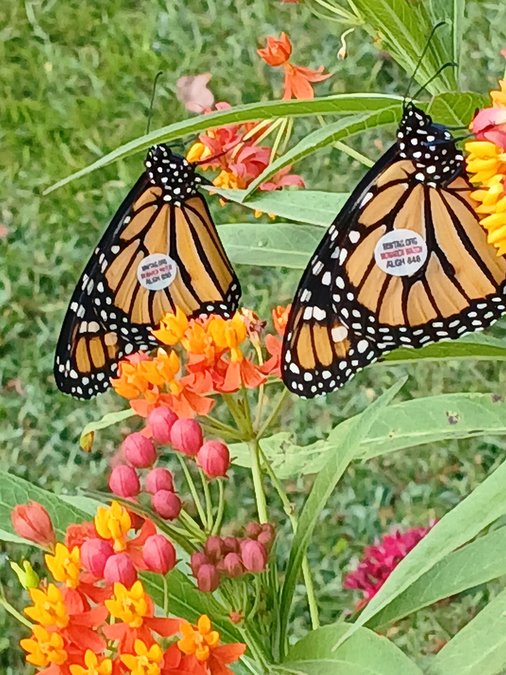
Dogs days of summer are upon us! Silent visitors wing their way through the Boro skies. Fluttering orange and black, regal Monarch butterflies pause here on their annual trek to Mexico.
Take notice of this fascinating creature. They are the only butterflies that migrate in a two-way pattern as do birds. Their annual marathon takes four generations to complete, spanning more than 3,000 miles from Mexico to Canada, Minnesota, and Maine.
The first three generations hatch, mate, and die within 6 weeks. The last generation, however, “born” in August or September, lives for six to nine months, wintering in the oyamel fir trees of Central Mexico.
Navigation is a wonder of nature. Using the position of the sun horizontally, they employ the earth’s magnetic field and an internal antenna clock to find the way. So accurate is this reckoning that each year the offspring from the previous year return to winter in the exact same tree.
For more than 20 years now, we’ve been raising and releasing these wondrous, intricate creatures at home and in school classrooms. “Monarch Watch,” a non-profit education, conservation, and research program from the University of Kansas, is your one-stop online location for detailed information.
Here’s a basic primer:
- Monarchs (females) lay their eggs singly on the underside of milkweed leaves. These plants once grew wild everywhere, but now are available mostly from nurseries or online.
- Eggs hatch in 3-6 days. Caterpillars feed voraciously for 10-14 days before forming a gold-spotted, emerald green chrysalis which hatches within 2 weeks.
- Upon emerging, the wings are wet and folded, yet dry within hours so the butterfly can take to the air and live for a few weeks more.
Only 1-10% of eggs laid reach adult maturity. But if you have the time and patience, your results could yield 70% or better! Information and aids are available online. We use small netted cubes or cylinders, with removable tubes to hold milkweed clippings.
The “cats” are then better protected from disease, parasites, and predators which often plague them in the wild! We’ve raised and released more than a thousand through the years!
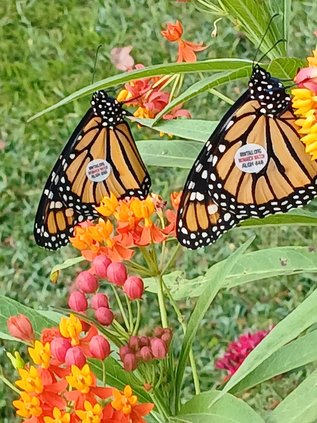
Monarch Watch even provides numbered “wing tags” as well – identification to track “raised and released data.”