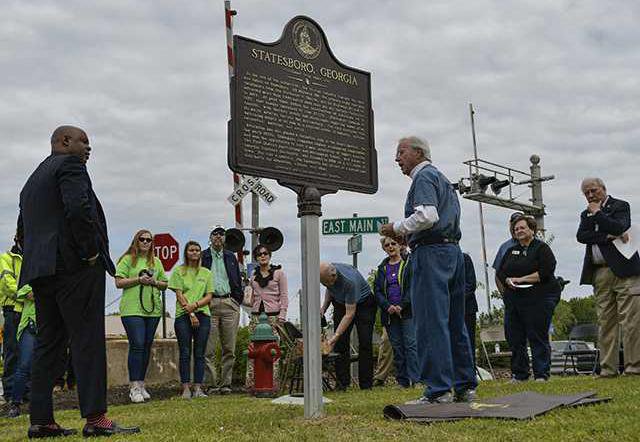
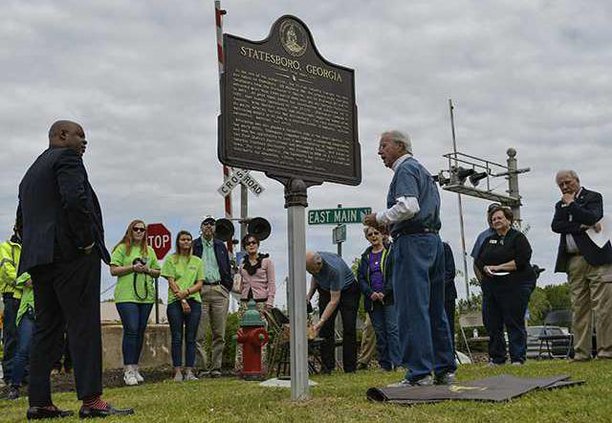
Saturday the Bulloch County Historical Society unveiled a freestanding, gold-leaf lettered, brown-coated cast aluminum "Statesboro, Georgia" marker, the 22nd historical marker the society has placed in and around the county and the ninth within Statesboro's city limits.
However, this marker, at Triangle Park in sight of City Hall, is unique in capsulizing the history of Statesboro. Mayor Jonathan McCollar met Historical Society members for the dedication ceremony during the Spring into Statesboro festival on East Main Street.
"We must embrace our history, our traditions, and we've got to build on that and use that as we move our community forward," said McCollar, who took office in January. "We want to thank the Historical Society for their hard work and dedication. They're always reminding us of where we've come from and how much our city has grown and progressed. Now it's on us to continue that tradition."
The capsule history written in gold covers both sides of the marker. The front text begins: "Statesboro, the only town bearing this name in the country, was created on December 19, 1803, as the seat of a young Bulloch County. Charging just $1.00, Augusta land speculator George Siebald sold 200 acres for the establishment of the town (then Statesborough). ..."
Farming, pine forests, business development, railroads, tourism, U.S. Highways 301, 80 and 25 and education's importance here are noted before the wording ends on the reverse, culminating with the role of Georgia Southern University.
The marker does not mention slavery or the Civil War directly, but notes that Statesboro's population remained very small before its growth as a commercial hub "in the decades after Reconstruction."
Markers like the one unveiled Saturday cost between $1,500 and $1,700 each, said Bill Waters, who chairs the marker program committee. The Historical Society orders the 100-pound markers from Sewah Studios in Marietta, Ohio, which Waters and his wife, the society's executive director, said makes about 90 percent of the historical markers produced in the United States.
Independent effort
The Bulloch County Historical Society's marker program operates independently and receives no state funding, Bill Waters said. Instead, a Jack N. and Addie D. Averitt Foundation endowment supports the marker program and many of the society's other projects.
Condensing "200 years of history to two sides of a marker" took Historical Society leaders three or four years, said Virginia Anne Franklin Waters, the executive director. They were allowed 20 lines on each side, and up to 62 characters and spaces in each line.
"But we think we've done a good job, and I'd rather have it correct and inclusive than to have put it up before that time," she said.
Over the decades, the statewide Georgia Historical Society has also placed nine similar markers in Bulloch County, less than half as many as have now been placed by the local society, noted its board member Rodney Harville.
The Bulloch County Historical Society placed its first marker, "United States vs. Darby Lumber Company," in May 2011, and 21 markers later is still planning for others. A list can be found on the website, www.bullochhistory.com.
City Hall exhibits
The Historical Society is also working with the city government to place displays highlighting Statesboro's history inside City Hall. Built in 1905 as the Jaeckel Hotel, the current City Hall building preserves exterior signs and several features of the historic hotel.
City officials asked the Historical Society in 2017 to work with the city to transform the lobby decor, especially the front portion, into a mini museum. The work is not complete yet, but much progress has been made, said Bulloch County Historical Society President Joe McGlamery, also president of the Statesboro Herald.
"We are giving that area of City Hall a bright new look but very much a look with a historic perspective," McGlamery said. "So we're excited about that, and we think that within the next few months we'll be able to finish Phase 1 of that project. There will be additional phases to come later."
For the first phase, two postcard photographs of street scenes from downtown Statesboro shortly after the beginning of the 20th century were greatly enlarged and printed on walls facing the front entrance. The postcards are in Virginia Anne Franklin Waters' own collection.
McCollar noted that visitors to City Hall now pose to take photos in front of the postcard murals.
Railway clock
Meanwhile, longtime Statesboro residents William R. "Bobby" Smith and Jenny Smith have given the Historical Society the use of a clock that once hung in the Jaeckel Hotel lobby to be restored and returned there, McGlamery said. The clock's face is emblazoned "Savannah & Statesboro Railway: Quickest Route to Savannah." The passenger service ran where the current tracks are, east of City Hall and just steps from the new marker.
Now at the Georgia Southern University Museum, the wind-up clock made by the Seth Thomas Company will soon be brought to City Hall along with some signs about the hotel's history, said the museum's director, Brent Tharp, Ph.D., also vice president of the Bulloch County Historical Society.
Cutouts of people important to Statesboro's history, accompanied by biographical sketches, will also be part of Phase 1, Tharp said. For Phase 2, one proposal is to place a video screen in the lobby, where visitors would see brief programs on local history.
Herald reporter Al Hackle may be reached at (912) 489-9458.