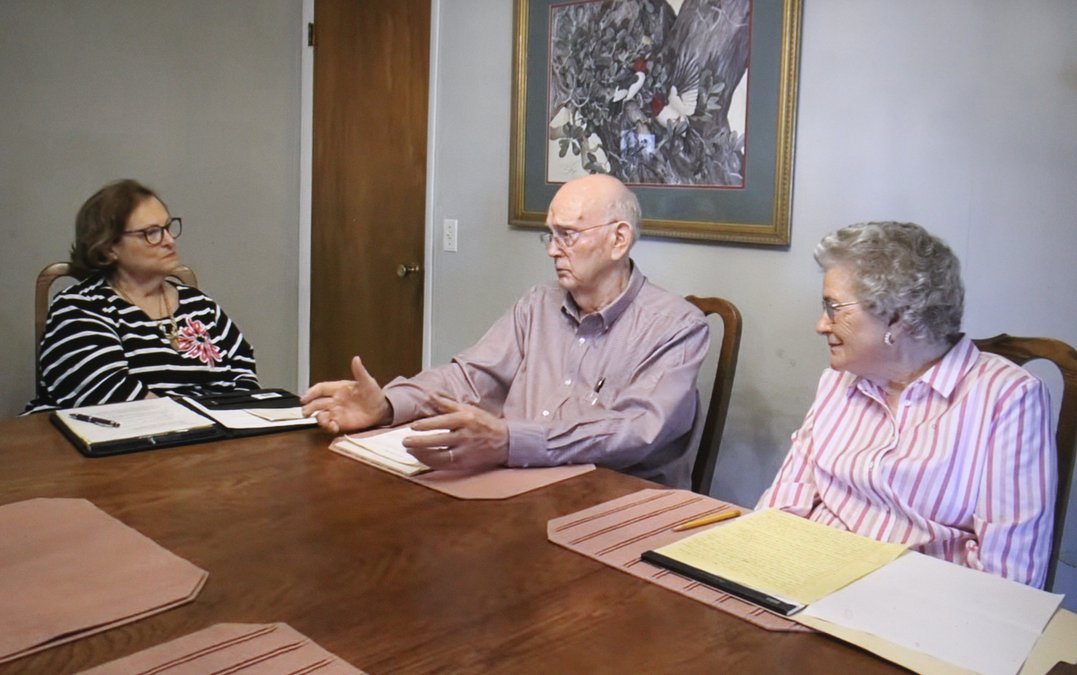
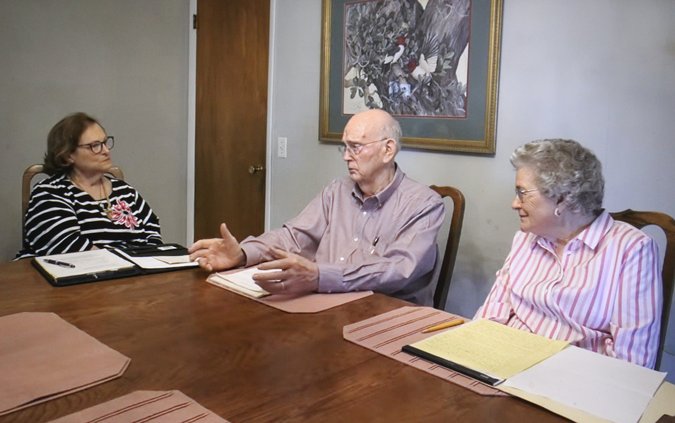
On Monday the Bulloch County Historical Society debuted the latest video in its oral history Legends Series, an interview with the society's President Emeritus Rodney Harville and his wife, Nadyne Brannen Harville, over lunch in the usual meeting place.
That's the social hall at Pittman Park United Methodist Church, where the Historical Society's members and guests meet on usually the fourth Monday of the month for 10 months of the year. The Legends Series consist of videos produced with a Historical Society member, current Vice President Tyson Davis, handling technical aspects. The interviewer for this one was Virginia Anne Franklin Waters, the Historical Society's executive director.
The Harvilles have been active in the Historical Society for decades, and the organization bestowed the new title of president emeritus on Rodney Harville, who is now 91, last July. Nadyne Harville is now 85, and they have been married 63 years.
Both Harvilles were born in rural areas of Bulloch County at a time when more rural communities had their own schools, and when some that still have elementary schools — such as Nevils and Stilson — actually had their own high schools and highly competitive sports teams.
Nadyne Brannen was born in a three-room farm tenant house "on the Winskie place" in the Westside community in 1941. She attended Warnock Elementary School for her first four years in school, but school consolidation and a parental decision soon had her gravitating more toward Statesboro.
"After that year some of the elementary schools in Bulloch County were being consolidated, and we had to choose another school because Warnock was one of them, and Mama and Daddy chose the Laboratory School at Georgia Southern," she said.
A teaching lab
As she acknowledged, at that time it was actually the Laboratory School at Georgia Teachers College, because what is now the university wouldn't be renamed Georgia Southern College until 1959. Marvin Pittman was president of the college in the 1940s, and the lab school she attended — where teachers-to-be gained classroom experience under the supervision of education professors on campus — had been renamed Marvin Pittman Laboratory School by the time she graduated.
"I've often said … that I didn't know how privileged I was to have attended school at the laboratory school," Mrs. Nadyne said. "It was wonderful, because we were able to join in with the college students, parents, students, teachers. …"
"You sure did, you had the cream of the crop of Bulloch County because they were all trained right there at the college," Waters interjected.
They also exchanged comments about Harville's work as a farm girl — filling fertilizer buckets, picking cotton, putting in tobacco — and her cooking some favorite dishes to take to church socials and how the Warnock School had a canning plant, and the arrival of electricity in farm communities.
It was exciting for the family to get a water heater and a radio "and so many things," Harville said.
Born to live large
Rodney Harville was born in 1935, also in "a tenant house" but one belonging to his grandfather, Keebler Henry Harville, in the Denmark community. Mr. Rodney asserts that an early distinction of his was having been born rather large.
"A strange thing was that I weighed 11 pounds and 4 ounces," he said.
"My word in heaven, bless your mother!" said Waters.
"My mother once said, 'You know, I could've had twins, but then after you got older, the world couldn't stand another Rodney,' " Harville said without cracking a smile.
Waters said she'd have to disagree with his mother on that one.
After the young Rodney's grandfather bought another piece of land his parents moved there, to the Nevils community, and he has remained there afterward, except for a time when the family lived in "the Harville House," he said. That's a locally famous structure, built by his grandfather way back in the 1890s, that some people have claimed is haunted.
Rodney Harville attended school in Nevils and graduated from Nevils High School.
"And you were a basketball star at Nevils," said Waters.
"I played basketball," Harville said, flatly.
"You were a basketball star," said Waters. "Come on, tell the truth."
That start as a large infant led to his still being big for his age in school, so that he wore his father's shoes in seventh grade, he said. After Harville was chosen for the varsity basketball team in 10th grade, the Nevils team went to the state tournament in 1949 and lost in the second round. Then in 1950, when both he and his brother were on the team, Nevils advanced through the semifinals and lost in the championship game. Nevils High went as far as the semifinals again in 1951. Nevils and Stilson had a rivalry back then.
Harville also played on the baseball team and competed at track meets, throwing shot put.
Tobacco to telephones
Meanwhile, his first paying jobs were in the tobacco fields, picking tobacco by hand in the summers. From there, around age 15 and 16, he and his brother started working in one of the Statesboro tobacco markets — the Brannen Warehouse, which was on College Street in the area that is now the West District — in the evenings. Another of the neighboring warehouse companies was Cobb & Foxhall, hence The Foxhall as a current event venue's name.
In young adulthood, Harville found a different line of work, in the telephone industry. Starting out digging telephone pole holes for the Union Point Telephone Company in White Plains and Greensboro, Georgia, as phone systems were being expanded under the Rural Electrification Administration, or REA, cooperatives, he became foreman of the hole digging crew and a certified linesman.
Then he returned to Statesboro, and while working again at the tobacco warehouse, he was encouraged to apply for a job at the Statesboro Telephone Company and hired in 1955. He worked there for 40 years, retiring as vice president of operations in 1994 and continuing two fiber optic projects until April 1995.
National Guard career
Meanwhile, Harville had also joined the Army National Guard while a senior in high school. He says he thought this would keep him from being drafted for the Korean War, as he had his heart set on becoming a high school basketball coach.
He never became a coach, but remained in the National Guard while attending Georgia Teachers College and afterward while working for the phone company — a total of 38 years. He served in several different assignments, and finally in the field artillery.
"Thirty-eight years!" Waters exclaimed.
"Thirty-eight years, three months and 14 days," Harville recited without a second's pause, "and I retired on the 14th day of September, and that's our wedding anniversary."
In fact, after retiring from the National Guard, he became a civilian volunteer with a federal program that helps make sure that Guard and Reserve soldiers get their civilian jobs back when they return from deployments. He did that for another 22 years, receiving a Department of Defense volunteer of the year award and two presidential awards for his many hours of service.
The Harvilles have three daughters, Teresa, who was with them Monday, and Tiffany and Toni, and one granddaughter and one grandson.
The video can be found at www.youtube.com/watch?v=K_MosmbkMsg.