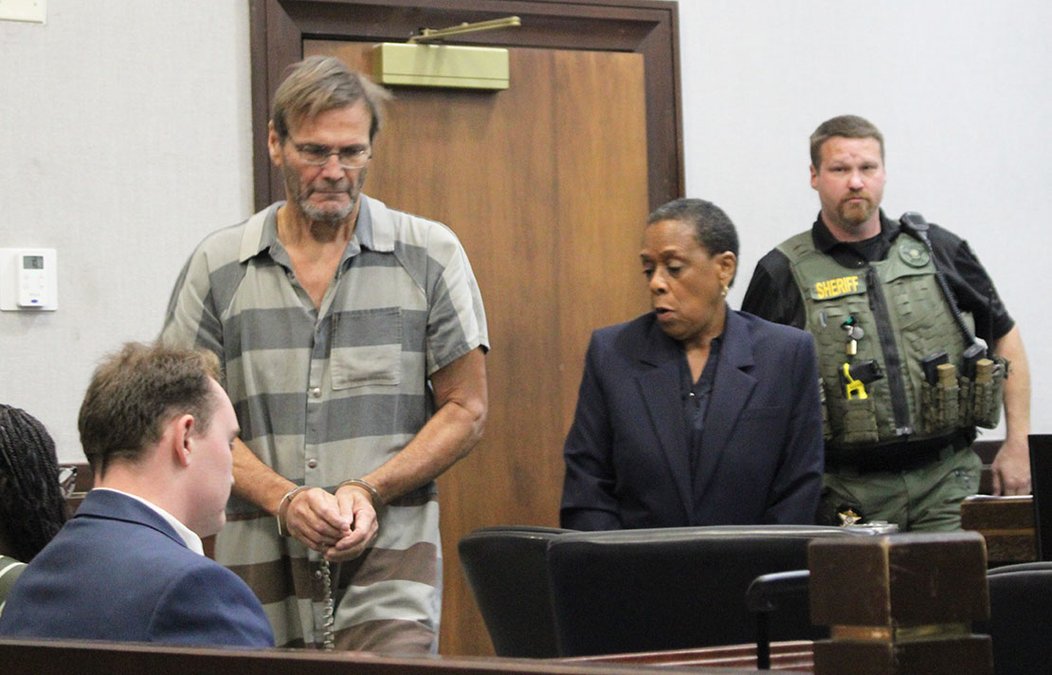
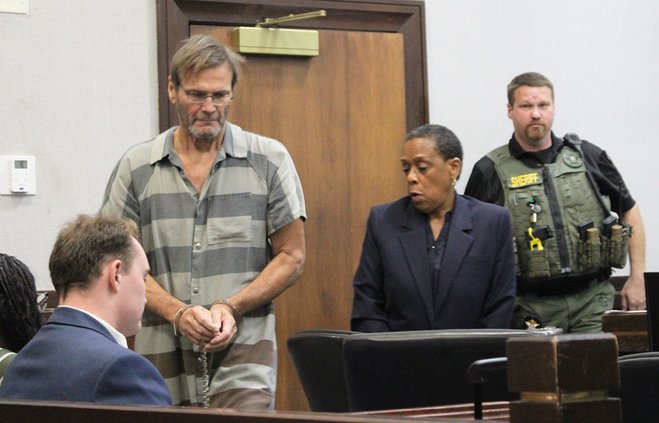
A Bulloch County man who had been accused in arrest warrants of removing an ex-girlfriend’s pet dog from her house, causing the animal’s death and “dismemberment” and abandoning it on another person’s property won’t get out of jail yet.
Those events were reported to the Bulloch County Sheriff’s Office the second week of September, and Kelly Williams, 65, was arrested Sept. 13.
Superior Court Judge Ronald K. “Ronnie” Thompson, at the conclusion of a bond and preliminary hearing Friday morning, Sept. 26, denied bond for Williams in this case and revoked his bond from an arrest earlier this year.
In the preliminary hearing portion related to the dog’s death, the judge “bound over” Williams for trial with a finding of probable cause only on the misdemeanor charge of abandonment of a dead animal. Thompson did not find probable cause on the two felony charges alleged in the arrest warrants – aggravated cruelty to animals and first-degree burglary – after no testimony was presented during the hearing that anyone saw Williams kill the dog or enter the house.
However, Ogeechee Judicial Circuit District Attorney’s Office prosecutors were set to present the felony allegations to a grand jury this week. The August-term grand jury met in a callback session Wednesday, Oct. 1, but no word on an indictment was available at press time.
Deputy’s testimony
Unlike grand jury proceedings, which are closed, Friday’s hearing was held in open court. The state’s one sworn witness regarding events surrounding the death of a brown Boykin Spaniel named Brodie was Deputy Isaiah Rehl. He testified that the investigation began when “someone with a past relationship with Mr. Williams called the Sheriff’s Office” asking that deputies check on the welfare of her dog.
That someone was Sara “Ginny” Smith, who outside of the courtroom said her relationship with Williams ended about seven years ago. She was out of town when she called the sheriff’s department, and Rehl testified that she told him she had found Williams on her property a day or so earlier digging a hole and planting a cross. She had asked Williams to remove the cross and leave, which he did, the deputy said.
Smith had told Rehl that when she asked Williams why he was doing this, he said, “I’m fighting some evil with some good.”
Rehl said Smith called with concerns about her dog around 5:20 p.m. Sept. 12. Then around 8 p.m., the Sheriff’s Office received a call from a man who owns property on Railroad Bed Road near Brooklet, miles from Smith’s home, and has been a friend of Williams’.
The man reported “a medium sized dog” was dead in a wooded area of his property and that earlier that afternoon he had seen Williams bringing a “box” or cooler onto his place, Rehl testified. At that time, the property owner had gone over and seen a dog, deceased but intact, in the cooler, and had thought it must be Williams’ dog he was going to bury, Rehl said.
But that evening, the Railroad Bed Road resident’s son told him he saw Williams burning the contents of the cooler, and that’s when the resident called to report it.
Arriving on the scene, deputies found the burned body of a dog “with no head,” Rehl testified. Deputies and animal control officers also recovered a fuel can, a lighter and a saw, he said. Smith had told him that Brodie, “an indoor dog,” always wore a diaper and a red collar, and these were also found with the remains. Photos were submitted into evidence.
How did the dog die?
Representing Williams, Public Defender QueAndra Campbell asked who had been taking care of the dog. A tenant of Smith’s “would every now and then let the dog out,” or Smith’s parents would sometimes as well, the deputy said.
“So, how did the dog die?” was another of Campbell’s questions.
“Unknown,” Rehl said.
That became a key argument of the defense as Campbell went through the legal definition of each of the three charges.
“Abandonment of an animal, we’ll concede to that,” she said.
That is the misdemeanor charge, punishable by no more than a year in prison and a $1,000 fine.
But aggravated cruelty to animals is a felony, carrying a sentence of up to five years and a fine up to $15,000. The charge was based on the idea that Williams caused the dog’s death, but Campbell noted that no direct evidence of this had been presented.
“The animal was already deceased, and no one has testified how the animal died,” she said. “That is a pertinent part of this entire case, how did the animal die? Nobody knows.”
First-degree burglary would also be a felony, carrying a potential sentence of one to 20 years.
Assistant District Attorney Donna Black noted that only probable cause was needed in a preliminary hearing, and argued that circumstantial evidence could provide it.
The charge of burglary was based on evidence that Brodie was “an inside dog,” she said. The judge asked why that mattered. “Because we have to establish, Your Honor, that it is a burglary, that (Williams) actually entered into the property to take the dog,” Black replied.
“You’ll need a lot more than just ‘the dog was an inside dog,’” Thompson said, “especially when the dog goes outside sometimes.”
After a brief recess, Thompson gave his ruling in the preliminary hearing, stating first that a finding of probable cause, “requires merely a probability, less than a certainty, but more than a mere suspicion.”
He said “it’s very possible” that Williams went into the house and took the dog, “but the court requires just a little bit more evidence, and perhaps by the time it gets to the grand jury those witnesses or evidence will be there and the grand jury can decide what to do with it.”
January incident
At the time of his arrest in connection with the dog’s death, Williams was out on bond from an arrest earlier this year following a January incident. According to warrants brought by the Sheriff’s Office, he called 911 the night of Jan. 30 and reported multiple trespassers on his property, who were never actually present, and then called 911 again four hours later to report that he had just shot and killed two people inside his home, which never happened either. Deputies also reported that Willams had fired shots into the walls of his own home.
During Friday’s hearing, Black successfully countered the defense’s request that Williams be released on bond in the most recent case with an argument for revocation of the bond in the earlier case.
After the Jan. 30 incident he was initially charged with misdemeanor counts of false report of a crime, reckless conduct and disorderly conduct, and a Feb. 8 warrant added a felony charge of false statements in a government matter. His bond was set at $2,500 in a March 14 order, but Black noted that a mental health evaluation and treatment she said the parties agreed to was not included in the order and that no report had been provided.
Bond revoked, denied
“It’s obvious that there are mental health concerns,” Thompson said. “The court finds that he’s a risk to harm himself and possibly others. … So we’re going to revoke the bond, and I’m not going to grant him a new bond at this time.”
Smith, who attended the hearing, said afterward she was pleased with that outcome but that some of the facts regarding the timeline of events and other details were not correct and she hoped to correct these with the D.A.’s Office.
“But I’m pleased with the outcome today,” Smith said Friday. “I’m pleased that no bond was issued and they revoked the last bond, so that makes me feel safer because I am concerned for my safety and the safety of my family … for what he did, it was horrific.”
Lindsay Gribble, non-attorney chief of staff in the District Attorney’s Office, confirmed Wednesday that the Williams case was to be presented to the grand jury.
An indictment would not be a determination of guilt, but only a decision by a majority of the grand jury members that enough evidence exists for charges to go to trial.
“For grand jury the District Attorney’s Office has prosecutorial discretion to move forward regardless of the preliminary hearing,” Gribble wrote in an email. “We routinely add, change, or take away when presenting to grand jury as needed.”