When Joe McGlamery started working at the Statesboro Herald in 1975, one of the charges he received from Herald owner Charles Morris was that the newspaper and its leadership needed to become more involved in the community. McGlamery was president of the Statesboro Kiwanis Club when he joined the Herald and, also, an officer of the Statesboro Planning Commission.
“I believed in the importance of being an active member of the community and I made it a priority for the Herald to editorially support improving the quality of life in Statesboro and Bulloch County,” McGlamery said.
Through the years, McGlamery said he made a purposeful effort to seek out and support local civic and service organizations that he personally believed in and that the Herald could report on and feature, where appropriate.
McGlamery served as chairman of United Way of Southeast Georgia and the Bulloch County Chapter of the Red Cross. McGlamery also served as president of the Georgia Press Association from 1994 to 1995 and for many years was on the Board of Directors of the Georgia Press Educational Foundation.
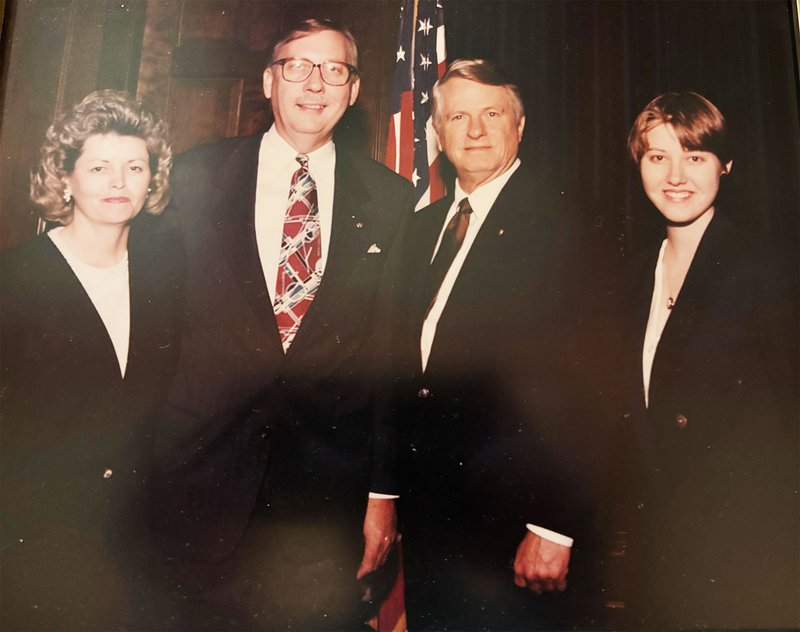
In 1993, McGlamery was appointed by Gov. Zell Miller to the Georgia State Board of Education and he represented the First Congressional District until January 1997.
For many years, the Statesboro Herald covered, and editorially supported, Georgia Southern College’s effort to earn full university status, which the Board of Regents granted in 1990. McGlamery served as a trustee of the Georgia Southern University Foundation for more than 27 years, including a two-year term as chairman from 1992 to
1994. He also served as chairman of the university’s A Day for Southern fundraising campaign in 2007.
In addition to his work with higher education, in 2006 McGlamery became the founding chairman of the Bulloch County Foundation for Public Education.
With the support of then Bulloch County Schools Superintendent Jessie Strickland, the group at first provided “mini-grants” to educators that allowed them to offer more opportunities for learning in classrooms and area and state scholastic events.
“Education has always been near and dear to my heart,” McGlamery said. “I think what separates what I consider progressive counties from non-progressive counties is how much is spent on education per pupil and how those funds are directed.
“We wanted to get more help directly to teachers in their efforts to better educate their students.”
In addition to teacher grants, the foundation provides the $1,000 seed money for all REACH Scholars every year and has sponsored 62 scholars since 2013.
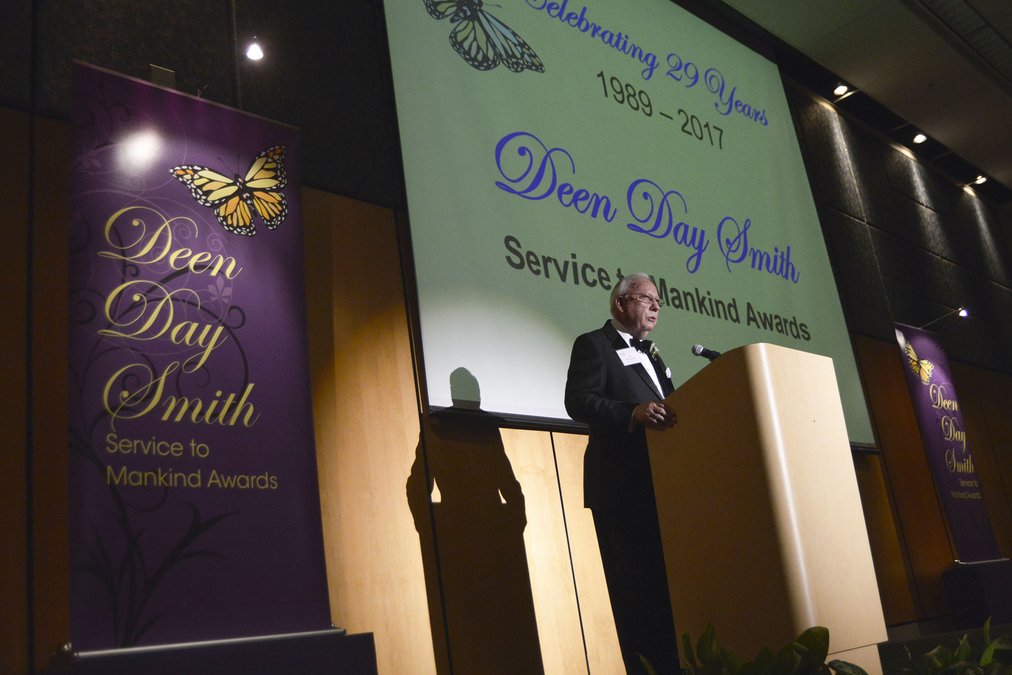
Among the many community efforts McGlamery helped launch, perhaps the most well-known in the community was the Deen Day Smith Service to Mankind Awards.
“Patsy Bobo came by my office one day in 1987 to suggest that we ought to do something to recognize the people who are the givers of the community, the people who volunteer, the people who make the community the kind of community that it is.
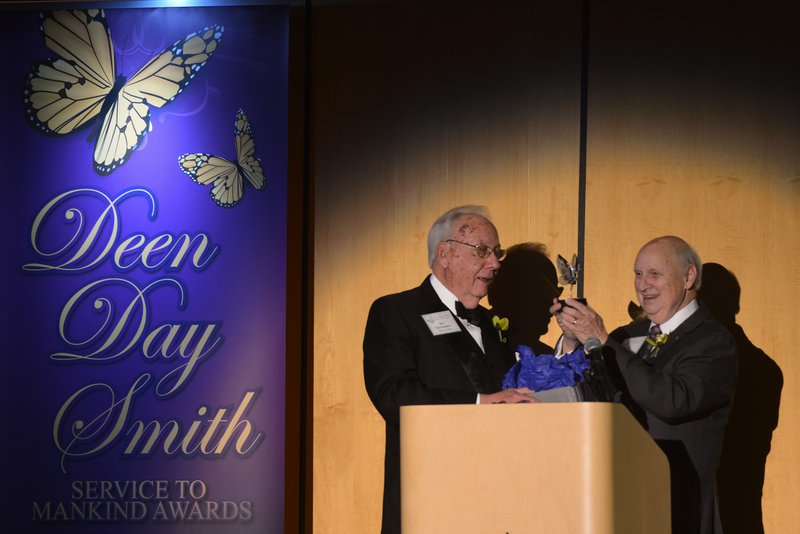
“Her idea was that we would talk to somebody like Deen Day Smith, who was recognized as a well-known philanthropist person in Georgia at the time and see if she would lend her name to an awards-type program.
(Smith’s first husband, Cecil Day, was from Brooklet and founded the Days Inn hotel chain.)
“Patsy had gotten to know Deen through a women’s group and felt she would be receptive.
“Fortunately, Deen was and we started organizing the awards program. We knew it had to be a first-class event all the way. There were so many people we needed to recognize because we were playing catchup. It took us about two years and in the spring of 1989, we held the first Deen Day Service Award banquet in the Williams Center on the Georgia Southern campus.
“The first year was a great event but it also was a great learning experience in how to improve the event moving forward. We had a good time doing it and we had a lot of community support and a lot of volunteers and a lot of financial support from the local banks and others.
“People like Ellis Wood, Arthur Howard and Bruce Yawn. Hal Averitt and Jimmy Hodges. Attorneys Jimmy Franklin and Gerald Edenfield. And so many more that I apologize for leaving out.”
McGlamery paid special tribute to Kathy Spivey, who volunteered at each year’s event, including serving on the selection committee.
He also noted the important contributions of Trish Tootle, Delia Mobley and the late June DiPolito, among others.
The event got its formal name – The Deen Day Smith Service to Mankind Awards – the second year, McGlamery said.
“We selected about 20 recipients, sometimes more, for the awards every year. We also decided that three people who had dedicated so much of their life in service to our community would be designated
Lifetime Achievement Award recipients each year. And I insisted we have a Statesboro Herald Humanitarian of the Year as the top honor at each event.”
Like so many events, the COVID-19 pandemic forced the cancellation of the 2020 awards banquet, which made the 30th anniversary event in 2019 the final Deen Day Smith Service to Mankind Awards banquet.
“Over a 30-year period we recognized nearly 1,000 individuals,” McGlamery said. “The majority of whom were not well-known in the community and did their good works in anonymity because it was the right thing to do.
“I guess I'm prouder of having participated in the Deen Day Smith Awards than just about anything else we did as a newspaper or me as a publisher. I think it was beneficial to the newspaper. I think that it that it created an atmosphere that the newspaper does stand for something good for our community.”
Patsy Bobo passed away in November 2019, and McGlamery said her contribution to the community is underappreciated. “Patsy was a visionary. I miss her every day.”
Statesboro First United Methodist Church
“When Susan and I became engaged in 1967, she was already a member First United Methodist. I believed that we needed to be a one church family and so I joined First Methodist in December 1967.
“I enjoyed worshiping in its beautiful sanctuary, I greatly appreciated the more formal tones of the worship service. Later, when Dr. G. Ross Freeman came to us as our senior pastor, I was really drawn to his introduction of the lay liturgist in involving the congregation more closely in the worship experience.
“Dr. Freeman set up classes of 10 to 12 of us and trained us on the elements of a public prayer, leading the congregation through much of the liturgical portion of the service. He also gave us some rudimentary training for filling the pulpits of area churches as lay speakers.
“Going through the chairs of church leadership, including chair of the administrative board was a heartwarming experience. I will always be grateful for my time of worship at Statesboro First United Methodist."
Bulloch County Historical Society
Though he was a board member of the Bulloch Country Historical Society for many years, by 2007, McGlamery knew the organization “needed to make some changes if we expected the organization to grow and prosper.”
McGlamery said that while there was a core group of dedicated members, the Society had to find a way to become more active and attract more members.
“That’s when Del Presley called me about the Jack N. and Addie D. Averitt Foundation,” he said.
Presley is a retired professor from Georgia Southern and the pre-imminent local historian in Statesboro and Bulloch County.
Jack Averitt was dean emeritus of the Jack N. Averitt College of Graduate Studies and professor emeritus of history at Georgia Southern University where he served for 35 years. He passed away in 2007 and his wife some years earlier.
They set up a foundation to help preserve local history, among other objectives, and Presley was chairman of the foundation. In relating his conversation, McGlamery said Presley told him the Averitts believed in the mission of the Bulloch County Historical Society, because the organization worked to help all citizens better understand local history.
Several more conversations then led to the Historical Society receiving a grant of more than $140,000 from the Jack N. and Addie D. Averitt Foundation in February 2010.
“I place the beginning of the modern Bulloch County Historical Society, the one that now boasts over 300 members, to those conversations with Del Presley,” said McGlamery, who has served as president of the Historical Society since 2011. “Del had the foresight and the confidence that we would use that very generous grant wisely.
“It meant that we had a dedicated funding source. It meant we had some operating income to pursue a number of goals that all involved the history of Bulloch County through educational opportunities and preservation opportunities.”
In the years since receiving the grant, the Historical Society has expanded to more than 300 members, including dozens of corporate memberships for local businesses – a category that was created in 2015.
The group has published two books about local history:
"Out of the Past," which is a selection of columns by Maude Brannen Edge, who wrote for the Bulloch Times in the 1950s.
“The Hodges Family Murders and the Lynchings of Paul Reed and Will Cato” about the horrific crime and subsequent lynchings in 1904, by retired Georgia Southern professor Charleton Moseley, who passed away in 2023, and edited by Statesboro Magazine editor Jenny Foss.

The Historical Society commissioned and staged the "The Ole Scarecrow Statesboro Medicine Show," a puppet play scripted and designed by Scott Foxx and performed for many years at the Emma Kelly Theater for Bulloch County students in third grade. Also, long-time Herald columnist and current chairman of the Averitt Foundation Kathy Bradley authored a 64-page coloring book to accompany the play that was given to every child who attended a performance.
With the dedication of the Dover-Statesboro Railroad historical marker in May 2024, the Society has now erected 28 such markers around Bulloch County.
The Society also has sponsored the annual “Tales from the Tomb” cemetery tour and the Jack N. and Addie D. Averitt Lecture series.
And, just this week, the Historical Society published “Downtown Statesboro Historical and Architectural Walking Tour,” a 48-page booklet that serves as a guide to 30 places of interest in a compact area of downtown Statesboro. It was written and edited by longtime Historical Society member Virginia Anne Franklin Waters, who is the group’s executive director.
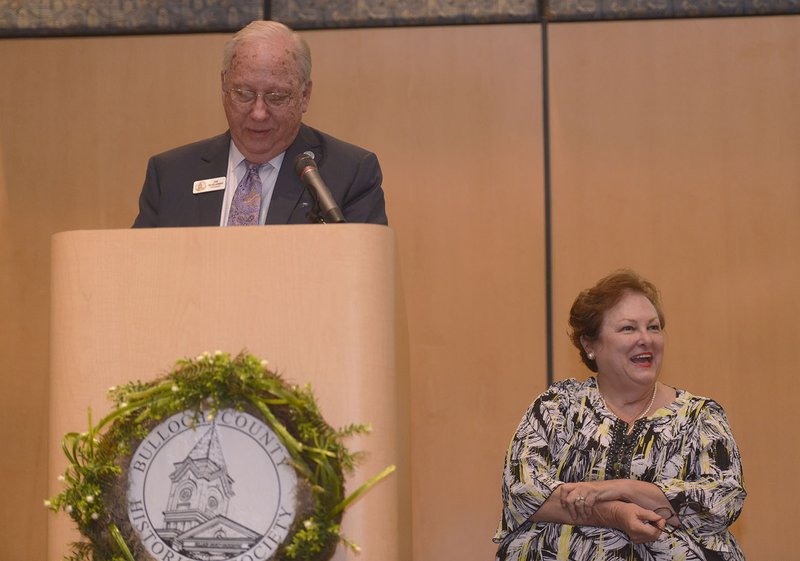
“Joe McGlamery is a born leader and gave much of his life to the Statesboro Herald,” she said. “Joe’s employees call him ‘Joe’ and his office door is always open to all. I experienced his ‘open-door policy’ working with Joe for 17 years with the Bulloch County Historical Society. His work ethic goes way above the bar.
“His involvement in the community, on behalf of the Herald, was all-encompassing. He constantly was thinking of and implementing ways to better our life in Bulloch County.
“I’ve always known Joe to be a man of integrity; both humble and humorous. His employees admire, respect and enjoy his friendship, as do I. He has been my mentor, and I’m honored to call him my friend.”
McGlamery called his “playing a part in revitalizing our Historical Society a legacy that I am proud to have had a role in. Preserving and sharing the history of a community that has given so much to me has been a labor of love.”
Ogeechee Choral Society
McGlamery always loved music and spoke with David Matthews, a professor in the Music Department at Georgia Southern, about the possibility of starting a community choral group. So, they approached Alice Christmas, also a professor at Georgia Southern and active in the local symphony board about the idea.
“Joe and David came to my office at Georgia Southern,” Christmas said. “I was still teaching at Georgia Southern at the time to talk about the possibility of starting the community choral society.”
And so the Ogeechee Choral Society was born
“That was one of the most exciting things I think I've ever been a part of,” she said. “We jotted down a few names of people that we thought might be interested. And then in a very short time, because we wanted to get started right away, the list grew and grew and grew and I'm not sure how many we had at the peak, but there were probably at least 50 or 60 members.
“We tackled difficult music. Challenging classical pieces,” Christmas said. “It was music that most of us would never have had the opportunity to sing otherwise.
“We sang locally, we sang in Savannah a number of times. We went to New York to sing at Carnegie Hall in 1990 or ’91. That was absolutely thrilling.”
Sadly, the Choral Society faded away after about 20 years due to lack of funding and the difficulty in finding new members.
“It was a wonderful gift to our community while it lasted and I’m eternally grateful to Joe for his support in getting it started and flourishing for a time,” Christmas said. “But Joe and the Herald have always done so many things in and for the community that people don’t know about.”