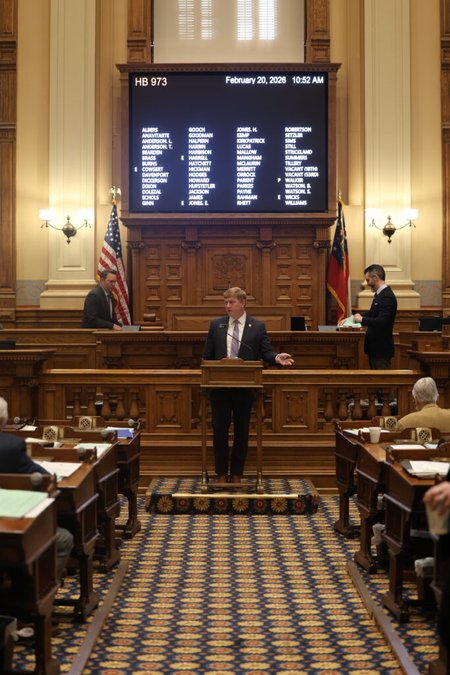
ATLANTA — Taxpayers, rural drivers and the mentally ill were among the winners in the mid-year budget adopted by the Georgia Senate on Friday.
Financially distressed college students and metro Atlanta drivers were not exactly the losers, but they would get less than initially proposed in the Senate’s version of the $42.3 billion amended budget for the fiscal year through June.
The state House started the budget based on a blueprint from Gov. Brian Kemp. On Friday, it was the Senate’s turn to make some edits.
Both the House and Senate kept Kemp’s $1.2 billion rebate to taxpayers that would break down to $250 per single filer, $375 for heads of household and $500 for couples filing jointly.
But the House added more gravy with an $850 million property tax grant for homeowners, and the Senate liked that line item.
Several senators are running for higher office, and voters tend to appreciate tax breaks, especially in an election year when affordability is key.
The property tax rebate would work out to about $500 per homeowner in urban areas and $300 in rural areas, said Sen. Blake Tillery, R-Vidalia.
“We are laser focused on affordability,” said Tillery, who is running for lieutenant governor and, as chairman of the Senate Appropriations Committee, helped craft the Senate’s budget.
What the Senate gives, the Senate can take away. Under its proposal, state employees would get a smaller bonus than Kemp wanted. He had put a $2,000 one-time pay supplement in the budget at a cost of over $600 million, but the Senate saved a couple hundred million by knocking the payment down to $1,250.
The Senate also kneecapped a new program for college students that Kemp had touted. Georgia is still on a path to give taxpayer dollars to a need-based scholarship fund called Georgia DREAMS.
But instead of the $325 million endowment allotted by Kemp, the Senate kept only $100 million.
The Senate also slashed Kemp’s idea for a $50 million grant to communities to address homelessness, trimming it to $10 million.
Senators needed the money for other priorities. They shifted $15 million to the Department of Veterans Service and put a whopping $409 million toward construction of a regional hospital for the mentally ill who often wind up housed in local jails by default.
The House had introduced money into the budget for the same project, but it was only $27 million to get it started.
Lt. Gov. Burt Jones, a Republican running for governor, said all could agree that mental health services in Georgia were lacking.
“This is not a partisan issue,” he said. Judging by the 49-1 vote to pass the budget, or House Bill 973, he was right.
The Senate made several changes Kemp might appreciate. The governor had proposed $88 million for an aerospace building at Georgia Tech, but the House had pared that back to $15 million. The Senate’s budget restored the funding.
But there were some bumps in the road.
The Senate cut nearly $100 million from Kemp’s $2 billion in improvements to I-75 south of Atlanta and to state Route 316, from Gwinnett County to Athens.
Yet the Senate added back $15 million that the House had trimmed from Kemp’s $100 million to fix rural bridges, some dating to the 1940s, according to Tillery.
Senators also added $30 million for rural infrastructure projects, and they expanded the $35 million improvement program for natural gas infrastructure that had been pitched by Kemp and endorsed by the House.
In the Senate’s budget there is now $55 million to deliver methane to customers as a means of spurring economic development.
“There are areas across our state where gas capacity is so weak that we can’t even put another Burger King on the line,” Tillery said.
The House said later Friday that it did not like the Senate’s changes. So, the budget will now go to a conference committee where a handful of lawmakers will negotiate the finer details.
After they pass the mid-year amendments, they will look to the full budget for the fiscal