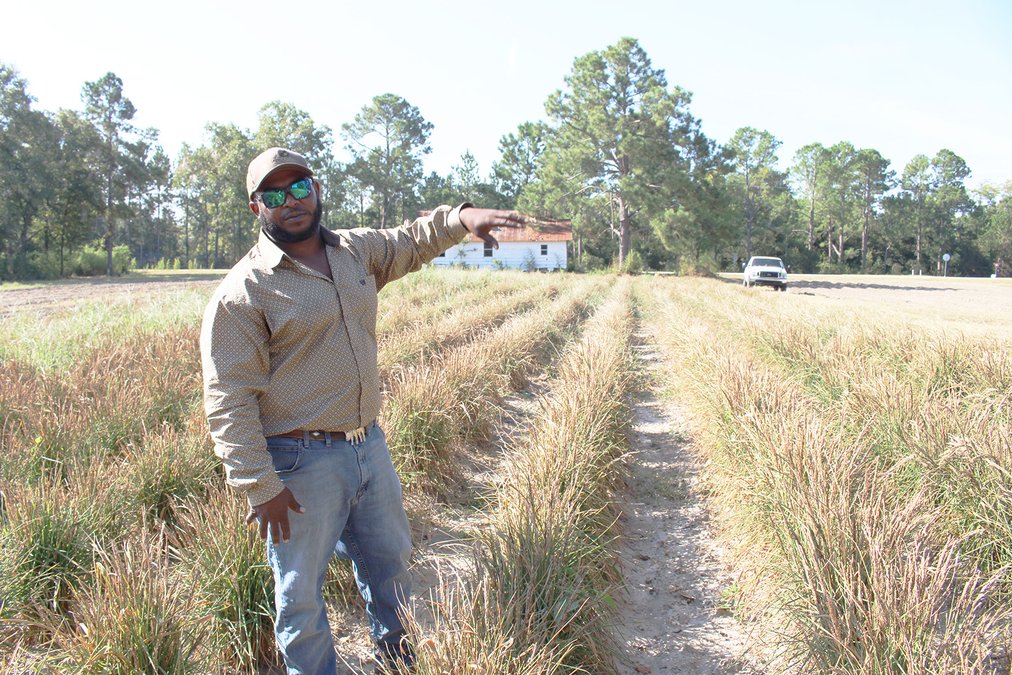
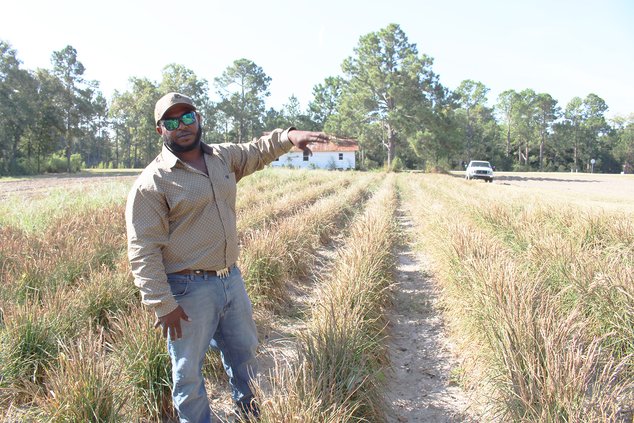
Roy Mosley, a farmer finding new routes to some old and “natural” paths, has added rice to his production of heirloom grain and vegetable varieties, natural-pasture pork and a few fresh chickens in the Willow Hill area.
Now, don’t imagine that he has flooded fields as rice paddies up along U.S. Highway 80 on the way from Statesboro to Portal. What Mosley has been experimenting with and learning to grow in test plots for the past three years and has expanded in 2025 to a single small field is a black-husked “sticky” rice, grown in somewhat drier conditions. Now he expects to harvest enough to sell for the first time.
He is growing it as a member of the Jubilee Justice farming co-op, which is based in Louisiana and promotes participation in sustainable farming practices by Black farmers, especially in a “System of Rice Intensification” that uses fewer seeds and less water. This co-op has rice-growing members at least from Louisiana to South Carolina, Mosley notes.
“We’re growing rice, old-type corn, old-type wheat – we’re finding like old-type wheat from back in the day that was developed down here in the South,” Mosley said. “We actually have five acres of wheat this year. We’re going to do 10 this coming year, two different varieties, five acres each.”
He also expects to increase his production of the heirloom corn varieties in 2026. This year he grew a total of eight acres of colorful – neither white nor yellow – corn of two different varieties that aren’t merely ornamental.
“This is Jimmy Red,” he said, holding a dry ear of blood-red or darker, mature dent corn. “This was a staple, like a unique corn back in the day that a lot of people used, especially for livestock feed. It was bred in the Shenandoah Valley.”
This old-timey red corn, he said, packs in about 12% protein, compared to modern fast-growing corn varieties that are about 5% protein.
The other heirloom-type corn Mosley grew this year was “Black Diamond Morado,” which produces black kernels. He and the co-op each received 10 pounds of the seed from growers from a Native American tribe during a conference in Arizona, he said.
For next year he plans to expand to have 10 acres of Jimmy Red and five acres of Morado and will also introduce an “old-type” yellow corn, for the co-op to use in making flour and tortillas in three colors. For this year, both the red and black varieties have been harvested, so that’s done.
Rice harvest approaches
But the rice plants – of which he has only about half an acre in cultivation – were green just over a week ago and have now turned golden-brown.
“This is the part where we can start getting excited,” Mosley said with a laugh.
The seeds, or grain, sit atop the plants just as they do in many other types of grasses. Already darkening, the husks will be nearly black when the rice is dry enough for harvest.
“This is what we call an Hb1, a black, sticky rice,” he said. “This is an African rice that was grown in the Serengeti and is grown almost close to the desert. … This is an inland rice. It needs water, but it doesn’t have to be flooded and up under water.”
Farmers in the co-op have tried different approaches to cultivating it. The first couple of years he used mulching, with wheat straw from bales spread down the middles and between the individual plants. But seeing that this was impractical for scaling up production, he has “direct seeded” the rice with clean middles and no mulch last year and this.
“I’m the first one in the co-op to do direct seeding … right into the dirt and plowed, and I treat it just like another crop, and it was successful. …,” Mosley said. “That’s why I’m so proud, because this is the first year I’ve actually made rice.”
He plans to use a classic Allis-Chalmers All-Crop harvester, pulled behind a tractor, to harvest the rice. Then he will clean and bag the rice and send it to Louisiana for final packaging, he said.
Mosley wants to be able to irrigate more for higher yields next year, and to expand to as much as five acres of rice in two different areas of his farm. One field he will keep “direct seeded” with no mulch, and in the other field he plans to try a method used by some other farmers in the co-op, growing the rice on plastic mulch.
Besides corn, wheat and now some rice, Mosley grows grain sorghum, in larger quantity so far than rice. But the sorghum is used for animal feed.
Those pastured pigs
If you look very closely, his business card does show a tiny drawing of the grain heads of sorghum and wheat – or is that rice? – and an ear of corn. But these float above larger pictures of two hogs of different breeds in a circular logo, and the card says, “Roy Mosley Farms: All Natural Pasture Pork.”
When guests during mealtime events at the Willow Hill Heritage & Renaissance Center try the sausage and pork chops, they are dining hyperlocal, within a mile of the pastures. There, little pigs suckle under old-fashioned tent-shaped shelters, and sows, gilts and a few boars roam to the woods.
Most of the pigs are sold young to other farmers who will feed them to market weight.
“The feeder pig business is actually my farm’s number-one source of income,” Mosley said. “That’s monthly; every month I try to sell feeder pigs. Our customers, that’s how they want them, in groups of 30, 40, 50 at a time.”
He generally keeps around 40 sows, and last year his farm produced nearly 700 pigs. He sold off 550 to 600 as feeder pigs; the rest became “meat hogs” and breeding stock.
Mosley keeps the pigs out on grass year-round and plants forage crops including crabgrass and African cowpeas, among others.
He receives surplus or past-date food items, such as bread, from Statesboro Food Bank and also partners with a place in Atlanta whose mission is to keep waste from vegetable and fruit processing plants out of landfills. These materials, such as apple cores, bruised mangoes and various peels and trimmings, arrive in refrigerated trucks, and “the pigs love it.”
Produce to Atlanta
Then there are the vegetables that Mosley grows for human consumption through all the warm and hot months.
He had some workers out picking dried purple hull peas this week. He grows other peas such as blackeyes, and Texas cream too, but the season for fresh peas has now ended.
Next up will be fall-planted greens to last into the winter. He had a field harrowed, turned and bedded up this past week, ready for planting.
“As soon as we get some water, we’ll be on the transplanter putting in this first go-round 3,000 collards and 3,000 cabbages,” he said, “and then we’ll have like half an acre of mustard and turnips over there.”
Mosley’s customer base is not limited to Bulloch County.
“The majority of my stuff sells right here from the farm, and then when we have those events and things in Atlanta. …,” he said. “One of the best things that’s happened to me is doing some of those events and the customer base I get with the Black-owned beer brewers and stuff like that.”
He has a friend in the Atlanta area whose wife makes planter boxes and they host “Sip and Plant” events. Customers, mostly women, but some men too, will decorate a planter box and plant things. Mosley supplies tips on planting and cultivation and also brings plants or seeds – tomatoes early in the season, later herbs and fast-growing squash, now collards and cabbages – and produce from the farm.
He attends events almost monthly in Atlanta, and takes orders for pork products and greens for example, to bring the next month.
Next up, he has been invited to make such a marketing visit to Atlantucky Brewing, one of the largest, as he mentioned Black-owned, craft breweries in the metro area.