
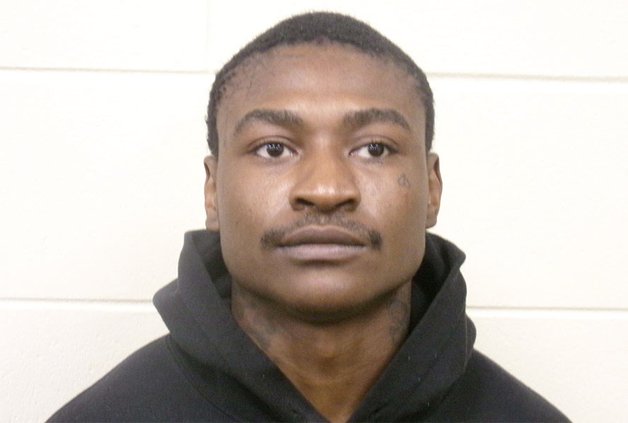
The jury deliberated for one hour Thursday afternoon before returning with a unanimous guilty verdict on all eight counts against Kentaevious Raeshon Davis for the murders of Christopher Joyce, 20, and Jamaryce Mincey, 23, whose bodies were found in a room at the Days Inn in Statesboro the evening of Feb. 29, 2024.
Davis, now 22 and then 20, was one of three young men who left the room alive at 11:58 a.m. that day, according to a date-stamping security camera with a view of the door. No one else entered the room until, after a relative of one of the other survivors called the motel office around 8:30 p.m., a motel clerk opened the door, glanced inside, closed the door and called 911.
Identified by Statesboro police as the prime suspect the next day, Davis was arrested at the home of his then-girlfriend and her grandparents at Reidsville, in Tattnall County, by the U.S. Marshals Service Southeast Regional Fugitive Force on March 6, 2024.
Originally from Glennville, which is also in Tattnall, he had been a resident of the Bulloch County Jail for more than 620 days when when the trial began.
After Judge Matthew K. Hube handled earlier portions of the case, Senior Judge John R. “Robbie” Turner presided at the trial. It filled three roughly 9 a.m.-5 p.m. days Monday through Wednesday and resumed at 9 a.m. Thursday, Nov. 20, concluding when, having heard the closing arguments and the judge’s instructions until about 1 p.m., the jury returned from lunch at 2 p.m., was sent out into deliberations around 2:20 and came back with the verdict at 3:20.
The clerk of court read the verdict aloud, but Turner then polled the 12 principal jurors to hear each say “yes” that this was their decision in the jury room and that it was freely and voluntarily made. Selected about three weeks before the trial, the jury group actually numbered 14 Bulloch County citizens, including two alternates who sat in with the others except during deliberations. Off the 14, six members appeared to be African American for a trial in which one young Black man was convicted of killing two others.
Before the sentencing, Christopher “Tootie” Joyce’s aunt, Natasha Joyce, spoke while standing at the attorneys’ lectern and mostly facing the judge but with remarks obviously intended largely for Davis, now convicted of killing both her nephew and Jamaryce “J-Mo” Mincey. She said her heart broke on hearing how they died.
“Tootie was among some of the worst of humanity during his final hours,” she said. “How could you value life so cheaply? Just the thought of this upsets me. …,” Ms. Joyce said in part. “I am Christopher’s voice today to tell you what he meant to his family, his eyes to see justice prevail.”
The trial made the family’s suffering worse for a time, she said, but expressed support for its outcome.
“I sat on the front row for my nephew’s funeral, for a deceased life,” Ms. Joyce said. “Now I sit in the second row for the trial for another deceased life, but this time it’s for justice, justice for Tootie and J-Mo. Before closing this impact statement, I wanted to share one final word with you that I never got to say to my nephew, ‘Goodbye.’”
Life without parole + 5
Then Chief Assistant District Attorney Jillian Gibson told the judge the prosecution’s recommendation for sentencing: life without the possibility of parole for each of the two malice murder counts, now convictions. The two felony murder counts, although also given guilty verdicts, were to be vacated, and the two aggravated assault convictions merged with the murder counts for sentencing. But for the two possession of a firearm during commission of a felony convictions, she requested a five-year sentence to be served consecutively, as a specific Georgia law requires.
Assistant Public Defender Que’Andra Campbell agreed to the rest but requested a sentence of life with the possibility of parole on the murder counts. She noted that Davis had no prior convictions. Life with parole still being possible and life without parole are generally the only sentences available to Georgia judges for murder convictions when prosecutors don’t seek the death penalty.
Turner said he believed the prosecution’s recommendation was warranted by the facts in the case, summing it up as “life without parole and five (years) consecutive.”
Davis sat still between his attorneys and made no audible reaction. Neither did Ms. Joyce or other family members or friends inside the courtroom, and the judge had instructed that there should be no outbursts.
Drug effects as ‘motive’
In the first of the closing arguments that morning, Assistant DA Matt Breedon, who works with Gibson in the “Major Crimes Attorney Team” recently formed at the Ogeechee Judicial Circuit District Attorney’s Office, set out the legal basis of the charges. He also argued, against the defense’s argument that Davis had no motive for the killings, that his motives lay in the effects of a drug or combination of drugs called “molly” or “bath salts” – not that any knowledge of a motive is necessary to prove murder.
“Even though the state is not required to prove a motive, there is a motive in this case, there absolutely is, you saw it,” Breedon told the jurors. “It is not motive in the sense that we think of, you know, ‘My wife’s cheating on me with another guy and now I have a motive to kill him,’ but motive in this case is what drove the defendant to pull the trigger.”
He pointed to a projected image from motel surveillance video of the area outside the motel room door where Davis and other young men from the group were smoking what the other two survivors called “molly” in drug-spiked “blunt” cigars.
“Now what we learned is from the chemist, or toxicologist, I should say, is that these are designer drugs … they’re not always the same, and they have different effects,” said Breedon. “So what we heard is … what this defendant was smoking for two days straight, was ‘bath salts,’ that cause confusion, paranoia, anxiety and aggression.”
Georgia Bureau of Investigation toxicologists had testified Monday that blood from Joyce and Mincey’s bodies tested positive for dimethylpentylone and pentylone or isomers of those drugs. These are among a variety of stimulant or psychoactive drugs given the street name “bath salts” but sometimes misrepresented as “molly” or “ecstasy,” nicknames traditionally for a different abused drug, MDMA.
‘Didn’t dig deep enough’
In the defense’s closing, Assistant Public Defender Daveniya Fisher argued that multiple lies were told by others who testified, including the two other young men who ran from the room together with Davis after the shootings and the woman who had rented the room.
“The problem with this case is that when it happened, the state didn’t dig deep enough,” Fisher said. “Think about it. On the 29th, they received a call that there were bodies in the room. They immediately responded, taped up the scene, nobody that was there at that time heard anything. Somebody comes up there and says, ‘It’s my room.’ … And they go to the police station and they tell lies after lies after lies.”
Continuing on this theme for about half an hour while suggesting that others planned to pin the crime on Davis, and that prosecutors built their case on lies they were handed, Fisher said, “You can’t prove a negative, but you also can’t build a murder case on lies.”
However, no testimony was presented by any witness that either or both of the other young men did it. Although both of the murder victims were found with guns with them where they lay dead in the room, the magazines of those guns were full of unfired ammunition. Prosecutors pointed to surveillance video that showed Davis holding his hand in his hoodie pocket as he and the two other survivors hurried from the motel on foot. Neither of the other two was doing this, and both denied having had guns at the motel.
Multiple people testified that Davis had a gun with him all that week and day.
The former Day’s Inn clerk was one of the first witnesses Monday. Audio of her call to 911 and surveillance video from the motel’s camera confirmed that – with a key – she opened the door, quickly closed it again, turned around and walked back to the motel office to make the call. She testified she had seen only one man on the floor, near the bathroom area in the back of the room, in a puddle of blood. That was Mincey. She said another person, on the bed, appeared to be asleep.
But the first Statesboro Police Department officer to arrive on the scene, Officer Kyle Wright, looked first in the window of the motel room, through the gap in the curtains, and saw an apparently lifeless man on the bed nearest the window. Then finding the door still locked, Wright threw a steel trashcan through the window, shattering the glass, for quick entry.
But by then, the blood on the floor was separating and starting to dry, and the two EMS personnel who arrived soon confirmed there were no signs of life, but rigor mortis beginning.
A forensic pathologist also reported on the autopsies the first day of the trial. Her evidence showed that Mincey had been shot once through the head and that Joyce was shot more than 10 times in the upper body, where the pathologists traced paths of bullets in his arms and underarms, back and head.
A firearms specialist matched all 13 spent cartridge casings found in the motel room to the specific Glock 9mm pistol that a Statesboro police detective found, along with a pair of Cheetos brand boxer shorts, in the passenger’s side front area of his girlfriend’s car at Reidsville the week of his arrest. Prosecutors pointed out that the waistband of Cheetos boxer shorts could be seen on Davis in some of the surveillance pictures.