
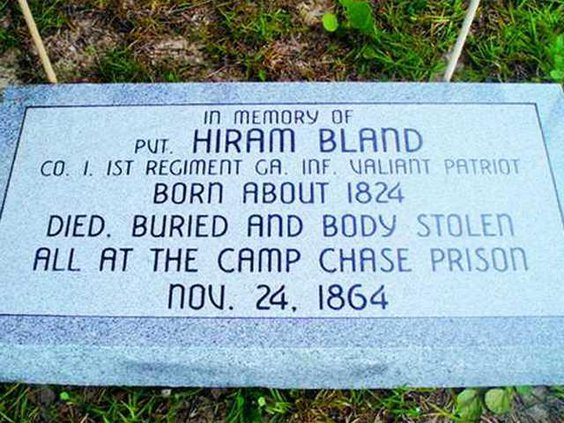
For Confederate Memorial Day, Mike Mull told the Bulloch County Historical Society about a local soldier, Hiram Bland, whose death in a Union prisoner of war camp took on aspects of a 19th century gothic horror story.
“It’s not your typical story about a Confederate prisoner of war,” Mull, Georgia Division commander of the Sons of Confederate Veterans, said before going to the front of the room to tell it. The Historical Society held its monthly meeting Monday, Confederate Memorial Day as observed in Georgia as a day off for some state employees.
As Mull explained, the original date this recalls is April 26, 1865. That day, 150 years ago Sunday, was when Confederate Gen. Joseph E. Johnston surrendered to U.S. Army Maj. Gen. William T. Sherman at Bennett Place in North Carolina. Coming more than two weeks after Gen. Robert E. Lee’s surrender to Gen. Ulysses S. Grant in Virginia, Johnston’s surrender marked the end of the Civil War – which Mull prefers to name by other names – in the Southeast.
“The War for Southern Independence, or whichever, is the bloodiest war ever fought by Americans,” Mull said. “Most estimates put the death toll at something like 620,000.”
But that number does not include deaths of civilians, or of soldiers who died from lingering effects of wounds and disease after the fighting had ended, he noted. Recent estimates raise the death toll to about 750,000.
By late April 1865, Hiram Bland had been dead five months, his body buried near Camp Chase in Ohio and illegally dug up that night by a team of “resurrectionists” for use as a medical school cadaver.
Twice a volunteer
But Bland’s story was already unusual before the gothic aftermath of his death.
In 1861, he was about 37 years old, past the Confederate Army’s conscription range of 18 to 35, when he joined the Toombs Guards of the 9th Georgia Infantry.
“War had broken out and Hiram answered the call for volunteers to serve in the defense of his home and family even though he was not required to do so,” Mull said.
Leaving behind his wife Jane “Jincy” Crumpton Bland, with whom he had five children, at home in the Westside area of Bulloch County, Hiram Bland was sent to be part of Lee’s Army of Northern Virginia.
Once in the service, Bland contracted typhoid fever and, in what could have been his permanent re-entry into civilian life, was discharged on July 18, 1862, for “debility and old age” at 37 or 38.
But by 1864, Bland had recovered and re-enlisted. Now in the 1st Georgia Volunteer Infantry, he was captured by Union forces July 22, 1864, during the battles around Atlanta.
Sent first a classification center in Louisville, Kentucky, Bland “was then taken by train to the infamous Camp Chase prison facility just outside Columbus, Ohio,” Mull said.
He noted that some camps and prisons where the United States held Confederate soldiers, such as Elmira Prison in New York, had death rates higher than the Confederacy’s notorious camp for Union prisoners at Andersonville, Georgia.
After about four months at Camp Chase, Bland died on Nov. 24, 1864, and was buried in the prison cemetery, about a quarter mile from the stockade.
“But even in death, Hiram Bland would not find peace,” Mull said.
The body snatchers
The Cleveland Medical College in Cleveland, Ohio, needed cadavers, he said, and Dr. Joab R. Flowers, a prison physician in Columbus, had a track record of supplying them.
“On the night of Nov. 24, 1864, the date that Hiram Bland and others had been buried in the ground for only a short time, Dr. Flowers gathered his accomplices and went to the freshly dug graves and using wooden shovels so as not to make too much noise, dug up those bodies,” said Mull.
They removed the dead men’s clothes because Ohio law made taking personal items from the dead a more serious crime than stealing the bodies themselves, Mull said.
Flowers and his associates were arrested after unearthing Bland and four other dead Confederates. A wartime newspaper, The Crisis, called Flowers’ men “an organized band of body snatchers” and “resurrectionists.” The Columbus Gazette published a less sensational but detailed report.
The other soldiers stolen from their graves were Jonathan Lindley from Cobb County, Georgia; John W. Lester from Tennessee; A.J. Hensley from Virginia; and Thomas J. Stephens from Louisiana. An attempt to remove a sixth soldier, Curtis Hooks of Georgia, failed when Flowers was caught with the body, Mull said.
The military authorities who arrested the body snatchers brought them to the superintendent of the prison.
“The excuse given by Dr. Flowers was, quote, ‘The medical school in Cleveland needs bodies’ and that ‘the dead rebels aren’t good for anything else,’” Mull said.
Flowers was released on bail, and federal war records preserved the superintendent’s incident report. But Mull said he has found no record of any trial of Flowers, who was elected to the Columbus City Council in 1876.
Nor has Mull discovered any record of what became of Bland’s body.
In 2009, a Sons of Confederate Veterans camp, or chapter, in Worthington, Ohio, took the initiative to have a marker made in his memory. It was sent to the Bland family, and the Ogeechee Rifles and other Statesboro-area SCV camps held a dedication for the marker at Upper Mill Creek Primitive Baptist Church Cemetery, where Jane “Jincy” Bland, later Jincy Jones after she married again, was buried when she died in 1910.
“So maybe, just maybe, Hiram is resting a little bit easier, no matter where he is, knowing that his story has been told,” Mull said.
Two of Bland’s great-great grandchildren, Mike Bland and Julie Miller, attended Monday’s meeting. Mull has not found a photo of Hiram Bland, and these descendants did not know of any. Mull is seeking one to accompany future presentations.
Al Hackle may be reached at (912) 489-9458.