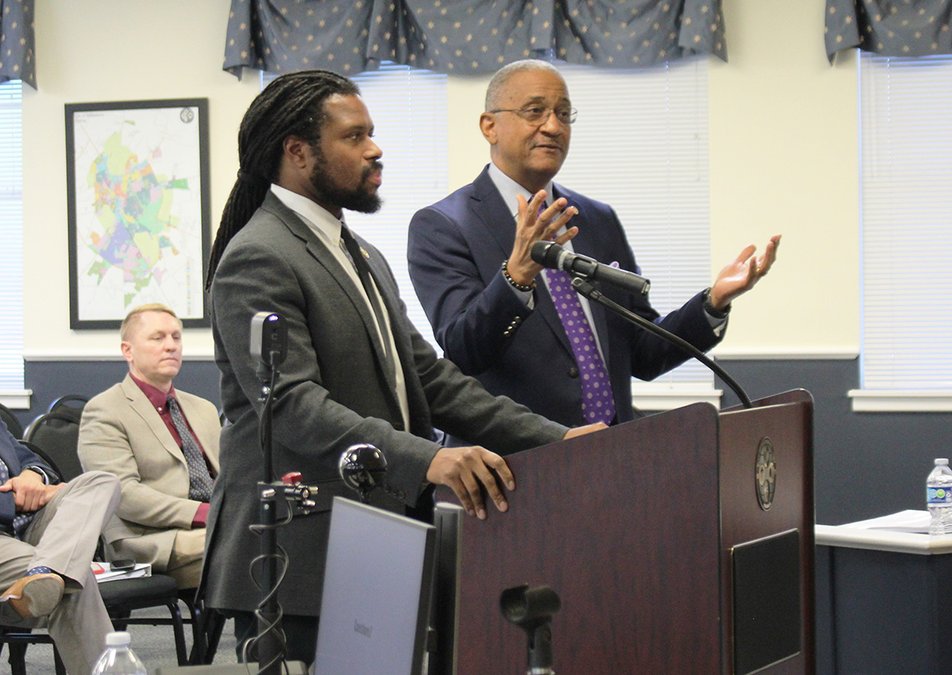
While also planning to regulate data centers, Statesboro city officials are proceeding differently from the county leadership. Later in the day that Bulloch County commissioners imposed a 90-day moratorium against development of any data centers in the county unincorporated area, Statesboro city officials acknowledged queries about smaller data centers and expressed interest in the potential revenue.
That was Feb. 17, when the county commissioners that morning during their regular meeting voted 6-0 for the moratorium and then went on to have a work session on the topic.
During that session, Mickey Daniell, Georgia Power Company’s area manager for Chatham and Effingham counties, spoke to the commissioners and responded to their questions about “large load” data centers, meaning those that use exceptionally large amounts of electrical power. Daniell, previously Georgia Power’s regional community and economic development manager, talked about safeguards the company and the state Public Service Commission have put in place to ensure that data center developers pay the cost of electric power infrastructure needed to meet their demand.
But also, when commissioners asked about the potential size of data centers, Daniell, expressing some reluctance to give an estimate, noted that some occupy several hundred acres. That could leave the impression that no data centers – or at the least those on the scale the commissioners were expressing concerns about – would fit into the relatively small parcels of land available in the city limits or existing vacant buildings.
City exploratory trip
However, Statesboro city officials had done some research on the topic and revealed details during the mayor and council’s work session that afternoon. In fact, Mayor Jonathan McCollar, some of the City Council members and staff members had taken a trip to the metro Atlanta area on Jan. 22 to visit several data centers and have related discussions.
The Development Authority of Bulloch County coordinated the trip. It also included a meeting with Shane Short, executive director of the Walton County Development Authority, to discuss the Stanton Springs Data Center operated by Meta – parent company of Facebook, Instagram, and other services – and its community impact, as well as a meeting with Georgia Power staff at the company’s Georgia Experience Center.
Meta’s center in the Stanton Springs Industrial Park near Social Circle, with buildings covering 970,000 square feet on a 285-acre tract of land, was described as a “hyperscale” center. “Power information unavailable,” stated the slide in the city work session sequence presented by city Planning and Development Director Justin Williams.
He also noted that specific power usage information was not available for the other centers visited, and McCollar commented that he had heard this is usually not released because of security concerns.
Data centers often use water for cooling, and the volume of water needed can be a city or county planning issue, as well as a state environmental concern. According to the same slide in the presentation, the Stanton Springs Data Center reuses water up to seven times but the company pays to use over 1 million gallons daily.
“Some of the significant findings that we really found are how much these things have improved, I think, since they first started springing up in the United States,” said Williams. “Data centers can reuse a substantial amount of their water.”
He also reported that “these facilities didn’t generate a lot of noise.” Measurements taken outdoors at the Stanton Springs Center showed a top noise level of 57 decibels, about the same as “a happy conversation amongst people,” Williams said.
Georgia Power’s study process for approval of a data center takes about 18 months with the data center owner having to foot the bill, the power company’s representatives told Statesboro and Bulloch officials.
“Grid capacity is a concern, but they are going to have to upgrade grid around these data centers, and they are not going to be impacting rates of residential users, and that came from Georgia Power specifically,” Williams said.
The permitting process is “more restrictive the more kilowatts you use,” with Georgia Power’s policy placing special requirements on “hyperscale” centers operating at more than 100 megawatts, he noted. But again, information on actual power usage was not provided on any of the facilities Statesboro officials visited.
‘Edge’ centers
The January trip also included visits to two somewhat smaller data centers, which Williams referred to as a different category, “edge” facilities.
One edge facility the Statesboro contingent visited was a 102,100-square foot building, at a Webb Bridge Road, Alpharetta, address. Built in 2011, it is owned by the Fulton County Development Authority.
“This is within in area that was located around other things,” Williams said. “I think that’s something that was important to mention about the edge facilities, that they’re generally going to be (placed) in areas that are already busy, such as commercial areas or by high-density residential areas.”
Another edge facility they visited, 1001 Windward Concourse, also in Alpharetta, reportedly occupies four buildings encompassing 184,553 square feet, and was built as an office complex in 1988. It is currently owned by Cumberland DC Assets.
“There was no significant sound generation at this facility,” Williams said. “We just thought it was a library at one point and then come to find out it’s being utilized as a data center.”
Size comparison
To give readers some idea of the scale of the data centers mentioned, the Statesboro Herald notes that the Kroger supermarket planned for Cypress Lake Road at the bypass is proposed to cover almost exactly 100,000 square feet, while the Walmart Supercenter covers about 186,000. But Walmart’s Distribution Center in the Gateway Industrial Park has an interior area of than 2 million square feet, and Walmart owns about 157 acres at that site.
So, the two example “edge” centers Williams described are the size of large supermarkets. But in contrast, Meta’s “hyperscale” data center has buildings totaling about half the floorspace of the largest warehouse in Bulloch County and is spread out over a larger land area.
In a vacant store?
“Compared to some of the larger facilities, an edge data facility is really moderate in size,” Williams said. “I would have to say you could probably put one of these edge data facilities into one of the old Hull Property buildings that have sat vacant. They can be disguised in a number of different ways, but an edge data facility is something we could actually have in Statesboro.”
Hull Properties and associated companies own the former Winn Dixie shopping center on Brannen Street, as well as some long vacant commercial spaces on either side of Northside Drive that have recently received new tenants or prospects.
Williams acknowledged that people in Statesboro and elsewhere have “mixed feelings” about data centers, but said some of this is based on “historical” information.
“These are high tax-generating facilities, but they are low-usage facilities, outside of water, and we’re seeing water usage be reduced as the technology continues to evolve.”
By “low-usage,” he means that data centers, which usually have few employees compared to manufacturers or large commercial businesses, add relatively little to demand for tax-supported services such as policing and the operation of the schools.
The county’s moratorium is intended to provide time for the Bulloch County Board of Commissioners and staff to consider creating some new regulations.
City regs ahead
The city staff also plans to propose some regulations, but so far without having City Council impose a moratorium.
“Next steps in regards to it, staff at council’s directive would like to develop an amendment to the Unified Development Code, specifically to ensure that there’s some regulation associated with data centers versus what we’ve seen in some municipalities where an individual shows up, there’s no rules and it’s the Wild West for making it happen,” Williams said.
City staffers plan to talk to “outside partners,” such as the TSW consulting firm that helped write the Statesboro UDC – the city’s code of zoning and development rules – and also to look at “model ordinances” from around the state, he said.
Council members asked some questions and gave their informal go-ahead for the staff to develop regulations.
Hints of a project
City Manager Charles Penny described data centers as computer facilities that support “the cloud” of information processing and storage for the internet and smartphones. He said there are none in the Statesboro area now. But he – and Benjy Thompson, the Development Authority of Bulloch County CEO who was there to give the next work session presentation – said there have been informal contacts expressing interest in putting one here.
“Up in the Atlanta area they have more of them but they are looking to spread out, because of just the demand,” Penny said. “They need to be in different places because everybody’s got a cellphone. Everybody takes those pictures.”
The mayor then went further in his remarks, stating “data centers are already here; Georgia already has 164 data centers,” a count attributed to a source city officials talked to on their trip.
“We looked at, if a data center came here of a certain size, I think we looked at an additional (tax) revenue of $1.5 million per year, and I think that it was Georgia Power franchise benefits would go up to a million,” McCollar said. “So I think it was like $2.5 million that would be available for us to utilize.”
The $1.5 million would supposedly be derived mainly from property tax on the value of the computer equipment inside an edge facility. Utility companies pay franchise fees to the city, with the further $1 million being an estimate of what Georgia Power would pay based on the usage by a data center that size.
McCollar noted that this would be roughly equal to 2.5 mills of tax on Statesboro’s current tax base.
“And so, some of the things that we’re wanting to do as a community – I know there are some things I want to do for the community – that could help us go a long way,” he said.