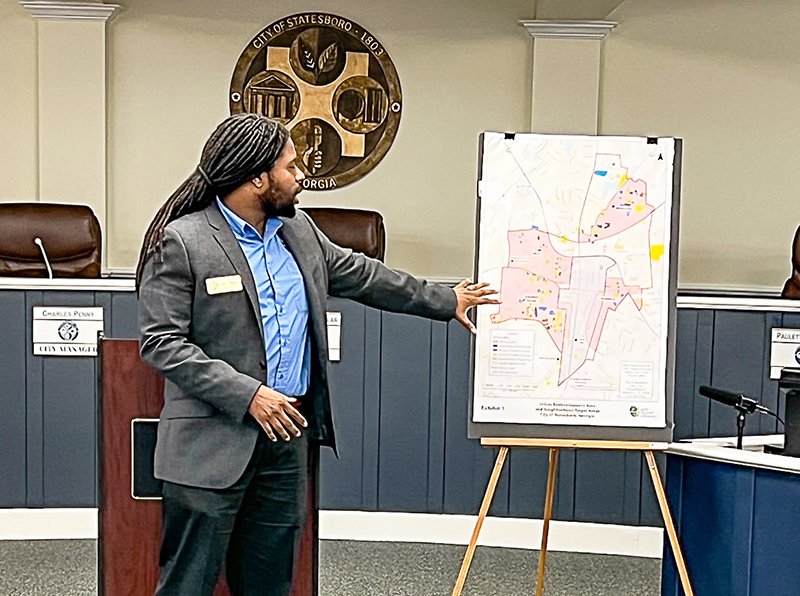
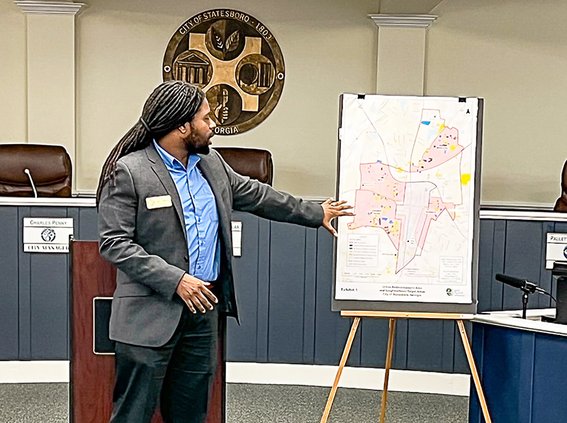
The city of Statesboro this week launched the first half of its $5 million program to rehabilitate privately owned substandard housing, and applications are now available online and at City Hall.
The city government created the program using federal cash received under the American Rescue Plan Act. What in most cases should turn out to be grants that qualifying homeowners do not have to repay will be paid directly to contractors who do major repairs or system replacements to homes with “structural deficiencies.”
To be eligible, the owner-occupants must have annual household incomes less than 80% of Bulloch County’s median household income for each family size. For example, the maximum income for an individual living alone is $31,150, and the maximum for a family of four is $44,500. An income chart for households with up to eight members appears with this story at www.statesboroherald.com. Income verification is part of the application process.
The maximum fundable cost of repairing a home is $50,000.
For this first, $2.5 million, phase of the program, the city is targeting $1.5 million to the neighborhood around Johnson Street that was identified as the area of greatest need in the city’s 2021 Urban Redevelopment Plan and another $1 million to “scattered sites” in other neighborhoods.
Justin Williams, who is now the city of Statesboro’s planning and housing administrator; Kathy Field, the city’s Planning and Development Department director; and Chris Hilbert, community development director for Insight Planning & Development LLC, led a community information meeting Wednesday evening in the City Hall council chambers. Then the application form was released on the city website Thursday morning. Williams reported that 18 community residents attended the meeting and that a few people picked up applications at City Hall the next day or called to ask about the process.
“We’re off to a start. It’s not the fastest, biggest start in the world,” he said Thursday afternoon. “We have some skepticism to get over, and we get that, so we’re just going to keep on trying to show people that we’re trying to do something good.”
Forgivable loan
One predictable source of skepticism from some homeowners is that the money the city pays to have the work done will take the form of a five-year forgivable loan. The homeowner has to sign a promissory note and secure it with a “deed of trust” to the city.
But the city does not intend to take anyone’s property, City Manager Charles Penny repeatedly explained when the program was being developed last fall. After the renovations are completed, the loans will be forgiven at the rate of 20% a year. So, if the owners keep their homes for five years after the work is done, they will owe nothing.
“After the five-year period, then that deed of trust is cancelled,” Penny said in December.
But if someone sells their home with ARPA-funded, city-provided improvements just past the one-year mark, they would have to repay 80% of the renovation cost; after the two years, 60% of the cost; after the three years, 40%; or after four years but not yet five years, 20%.
Most people won’t sell and move away, Penny said, but the requirement also applies if a homeowner dies and their heirs decide to sell the home. A portion of the sale proceeds would then go to the city to repay the renovation cost.
One of the questions citizens asked during the meeting is whether there is a fee to apply. There’s not, Williams noted.
Structurally deficient?
But the funding is not available to make changes to homes that are in good condition, and it’s not for people who just need to paint a room or refresh the exterior trim. The overview states that it is for homes that are “structurally deficient.”
Homes that qualify will be those that require major repairs to or replacement of whole “systems,” Williams said, such as the roof, foundation or windows, or the plumbing, electrical or heating, ventilation and air-conditioning systems.
“It’s not for a purely cosmetic situation,” he said. “I know some people have homes that may need some paint, things like that, but we’re looking to really improve the standard of living for those individuals who (qualify). You know, if you’ve got a leaky roof, that can damage other systems of your home, or if you’ve got some foundation issues, that’s important. So those things are what we’re looking to help renovate.”
“Manufactured housing” can qualify, but only if a previously mobile home has been “converted into real property” and is occupied by the homeowner. This implies that the land the home sits on must be owned with it, not rented from someone else.
“If you think you qualify, apply,” Williams said when asked if there was anything else people should hear about the program.
The deadline to apply during the current phase of the program is June 23.
The application can be found at www.statesboroga.gov/housingrehabilitation, and paper copies at City Hall on the first floor as well as the third-floor Planning and Development Department offices. Questions about the program should be directed to the department at (912)-764-0630 or by email to planning.development@statesboroga.gov.
ARPA-funded
In 2021, the city of Statesboro was approved for $12.3 million in American Rescue Plan Act funding. In November the mayor and council earmarked $5 million for improvement of substandard housing, and the rest for other purposes. But only half of that $5 million has been allocated for the Johnson Street neighborhood and “scattered sites” at this point. Another target area could be identified for the second phase.
City Council in December approved contracting with Insight, a consulting firm based in Wilmington, North Carolina, to administer the program.
Insight prepared a 107-page “contractor’s handbook,” and the city will use a bidding process to hire contractors to do the work on behalf of homeowners.
Williams, previously the city’s senior planner, is the City Hall staff member assigned to work most closely with Insight on the program. In February, the council, on a recommendation from Penny, reclassified Williams’ job to planning and housing administrator, in effect awarding him a promotion.
No rentals yet
Insight actually recommended that investor-owned housing, or in other words rental properties, be included in the program, because a large portion of the housing in the target area is renter-occupied. But council members insisted that this first phase of the program be exclusively for owner-occupied homes.
Penny and the consultants have said that a rent control policy will need to be part of the requirements for owners of rental housing to obtain funding in a future phase.
“We will be reopening applications in the fall, and that’s when we will open that opportunity for our investor-owned properties,” Williams said. “But the intent now is really, really to focus on the homeowners who need some renovations on their properties.”