

Statesboro City Manager Charles Penny’s recommended Fiscal Year 2026 budget won’t require an increase in the actual millage rate, but it also doesn’t allow for any September rollback to offset rising property values. Meanwhile, he is recommending 10% increases in water and sewer, storm water, natural gas and solid waste service fees.
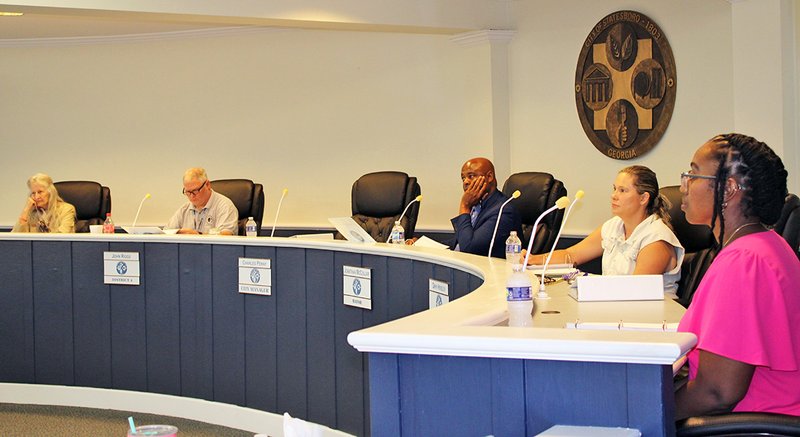
Penny presented his budget plan to the mayor and council members during a 2 p.m. budget work session Tuesday. As was revealed, he and city Finance Director Cindy West also propose having the water-sewer fund, the natural gas fund and the solid waste collection fund make loans totaling almost $3.2 million to the fire service fund. Those one-time, in-house loans, to be repaid by the now city-only fire fund or general fund over 10 years, would cover the expected loss of at least $2.3 million the Bulloch County government previously paid for the Statesboro Fire Department’s service to a five-mile district outside the city limits, plus a $1 million subsidy the city’s general fund already provided to the fire fund.
Now the city and county have ended their fire service agreement effective July 1 – first day of fiscal year 2026 for both local governments – with the Bulloch County Fire Department now to provide primary fire service to the former five-mile district.
“This was a challenging budget to put together, but it’s done,” Penny told Mayor Jonathan McCollar and the four council members in attendance Tuesday afternoon.
As Penny acknowledged later in his more than one-hour presentation, the change in the fire service was the major reason balancing the budget across its several funds became a challenge.
Police fully staffed
But he started his overview with some positive developments, particularly in view of the city’s longstanding budget priorities to “retain and recruit exceptional employees” and provide an “emphasis on public safety.”
In mid-2023, Chief of Police Mike Broadhead had reported that the Statesboro Police Department, after struggling for years to recruit and retain officers, was 17 cops short of its full council-authorized force. That preceded a compensation study by consultants from the Condrey and Associates firm who recommended several options for a new pay plan, and the council approved the most generous option for salary ranges in all of the city’s departments.
“I’m pleased to tell you that today we are over 80 employees, 82 or 83 employees in the Police Department, so we’ve filled all of the authorized positions, and Chief has over-hired by four,” Penny said Tuesday. “That’s the first time in my history that we’ve been that full.”
Penny had long said that he would allow Broadhead to “over-hire” by that number.
Further, other staff members had informed Penny recently that, with the city having about 360 employees authorized by council in the current budget, there were only 10 vacancies throughout all offices and departments.
“So our workforce is stable, and I would just simply say I believe it’s that way because y’all have taken the steps to ensure we had a pay plan that led the market,” Penny told the council. “So I think our employees are pleased with the way y’all have taken care of them.”
No added jobs
The recommended fiscal 2026 budget contains no added employee positions in any department.
“There are no increases in personnel requests,” Penny said. “I can’t tell you they didn’t ask, but the answer was ‘no.’”
However, the budget does contain a 4% “pay plan adjustment,” or approximately and across-the-board raise, which Penny said was recommended by Condrey & Associates to take effect July 1, which will be 18 months after the pay plan first took effect. The budget will also continue funding for “pay for performance” raises, awarded to employees based on annual evaluations.
Revenue to the city’s general fund budget – the one that receives property tax, as well as some cash from other sources – is projected to increase by 8%, from $25.34 million in current fiscal year 2025 to $27.37 million in new fiscal year 2026. This includes an estimated 12% growth in the tax digest, reflecting the value of all the taxable property in the city.
But the city’s overall budget includes many other fund categories, and overall revenue and spending is projected to decrease.
Total expenditures for all funds, minus internal funds and transfers between funds, are a little over $93.5 million for the current year and are projected to be about $87.96 million for the new fiscal year. This decline reflects the fact that pandemic-era federal funding has now been exhausted. The city’s ARPA grant money awarded under the American Rescue Plan Act of 2021, still a $4.46 million source in fiscal 2025, goes to zero for fiscal 2026.
Interest & fund balance
With relatively high interest rates persisting, Penny and West have figured on about $1 million interest income and are using this as part of balancing the budget. But they cautioned against counting on this, noting that the city averaged less than $25,000 interest before fiscal year 2023. They are also “using” $928,755 from the accumulated fund balance, or informal reserve, to balance the budget. This is often more a matter of bookkeeping than actual spending, and Penny said city staff leaders will try not to actually spend this amount from the reserve.
But vacancies in budgeted positions helped keep spending below budgeted amounts in previous years. Options for cost cutting are more limited now with the city workforce nearly full, and salary and benefit costs amount to 64.8% of general fund spending, he said. With the pay plan increase and other raises and the city not increasing employees’ share for health insurance, salary and benefits are projected to add $1,227,000 to general fund spending.
Statesboro’s property tax rate, 8.625 mills after increases the past two years, was already the city’s highest in at least 25 years. The lowest rate in that period was 6.358 mills from 2008 until 2018. However, Statesboro’s city rate is lower than the Bulloch County government’s rate of 11.35 mills, despite the county having a much larger tax base, and lower than the rates of some regional and comparable-size Georgia cities, as shown in a chart included in Penny’s slideshow.
“We’re not proposing a property tax increase with this budget; however, just to get it out there, we’re also not recommending that, come September, you roll it back,” Penny told the mayor and council members.
Hearing June 3
After a public hearing on the budget slated to be held with the regular City Council meeting on June 3, the council may adopt the budget during the June 17 meeting. But the millage rate is set later, often in September, and as Penny noted, lack of a rate rollback could trigger a series of three tax increase hearings then.
The loans from city enterprise service fund budgets to the fire fund are intended as a one-year, stopgap measure. The city is having a feasibility study done for a possible fire service fund to be charged to all addresses that receive city services.
When the study is completed, the council will look at whether to enact such a fee or make other funding or cost-cutting measures related to the Fire Department for fiscal year 2027, Penny said.