

A Bulloch County Superior Court jury on Thursday unanimously found Chaz Joseph Burgest guilty of voluntary manslaughter for shooting De’onta Trowel Mosteller to death last April 23, and guilty of possessing a firearm during commission of a felony.
But the 12 jurors, who deliberated for nearly four and half hours in a case involving a claim of self-defense and conflicting interpretations of video evidence, found Burgest not guilty of the original malice murder and felony murder charges in the indictment, as well as not guilty of aggravated assault. Judge F. Gates Peed at first suggested the court might proceed immediately to sentencing, but Burgest’s defense attorney, David N. Ghazi, requested a later sentencing hearing, and Peed scheduled one for 9 a.m. Feb. 28.
The maximum sentence for voluntary manslaughter is 20 years in prison. The maximum sentence for possessing a firearm in committing a felony is five years, consecutive to the sentence for the other felony. So Burgest, now 33, could be facing a sentence of up to 25 years.
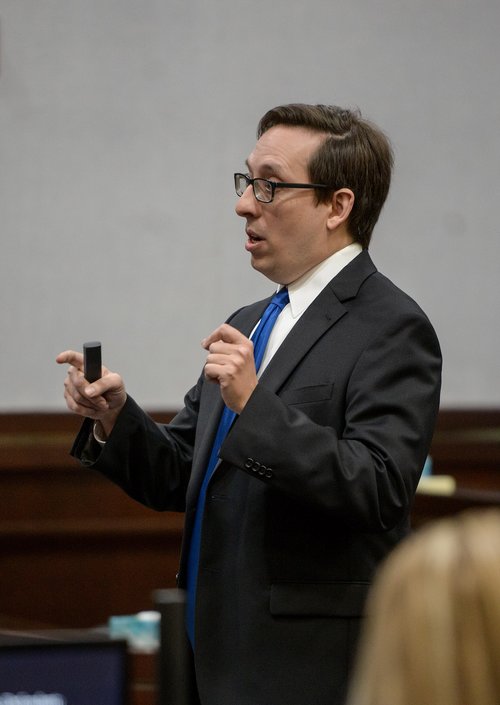
Near the end of his closing argument Thursday morning, Ogeechee Circuit Assistant District Attorney Russell Jones let two photographs of Mosteller as he looked in life linger on the screen at the end of the jury box. He was 26 when he died, and the images, one closeup and one of him seated, apparently at home, showed a casually but neatly dressed young man with a beaming smile.
“De’onta Trowel Mosteller was a son, he was a father, he loved his family, and he was loved by his family, many of whom are seated in this courtroom here today,” Jones said. “De’onta Trowel Mosteller did not deserve what happened to him. That’s the truth.”
Jones argued that he was counteracting a false impression he said the defense had given that Mosteller was a dangerous criminal.
Burgest had testified in his own defense the previous day. But Jones said the defendant’s story had changed between his previous statements and his courtroom testimony.
After running from the grounds of Building L at the Pinewood Manor apartment complex on Packinghouse Road where the shooting occurred about 6:45 p.m., Burgest knocked on the door of a woman at a neighboring apartment complex. The woman testified that he had said he needed to use her phone because his mother was having an asthma attack. When sirens were heard, he said there had been a fight at Pinewood Manor, but Jones noted that Burgest had not said he was involved in the fight.
Three days later, on April 26, 2022, after police had obtained a warrant for Burgest’s arrest and called on the U.S. Marshals Service to help find him, he turned himself in at the Statesboro Police Department, surrendered his Taurus .38-caliber revolver and was interviewed by Statesboro Police Capt. Jared Akins.
In his statement to Akins, Burgest reportedly said that he knew his life was in danger after Mosteller walked behind him in the breezeway of Building L and said, “Let me holler at you …,” and a profanity and started walking away.
In his testimony, Burgest said Mosteller had flashed a gun at him, prompting Burgest to throw his hands up, the prosecutor noted.
“I submit to you that what’s going on here is that his lies are changing as he learns about the evidence,” Jones told the jury.
Neither side disputed that Mosteller had a gun that evening. Police found a Jimenez .380 semiautomatic pistol beside his body. That pistol and Burgest’s Taurus revolver went to the jury room as two of the 41 evidentiary exhibits.
Fired four shots
Nobody contested that Burgest, while in the breezeway of Building L, fired the two shots that hit Mosteller. Both Jones and defense attorney Ghazi mentioned Burgest’s having fired four shots.
But Ghazi, in his closing argument, again asserted that the shots were fired in self-defense. Burgest had gone to Pinewood Manor to attend the barbecue being held behind Building L that afternoon, his defense attorney said.
“He was minding his own business when he was approached by Mosteller, with a weapon,” Ghazi said to the jury. “Also significant, I believe, is that he fired four times, four times, after Mosteller turned around. Why? Why not just fire once? Because he was about to get shot. He was acting reasonable.”
Jury revisits video
Jones replayed a portion of the video from a security camera showing the back of Building L during his closing argument. It was the only video that showed Mosteller as he was shot and fell. In it, he emerged, walking, from the breezeway, across a paved patio area with a grill beside it toward the lawn. After taking a few steps forward with his hands by his side, he turned his face and torso toward the breezeway and collapsed, within three or four seconds of appearing on the screen.
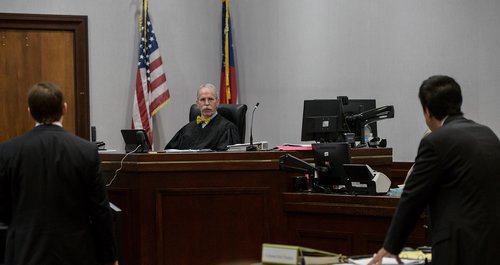
As a forensic pathologist testified, he was struck by one bullet in the face and another in the back of his right arm.
After beginning deliberations, the jury sent some questions to the judge asking for slow-motion and zoomed-in access of any security camera views of Mosteller as well as the police bodycam footage from SPD Sgt. Nathan Janney’s arrival on the scene.
Peed had the jurors return to the courtroom, and both video segments were reshown. The security camera footage was viewed more than once, and slowed down at the jury’s request.
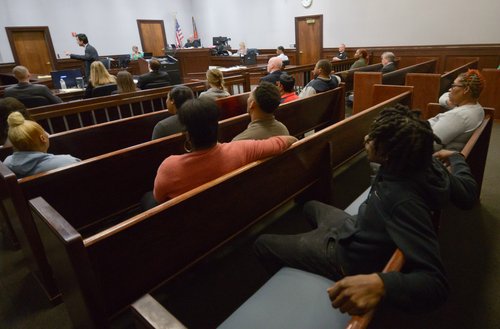
In the body camera footage, Mosteller was flat on his back and motionless, a woman at first hugging him, with a blood-soaked towel across his neck, as police arrived and checked his pulse. When the woman, his girlfriend Darryelle Strong, moved away, Mosteller’s pistol could be seen beyond him on the lawn, not quite as far from his side as the hand of his outstretched right arm.
But when the earlier security camera footage was replayed, no gun was visible, from a reporter’s vantage point in the courtroom, in Mosteller’s hand as he turned and then fell. Investigators had suggested that the pistol may have fallen out of the pocket of his shorts.
Mosteller and Strong were residents of Building L. Mosteller had four sons at the time of his death, and his daughter was born a couple of weeks after his funeral, family members said.