Did you know that a child who is 10 years of age in Korea is no more than 9 in the United States?
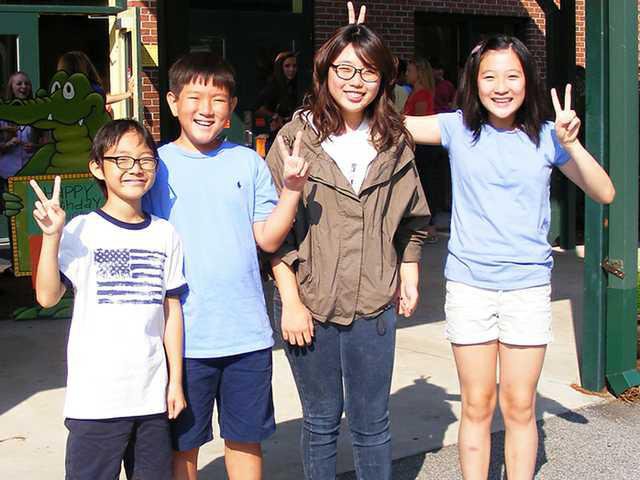
That’s just one cultural tidbit that South Korean and American children at Bulloch Academy have learned from each other since school started in August. At first, 13 Korean students, U.S. ages 9-16, traveled from the Oedae Language School in Seoul to attend Bulloch Academy and stay with local families, most of whom have children of their own at BA.
Ten of the Korean students returned home after five weeks. But three others — Hyuk Jin Cho, or “Danny,” Min Hyeok Kim, or “Kevin,” and Se Bin Ryu, or “Sebin” — remained for an additional month, and won’t be flying back to Korea until Sept. 24.
The purpose of the stay is to infuse children with both the English language and U.S. culture so they will grow up to have greater career opportunities, explained Professor Sang Un Yun.
“Korea has nothing as a geographical condition,” Yun said. “It’s all mountainous and very small, no raw materials. We have nothing but people and the mountains. So the only way we can survive is to work hard and compete.”
Affiliated with Yonsei University in Seoul, Yun is in his second stint as a visiting professor of quantitative analysis at Georgia Southern University. When he first came in 2004-05, Yun took an interest in helping the area’s growing community of Korean immigrants. He started some English classes for adults, since superseded by the English for Speakers of Other Languages program at Ogeechee Technical College and Statesboro Regional Library.
After returning to Georgia Southern in August 2010, Yun helped Jason Koo, principal of the Oedae Language School, find a Statesboro school that would welcome Korean children for one to two months.
Coming to BA
Bulloch Academy Head of School Leisa Houghton approved, and she and her family even hosted one of the students. Sol Lee, a girl the same age as Houghton’s daughter Kendra, 13, returned to Korea as part of the first group, as did Sol’s brother Jun Beom Lee, 15, who had roomed with a different family.
“Not only the students, but the teachers and even the families learned so much about the Korean culture and that it’s OK to be different,” Houghton said.
The Oedae School is an after-school academy that gives children and teenagers English instruction beyond the already extensive English classes offered by South Korea’s public schools. Most South Korean parents send their children to after-school programs for additional instruction in English and other subjects.
Meanwhile, according to Yun, regular Korean schools offer English, usually as a required subject, beginning in fourth grade. Some parents even start children 2 or 3 years old in private English classes, he said.
One or two months of American school and home life will not perfect the students’ English, Yun acknowledged. But he asserts that the experience motivates students by showing them how much they still need to learn.
“That’s very important,” he said. “Secondly, it’s a matter of cultural experience. … Some things are different between America and Korea, and to be an international gentleman or lady, they have to know Americans’ culture, because America is the leading country in the world.”
Age difference
The age difference isn’t really mathematical. In Korea and some other Asian cultures, the year of your birth is counted as your first year, so you are “1” as soon as you are born, and each year after is counted from the lunar new year.
Danny, who is 9 here but 10 back home, tried to explain this when asked his age. He and Sebin, who is 12 in America, and Kevin, who is 11, were interviewed briefly about cultural differences and similarities. Suji Jang, a high school senior from Korea whose year-long stay at Bulloch Academy is unrelated to the Oedae program, served as interpreter.
Asked if there are differences in the way children play in South Korean and the United States, they all agreed, “no.” The two nations share many youth-oriented cultural phenomena, such as computer games and cartoon characters.
Danny greatly enjoyed a visit with his host family to a local facility for bowling and laser tag. They will all carry home memories of an excursion to Atlanta, with Yun as their guide. Stops included the Georgia Aquarium, Stone Mountain and their favorite, The World of Coca-Cola.
Min Hyeok, known here as Kevin, seems to have been all but adopted by his host parents, Bubba and Jo Helen Propes and their sons Elliott, 16, Blitch, 14, and Joseph, 12.
“He calls them his brothers, and we’re his American mom and dad,” said Jo Helen Propes.
The entire family turns out on Friday nights to watch Elliott, an 11th-grader, play football. That has been a new experience for Kevin, as American football is one pastime not shared by Korea.
Kevin has developed such a fondness for sweetened ice tea that he will be packing home a box of Lipton and instructions on how to prepare it, along with a football and other souvenirs. His “American mom” also reports that she will be sending Kevin back more than 15 pounds heavier. He has not turned away any American food, from hamburgers to chicken pot pie.
“I think we see now why American kids are so overweight,” Mrs. Propes said.
The Propeses have suggested that they would host Kevin for a full year of high school here after Elliott leaves for college.
“He’s been a joy, and we’re going to hate to see him go,” said Bubba Propes. “He fits right in with the boys, and he’s got a great sense of humor.”
Lost in translation
The ride hasn’t been free of potholes. Students and host families have learned the hard way that electronic translation devices cannot be relied on for more than simple, literal statements. They now know that some expressions young Americans use innocently, such as “Yo, dog!” are difficult to explain without giving offense.
On the other side of the exchange, it’s hard for American parents not to see Korean children as spoiled, Yun said. In Korea, parents tend to view studying and preparing for the future as their children’s only job. So, while long hours are demanded of children in their studies, parents clean up after them and don’t ask them to do household chores.
Americans’ idea of what it means to be a responsible young person is one of the differences that Korean students need to appreciate, Yun said.
Yun, Koo and administrators at Bulloch Academy are now talking about bringing a larger group of Korean students, perhaps 20-30, to the school in January to February. Korean schools have an extended break at that time.
Houghton and Bulloch Academy’s institutional development director, Rahn Hutcheson, say that lining up enough host families is the biggest challenge. January-February may be more convenient for some because the timing won’t conflict with summer vacations, Houghton said.
Unlike year-long exchange programs, the Oedae School pays host parents what Hutcheson describes as a small stipend to offset costs. That alone, he said, is not enough to convince parents.
“It’s a huge responsibility, first to have another child come into your house, and a child that you don’t know if they speak any English or not,” Hutcheson said. “It took a very big leap of faith for some families, and we were very proud that that happened.”
Bulloch Academy's cultural connection
South Korean children attend the school, live with local families
Sign up for the Herald's free e-newsletter