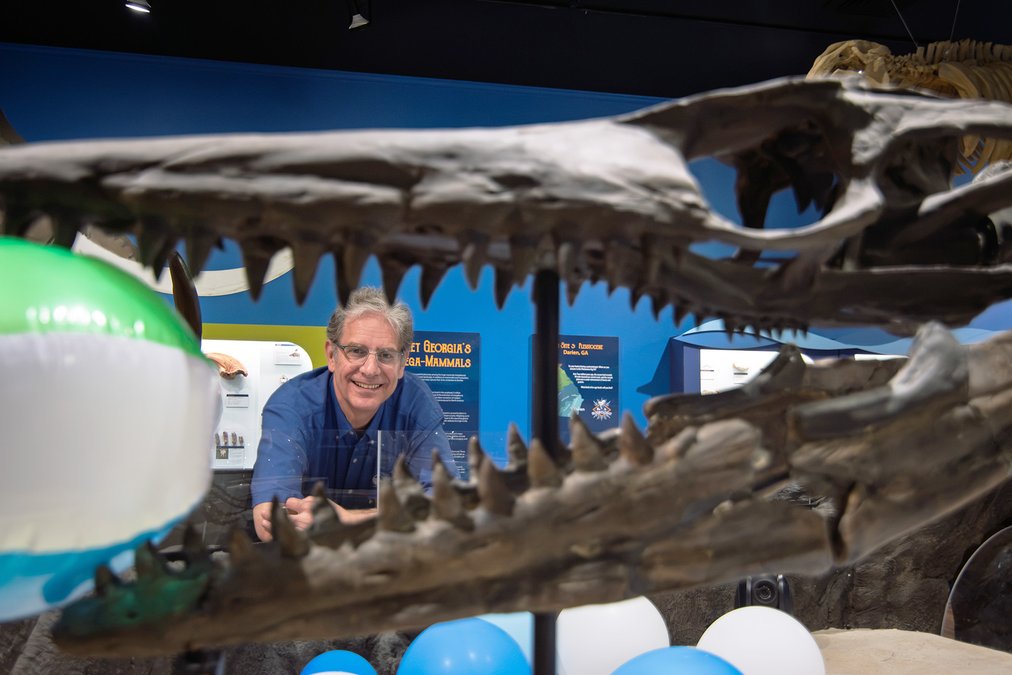
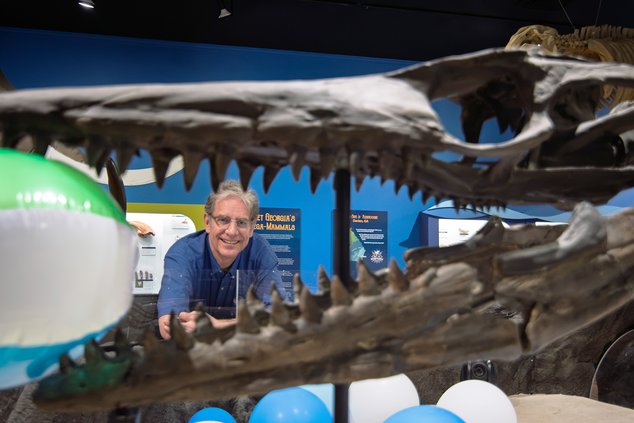
When Dr. Brent Tharp arrived as director of the Georgia Southern University Museum in 2000, it was already based in the Rosenwald Building, and the mosasaur was there to greet him. When Tharp leaves as a retiree Tuesday afternoon, the mosasaur will still be there.
But under Tharp’s leadership, the museum has evolved through partnerships on and off campus and extended its continuing presence far beyond the walls. With 26 years in, he retires as the museum’s longest-serving director so far. His wife, Kelly Tharp, is retiring from the university the same day. Previously principal of Julia P. Bryant Elementary School from 2000 to 2005, she has worked in Georgia Southern’s College of Education in various roles since then, including as a full-time instructor since 2011.
“So we’re both retiring, together, from Georgia Southern, which has been really good to us, but we’re looking forward to traveling and not always having to squeeze it in between semesters and spring breaks,” he said.
Much of their planned travel will be by water. First up, they’re going to Alaska for a cruise. They have also taken some boating-related classes and joined a boat club in Savannah, “to power boat, not sail.”
The couple will also have more time to visit their daughter Emma, a Georgia Southern graduate who now lives in Colorado.
But Brent and Kelly Tharp are another case of people who weren’t originally from around here being drawn to the Statesboro area for professional jobs and deciding to make it their home into retirement.
“We’ve got so many good friends around here, and this been our base and home for a long time. It’s going to continue,” he said this week, interviewed at his little office in the museum.
Packs during Shark Week
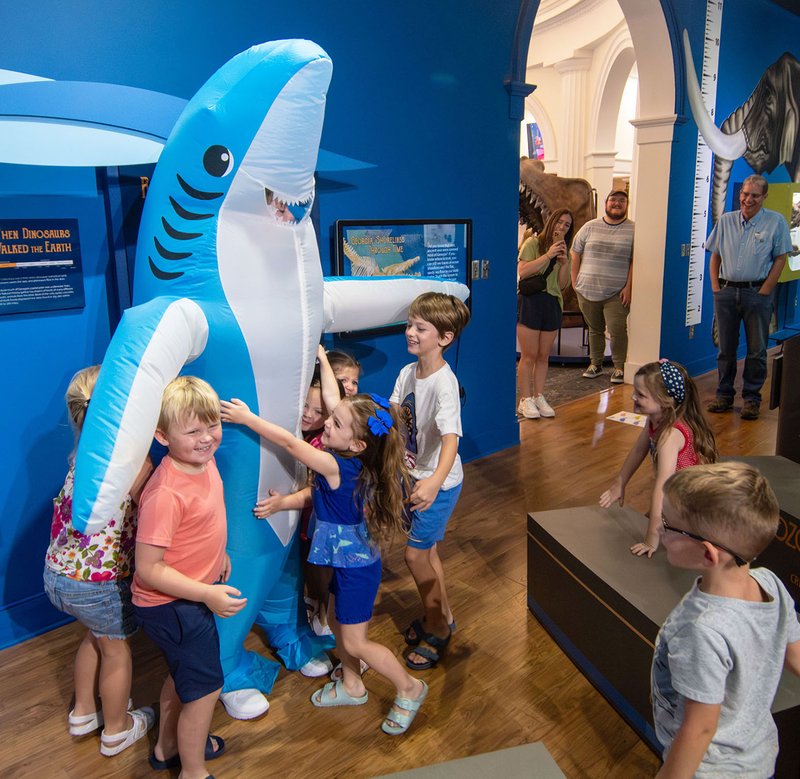
Most of the books and personal memorabilia had been packed away. Sounds of children moving about, occasional squeals of delight or faux terror echoed as kids encountered the toothy, stony, bony mosasaur and Vogtle whale and various representations of sharks. Tharp’s last full week on the job coincided with Shark Week, you see.
Museum’s history
The Rosenwald Building, with its impressive but acoustically weird lobby rotunda, dates from 1937, when it began service as the first freestanding library at what was then South Georgia Teachers College. Even before then, as early as the late 1920s, there was reportedly a small museum for students on the Georgia Normal School campus.
But the current museum really got started in the 1970s, when paleontologist Dr. Gale Bishop gathered staff members “to really push to get a space in the building, and that was all related to the mosasaur, and the discovery of the mosasaur,” Tharp said.
So Bishop became this museum’s first director, but he was part-time in the role, while doing teaching and research. “For years the museum was really just for students here,” Tharp explained. But when the building was ready and university leaders wanted more public exposure for the collection and a full exhibit schedule, “the museum opened with its first full-time director, and that was that was Del Presley, in January of 1982.”
Presley continued as director for 19 years, until he retired and a search brought Tharp on board. Delma Eugene “Del” Presley, who in addition to being museum director emeritus was a professor emeritus of English, died Jan. 8, 2026, at age 86.
“Obviously Dell, too, was dedicated to sustaining us, and he was a great mentor for me,” Tharp said.
Tharp’s history
Born in Indianapolis, Tharp attained his bachelor’s degree in history, with honors, at Indiana University. Then he went to the College of William and Mary, in Virginia, for his master’s in history, in a program that allowed students to simultaneously earn their certification in museum administration, completing the degree in 1988. He worked with Colonial Williamsburg while in that program.
Then he went on to complete his Ph.D. in American Studies, also from William and Mary, in 1996, meanwhile working as a curator at the Museum of the American Revolution in Yorktown, Virginia. He was first a museum director at the North Carolina Pottery Center, a small museum in Seabrook, N.C. He finished a fund-raising campaign and opened its first museum building.
Next, Georgia Southern called him, 26 years ago, as its museum’s second full-time director.
Lots of partnerships
In early May of this year, while the full spring contingent of faculty and staff were still around, a retirement reception for Tharp was held elsewhere on campus.
Dr. Katie Smith, the museum’s curator of paleontology, presented a lengthy “resolution” from the staff, with a lot of “whereas” clauses, some earnest and some comical. One of the more serious clauses referred to Tharp “creating lasting collaborations with various departments throughout campus.”
Because of the nature of the museum’s permanent collections, it has close relationships with the Departments of Biology, Geology, History and Anthropology.
“But we’ve really strived to do collaborations with folks all across the university,” Tharp said this week. “So we’ve worked with a professor in the College of Business…. We did a project where the museum and the (Bulloch County) Historical Society went together and worked with the Engineering Department that helped get 3-D scans of historic barns using LIDAR. We’ve done exhibits with Chemistry, and with the Fashion Merchandising Program.”
One of the museum’s longest lasting partnerships has been with the Betty Foy Sanders Department of Art.
“Almost 15 years ago, I started working with a professor there that, as we designed changing exhibits, he was teaching a senior practices graphic design course, and we started dividing the class up into teams and they competed to design the exhibit for us,” Tharp recalled.
That first art professor he worked with has since moved on, but the collaboration continued with others.
“We got the benefit of a really talented group of students that were here and professors that helped them design, and they got the value of dealing with the realities of budget and the requests of a client and everything else, and actually got to produce,” said Tharp.
Museum on Main
Another, similar partnership with lasting results actually involves three organizations, two on campus and one off campus. In what Tharp describes as something like a happy coincidence, Associate Professor Michael Van Wagenen had arrived in the History Department some years ago to develop the graduate program in Public History just as the Statesboro Convention & Visitors Bureau was renovating the former Shoney’s on South Main Street as what is now the Visit Statesboro center.
It was SCVB staff who first reached out to ask if the museum would help create some displays for the Visitor Center, Tharp said, but he asked, “How about supporting a class?” and suggested the Public History graduate students. This led to the continuing series of exhibits called Museum on Main.
While museum director, Tharp has served as adjunct faculty in the History Department. As such he taught just one class each year, Museum Studies, during spring semester. Students design the exhibits, work with the artifacts and get a real budget to work with.
“We’ve had a lot of fun over there,” he said. “We’ve had some really fun music exhibits.”
These have included the Otis Redding exhibit, created with assistance from the Otis Redding’s family, a Gretsch Collection musical instrument exhibit and an exhibit on the Music of Bulloch County, from Blind Willie McTell to Emma Kelly.
Speaking of the Gretsch Collection, the museum staff resolution credits him with working to secure, circa 2023, that collection. It was provided by the family who established the century-old manufacturing company for guitars and drums, now with offices in Pooler with a drum factory in Ridgeland, S.C.
Georgia Southern established exhibit space for the collection in Savannah’s Plant Riverside District.
A crisis opportunity
Also during Tharp’s tenure, age-related issues with the Rosenwald Building provided a crisis that presented an opportunity.
When he arrived, the museum had a modest but growing collection of items related to the cultural history of the region but could only display these in temporary, changing exhibits. Its only permanent gallery was dedicated to “natural history,” such as those fossilized aquatic creatures.
“So one of the neatest points was when we discovered that we had to do renovations on the building anyway,” he said. “That was an opportunity to finally say, ‘Oh, we have this really significant collection now about life in Coastal Plain Georgia,’ and especially how it related to the environment of this area.”
The permanent natural history exhibit, where the Mosasaur is the oldest resident in more ways than one, was remodeled in the gallery to the right of the front entrance. The permanent cultural history exhibit was created in the gallery to the left.
Because of 1937 plaster ceilings starting to collapse, asbestos needing removal and the COVID-19 pandemic, the more than $1 million renovation took longer than expected. Closed to the public in late 2018, the museum reopened, with new and ancient attractions, in October 2021.
Incidentally, he did not launch Shark Week, which has been a led by the museum’s curator for education, currently Marjean Cone. But Tharp says, “Sharks are an important part of the collection, and they’re something kids really love.”
‘Bittersweet to leave’
“Whereas Dr. Tharp mentored his students to fulfill their potential as historians, archivists and overall human beings through his compassion, patience and by example …” was another clause in the resolution Smith read.
“Whereas, Dr. Tharp can always find a reason to celebrate with doughnuts or ice cream,” was another.
In addition to Smith and Cone, the museum staff includes a third curator, Matthew Hill, curator of the Gretsch Collection. Dr. Lashanda Hicks-Griffin continues as the museum’s assistant director.
“It’s really bittersweet to leave after all this time, but one of the things that makes me happy is there’s just such an extraordinary staff here that it’s not a problem, and they’ll find somebody to work with them as director,” Tharp said.
After more than two decades of involvement with the Bulloch County Historical Society, a decade or more as its vice president and one year as its president, Tharp is also stepping down from that role next week. But he said he plans to remain an active member.