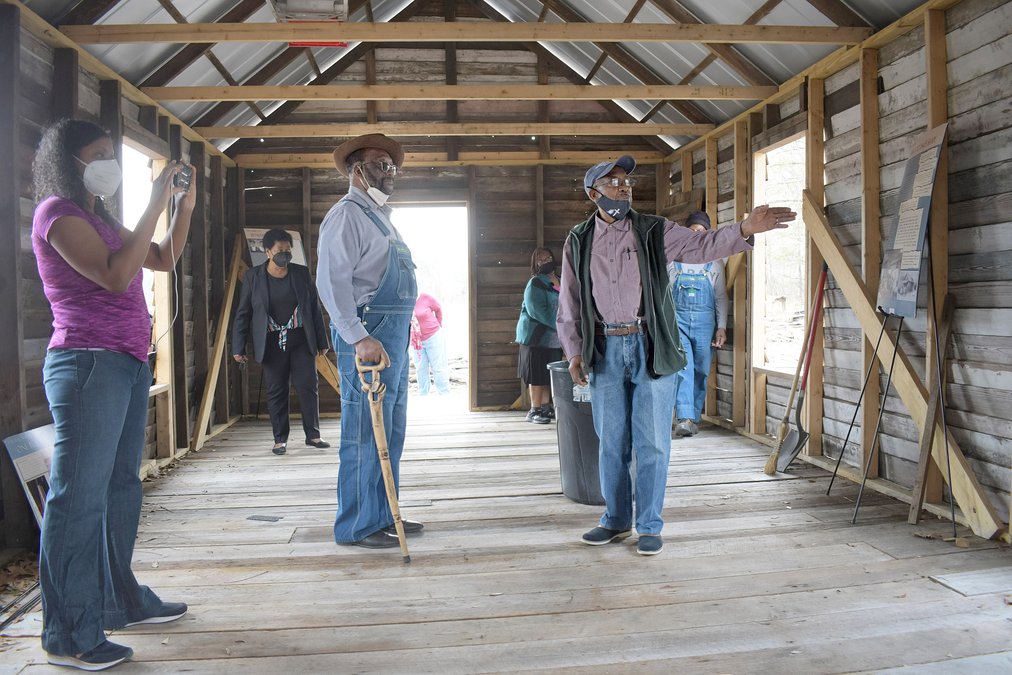
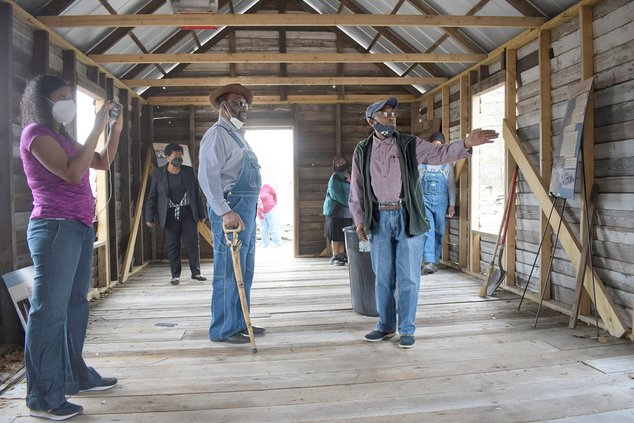
Putting life into history, Ozell Lawrence, now 84, recollected games of marbles and a maypole from his student days at the Bennett Grove School, the last extant one-room, African American school in Bulloch County.
His sharing of memories became a highlight of Friday afternoon’s public presentation of the one-room schoolhouse now reconstructed on the grounds of the Willow Hill Heritage and Renaissance Center near Portal. As revealed during the program, which was livestreamed and remains viewable through the center’s Facebook page, the school’s origins and history were not all fun and games.
Benjamin Bennett, the school’s namesake founder, had been born into slavery and as child witnessed Gen. William T. Sherman’s 1864 march with thousands of U.S. troops toward Savannah, helping to bring the Civil War and slavery to an end. After Bennett and neighbors built the wooden schoolhouse circa 1918, the primitive condition it remained in until it closed in 1952 – still with neither plumbing nor electric power – illustrates how unequal the separate schools for Black children often were during more than half a century of segregation.
But that doesn’t prevent Lawrence, who attended Bennett Grove in the mid-1940s, from having happy memories of childhood at a school whose teachers he respected.
"One thing I can say to start off with is, we had good old marble days at Bennett Grove School," Lawrence told the online and in-person audience. "We played marbles so hard till we wore out the thumbs. Busted marbles, rough marbles, had half a marble, whatever we could play with, that’s what we played with.”
He added that he was happy to see the school “by the grace of God … still standing” even though it’s now reassembled, with a number of replacement boards and posts, a few miles from the original location. This had occurred, he said, also “by the help of” Dr. Alvin Jackson, the Willow Hill Center’s board president and a great-grand nephew of Benjamin Bennett.
Teachers remembered
When Jackson asked Lawrence if he remembered any of his teachers, he named several, among them Veronica Young and Thelma Jones.
These and other teachers from the Bennett Grove School’s 30-plus years in operation are identified on a panel in a 10-panel display about Bennett Grove that has been exhibited inside the Willow Hill Center for several years. For Friday’s event, several of the panels were set up on the porch and inside the replicated Bennett Grove schoolhouse, now on a corner of the Willow Hill campus away from the larger, more modern looking, but also historic, Willow Hill School building.
In past years, Jackson and other volunteers interviewed many older African Americans with roots in the Willow Hill community and the surrounding area, building a collection of oral history recordings retained by the Willow Hill Center. Among those he interviewed were several Bennett Grove teachers, including Evelyn Greene Burks, who died last year at the age of 100, Jackson said.
“We interviewed her and got the great story of Bennett Grove,” Jackson said. “She talked about the end-of-year when all of the parents would come, when the stage would be the front porch and the men of the community would dig a pit and roast a hog and … they made lemonade in wooden barrels.”
Another former teacher Jackson interviewed, Fairbank Love Hendrix, who was born in 1918 and lived to be 99, had stayed in the home of Benjamin Bennett and said he often talked about Sherman’s march and had been very interested in education.
“I have a number of recordings of students and teachers of this Bennett Grove School that will forever keep the story of Bennett Grove as a part of Bulloch County and Georgia history,” Jackson said.
Dressed for history
He wore blue bib overalls and a brown fedora, as a man of Bennett’s time might have worn. Jackson’s daughter, Dr. Nkenge Jackson-Flowers, wore a high-waisted skirt and a shawl, as a Bennett Grove teacher might have, while serving as emcee for Friday’s program. Jackson’s wife, Dr. Gayle Jackson, the Willow Hill Center’s development director, helped organize and publicize the event, and their other daughter, Wiloise Harper, handled the camera for the Facebook Live production.
Inside the little school building, Lawrence recalled that the potbellied woodstove, which had been the source of heat in the winter, was in the center and that a cloakroom or closet on one end of the room had been where children placed their lunches and coats.
One privy too many
On the far side of the school building, the volunteers who reconstructed it also built a wooden replica shallow well, and at the back of the building, two replica outhouses. The idea was for these to represent separate privies for boys and girls. But Lawrence shared some startling information.
“The boys didn’t have no toilet,” he said. “They had to get permission, but they had to go to the woods.”
The school had been intended for up to 70 children. But for a rural school for Black children in a farming area, full attendance was almost never achieved, since the children, especially the boys, were expected to work on the farms, Jackson said.
Students walked to the school from homes in several directions. There was no school bus service, and Lawrence said he doesn’t recall parents ever dropping children off or picking them up in a vehicle. When a school bus service was provided for the African American public schools, as was the case for Willow Hill circa 1950, parents had to pay a fee for their children to ride, Jackson said.
Another speaker for Friday’s presentation was Inger Wood, who now works in academic advising at Georgia Southern University but has a background in archaeology and historic preservation.
Author of the February 2014 faculty presentation, “The Bennett Grove School: Bulloch County’s Last One Room African American Schoolhouse,” she recalled a symposium held on the topic that year. She and her husband, anthropology Associate Professor Dr. Jared Wood, and a group of student volunteers also took part in a cleanup and documentation effort at the school on its original site, along a dirt road north of Portal, that year.
Volunteers at that time talked about possibly stabilizing the building or moving it, intact, to Willow Hill. But already leaning onto a pine tree in 2014, the old schoolhouse collapsed when Hurricane Matthew came through in 2016.
Then a group of community volunteers helped catalog the beams and boards and transport them to the Willow Hill campus.
Bennett Grove reborn
More recently, Rondie Lundy, who works for the Willow Hill Center as its part-time handyman, led the volunteer effort to rebuild the Bennett Grove schoolhouse. Both he and Tommy Holloway, the volunteer who helped him most often, are descendants of some of the people who founded the Willow Hill School in 1874.
Lumber salvaged from some old barns was used to replace a number of boards from Bennett Grove that had deteriorated too badly to reassemble.
Representing others
Now the building stands again as the last representative of 43 African American one-room schools that existed in Bulloch County between 1920 and 1952.
“It tells the story of survival, it tells a story of struggle, it tells a story of overcoming, and that’s why I wanted this structure to be here so that students in future generations could see the great importance of African American education in Bulloch County, Georgia,” Jackson said.
The presentation was co-sponsored by the Georgia African American Historic Preservation Network, or GAAHPN, of which Jackson is the current chairperson. In existence since January 1989, the organization now has more than 3,000 volunteers, working together to preserve structures and tell the story of African Americans in Georgia, he said.