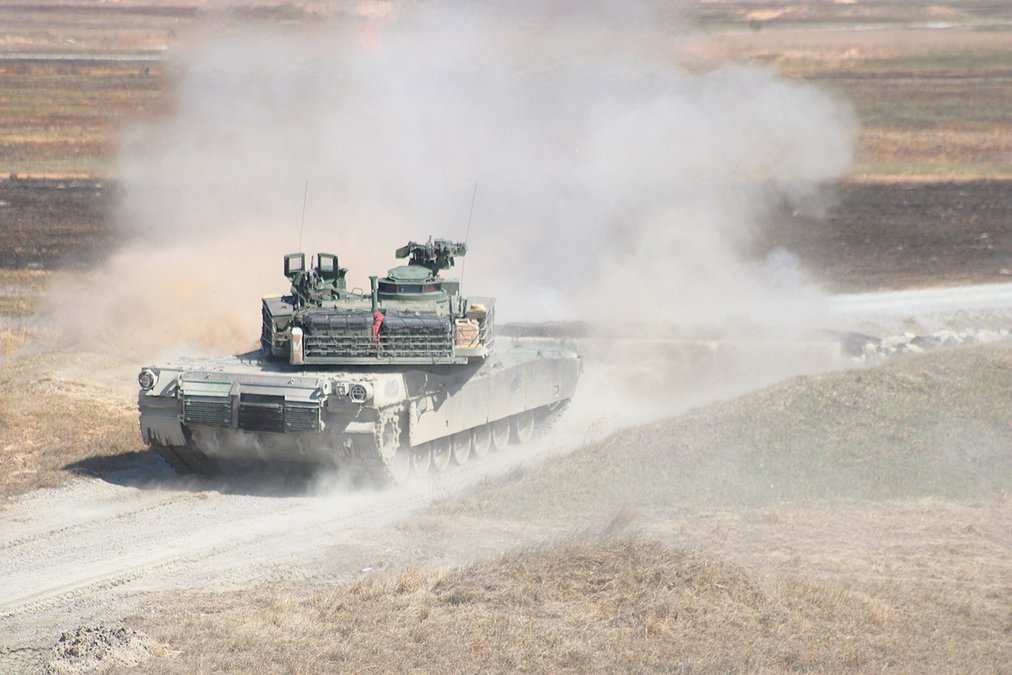
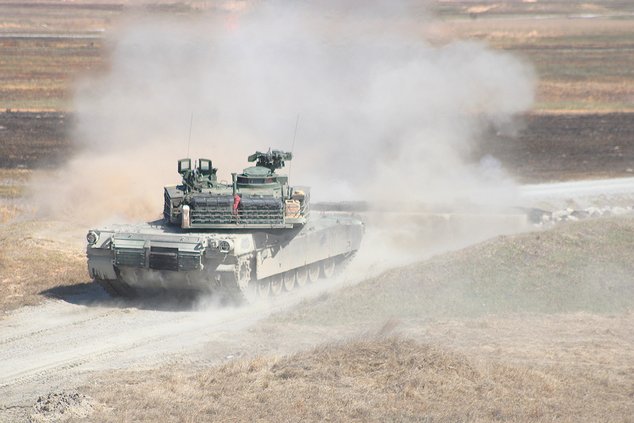
It’s not just the latest versions of vehicles that are putting the 3rd Infantry Division’s 2nd Armored Brigade Combat Team at the forefront of Army modernization.
It’s also a number of other items the brigade is testing in the field that could play a significant role in future combat.
“We’re on the cutting edge,” said brigade commander Col. Alexis Perez-Cruz.
The brigade is using drones, operated troopers in the 6/8 Cavalry Squadron, to identify targets for the newest M1 to have its crew sight and shoot. Also being tried is a smoke generator that can obscure the movements of vehicles and soldiers, and can be deployed through a drone.
Another innovation allows a unit to get water from out of thin air.
It’s all part of the Army’s Transformation in Contact 2.0, and the 2nd ABCT is putting much of how the Army could fight its future battles into practice.
“For us, it’s a huge responsibility and we take it very seriously,” said Col. Perez-Cruz. “We are the 911 force for the world, for the U.S., when it comes to armored brigade combat teams.”
The 2nd ABCT is one of three brigades Gen. Randy George, the chief of staff of the Army, considers to be “ABCT Next,” Col. Perez-Cruz said. That means integrating drones into a variety of roles, from delivering supplies to spotting enemy forces, and putting into use new ways to communicate and to disrupt an adversary’s communications.
“We’re lucky to be the first armored unit in the army to get the full suite of this equipment,” said Maj. Ted Moore, the brigade’s S3, or operations officer. “Warfare is going to be faster in the future. We’re going to have to communicate in multiple, different ways. We have to be able to talk to the 82nd Airborne, the 101st Airborne. It makes us easier for us to talk with those adjacent units.”
The new communications equipment gives commanders a digital look at where units are in real-time, allowing them to know where to shoot – and where not to shoot.
“Being able to pull all that information back to one central location, so we can see ourselves in real time, helps a commander to make decisions,” Maj. Moore said.
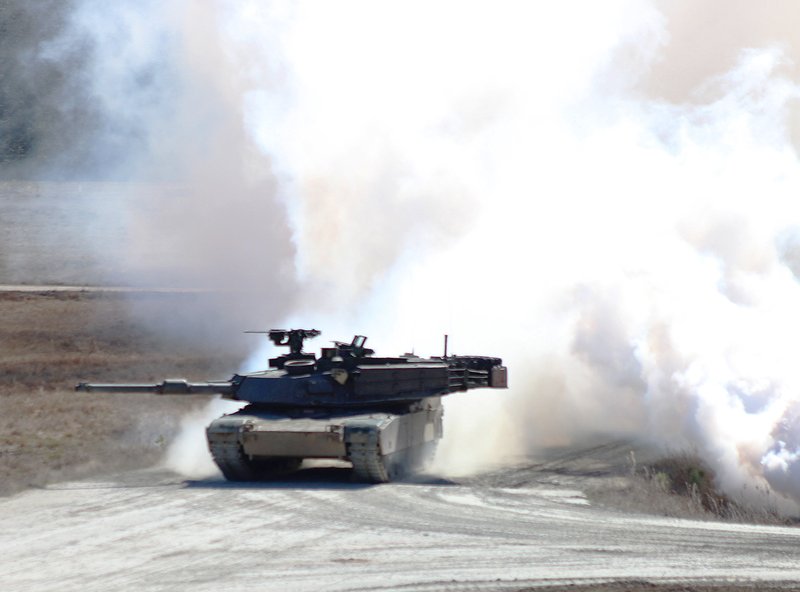
As part of an exercise Monday, drones went airborne to identify targets for Abrams tanks to aim their 120mm cannons at, and the 6/8 Cav drones have been used in real-world situations already, such as helping find soldiers on the base’s land navigation course.
Other elements are working on new electronic warfare hardware that can pinpoint enemy communication and possibly even jam their signals.
“Communication is a very big part of being able to complete missions and being able to deny or degrade communications is part of the job,” said Spc. Cody Winters. “To be able to have control over the electromagnetic spectrum is big in today’s Army.”
As Russia’s invasion of Ukraine now enters its fourth year, how that war is being fought has the attention of U.S. Army brass. But they are also looking at how such conflicts might evolve in the future.
“They are using drones, they are using electronic warfare,” Col. Perez-Cruz said. “We can innovate to be the best and fastest ABCT in the U.S. Army and the world.”
Even some of the ideas from soldiers that have been brought to life at the Marne Innovation Center are getting tested in the field. The remedies to problems they encounter include small items, such as a cable guard to keep a wire in place, or finding ways to merge new technology with older equipment.
“In the long term, it empowers a soldier to take their problem and be able to own it as opposed to relying on someone externally to solve it,” said Capt. Brenden Shutt of the Marne Innovation Center. “Our innovation team has a presence at every single training. The soldier can have an immediate impact on the entire division by solving a problem a lot of other soldiers are also experiencing. We scale it across the division and across the entire Army.”
Col. Perez-Cruz noted that soldiers will try new ideas, manufacture it and when they get the right innovation, an industry has picked up on it and made something bigger and better to use.
“I think our soldiers love what they’re doing right now,” he said. “We’re using the innovations our soldiers have and change the mindset we have and the Army as a whole is learning what we’re doing. It’s their ideas that are shaping the army. We need that innovation from soldiers who have grown up in the digital age. We’re open-minded about innovation and learning new things.”
Col. Perez-Cruz recalled the recent exercise where medics used a drone to bring blood to a unit, testing a drone’s capability to conduct such a mission, and said the use of robotics in the Army is nascent.
“The first contact should not be made with humans,” he said of the future battlefield.
The 2nd ABCT will go to Fort Irwin, California, and the National Training Center this summer to explore a further use of robotics in battle. Out there, in the High Mojave Desert, one of the latest experimental pieces of equipment may not be of much use. But in the humidity of Fort Stewart’s woods, the Genesis water cube has found a purpose.
The backpack-sized instrument can make water out of the surrounding atmosphere. Having water for troops in combat is essential. The 2nd ABCT is testing 10-gallon cubes and had a 100-gallon cube in the field in October.
“We had it with our field feeding team. They cooked with it,” said Lt. Col. Mike Sanford, the 703rd Brigade Support Battalion commander. “I love it. All it needs to go is to stay plugged in.”
The water from the cube, Lt. Col. Sanford said, was “10 times better” than the water drawn from the unit’s portable storage units, called “water buffaloes.”
For the 2nd ABCT, it is in its fourth long-range training initiative where soldiers are in the field for 30-45 days, with exercises conducted from individual tasks all the way to brigade-level tasks.
“We conduct all of the best ABCT training in the U.S.,” Col. Perez-Cruz said. “We can harness what these soldiers are doing for the future of armor. There is no better place than Fort Stewart to look at the future of armor.”