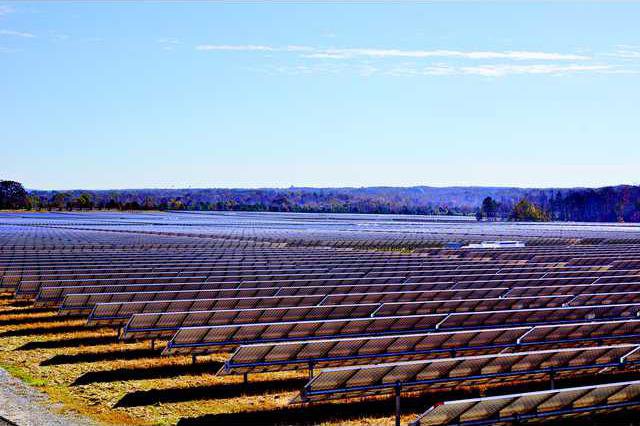
Some area farmers have begun using solar panels to power cooling fans in poultry houses, and a Georgia manufacturer is developing a portable solar plant for irrigation. Meanwhile, federal grants and guaranteed loans are available for solar energy projects by farms and rural small businesses.
The organizers of a symposium planned for Friday hope to illuminate the potential confluence of projects and funding. Coastal Solar, a Hinesville-based company that sells and installs solar power equipment, is hosting the free workshop for farmers and agribusiness people, 11:30 a.m. to 1:30 p.m. at Comfort Inn & Suites in Statesboro.
Al Burns, U.S. Department of Agriculture energy coordinator for Georgia, will be the featured speaker. Others scheduled to speak include representatives of lenders AgSouth Farm Credit and Ameris Bank and a solar battery manufacturer, Sonnen Batterie.
In this year’s State of the Union speech, President Barack Obama renewed his commitment to federal backing for sustainable “clean” energy sources.
“What’s not widely known is how much money has been turned loose for rural Georgia, and basically it goes beyond agribusiness, but this particular meeting is focused on agribusiness,” said Derek Duke, a Statesboro resident who does government relations and sales work for Coastal Solar.
"Our goal is to get everybody 100 percent of the money,” he said. “It's being made available nationwide, and we want Bulloch County to get as much of it as we should have at work for agriculture and small business in the community."
Farm and nonfarm
Burns, from the USDA, will talk specifically about REAP, the Rural Energy for America Program. Grants pay up to 25 percent of eligible costs for an agricultural producer or rural small business to install a renewable energy system or make energy efficiency improvements. Federally guaranteed loans are available for up to 75 percent of total costs.
There are minimum and maximum loan and grant sizes. Grants for renewable energy systems range from $2,500 to $500,000, according to a brochure Burns provided. Loans can range into the millions.
In rural areas, the funding is also available to small businesses other than agricultural producers. Bulloch and neighboring counties qualify as rural. Towns with fewer than 50,000 people are considered rural in this program, so Statesboro businesses are eligible. They have to qualify as small under standard federal criteria.
“It’s for any type of renewable energy that has technology that’s commercially available,” Burns said.
So wind and biomass systems, for example, also qualify, but next week’s symposium will focus on solar.
Poultry and pumps
One Bulloch County poultry farmer is using a solar array to power fans and other equipment in chicken houses, and Duke said a system is currently being installed for another poultry farmer in Tattnall County.
Meanwhile, a Georgia manufacturer is developing a mobile solar electrical system for farm use to Coastal Solar’s specifications. This has been designed with irrigation systems particularly in mind but has other potential uses, said Duke and Coastal Solar Director of Operations Mike Croft.
“We anticipate having a system for the farmers this summer that qualifies under this program,” Duke said.
Announced topics for the workshop discussion include tax benefits available for renewable energy projects, financing and leasing options and battery storage capabilities, as well as the USDA grant application process. Light refreshments will be served.
Duke asks that people who plan to attend call him at (912) 541-2200 as a courtesy so that sponsors will know how many to expect.
Herald reporter Al Hackle may be reached at (912) 489-9458.