For most Georgia Southern fans, 2006 sticks out as a sore thumb. The 3-8 season - still the lowest win total of any modern day Eagle squad - sticks out like an unsightly pimple in what is otherwise a beauty queen of a football program.
A lot of hyperbole has been thrown around during the struggles that the current rendition of the Eagles are enduring and I’m afraid that I have some bad news.
I think the program was doing better in 2006 than it is at the moment.
Now, before we all go running off the nearest cliff with fatalistic claims, let me qualify a few things about that statement.
This season’s team is absolutely better than that 2006 squad. For obvious reasons, the talent level currently dressing out in blue and white far surpasses their brothers of a decade ago and - even with the current issues - would be a heavy favorite to beat the 2006 squad.
The current Eagles are also in a better spot moving forward. Even after this year’s seniors have graduated, there is plenty of talent lying in the wings and the Eagles’ status as an FBS school gives them a much better chance of withstanding a rough season when it comes to the recruiting trail.
But now for the downside.
While the 2006 team’s overall record will be worse than this year, that team was much more competitive in many statistical categories.
More importantly, games were more competitive that season. For all the losing that was done that year, just three of the Eagles’ eight setbacks came by a margin of more than four points, and one of those was a 7-point overtime loss. On the flip side, the Eagles average margin of loss this season is 11 points. And of those losses, Saturday’s defeat and the Arkansas State game are the only losses where the Eagles could have seized the game on their final possession or defensive stand.
But the biggest black eye on this season has been the production on both sides of the ball.
Georgia Southern sported a top-25 defense last season, even after absorbing a 44-0 opening night defeat. Replacing the entire secondary was a tall task, but the front seven returned its entire two-deep, only to show regression in run defense and quarterback pressure.
Some of that can be credited to fatigue as the defense has worked long hours this season, but that just brings us to the issue of the offense.
In 2006, the Eagle offense was an unmitigated disaster. In trying to push a strictly pro-style scheme on a team set up to run the option, Georgia Southern was out of its element and set up to fail at nearly every position. This year, a new coaching staff brought new ideas to what was promised to be a similar shotgun, triple-option team.
Heading into their final game of the season, the 2016 Eagles who were supposed to be a similar version of their usually potent, ground-game selves are rushing for 0.4 fewer yards per carry and have run for just two more touchdowns than the 2006 squad that was doing its damnedest to not identify as a run-heavy team. If that’s not alarming, I don’t know what is.
That’s about as far as I like to dive into stats. Our prep writer, Chris Stanley, is more of the analytic type and has also raised plenty of red flags when looking at the Eagles’ production - or lack thereof - this season.
I don’t assume to know the intricacies of a given weeks game plan, so for all I know, maybe there are reasons for this year’s downtick that can be expected to resolve themselves before 2017.
But there is one thing that is clear to all Eagle fans, regardless of what they know about X’s and O’s.
This team returned 17 starters and plenty of backups from an Eagle squad that left the MAC champion for dead on the side of the road in last year’s bowl game. This 2016 team is still full of guys who - while recruited as FCS players - made the Sun Belt Conference look like a stroll in the park in 2014.
This is also a team who will send many of those players off on Senior Day in two weeks with plenty of tears and hugs and applause - but no bowl game.
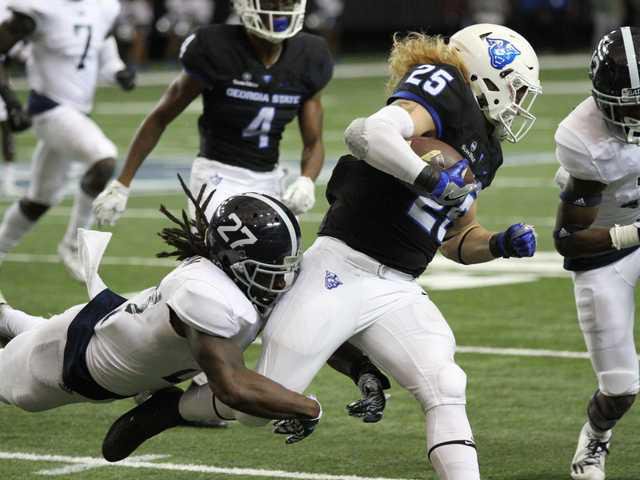
You see, at least the 2006 team set itself up to under perform, whether it be through schemes that couldn’t possibly be executed by that season’s roster or a head coach who was too determined to do it his way that no allowances were made to ease the team’s transition. This year’s squad is a different story. If you were to freeze things just before the snap, a photo of last year’s team might be hard to distinguish from the 2016 squad. It’s just everything that happens once the play starts that has taken a sharp downward turn.
If the long-term plan for Georgia Southern is to continue its run-heavy, option-oriented attack, there is something rooted in the current scheme that needs to change.
The old saying goes that if it ain’t broke, you don’t try and fix it. But what happens when the assumption is that nothing has been tinkered with, only to find that something is very, very broken?
2006 has a bad name, but 2016 seems all to similar