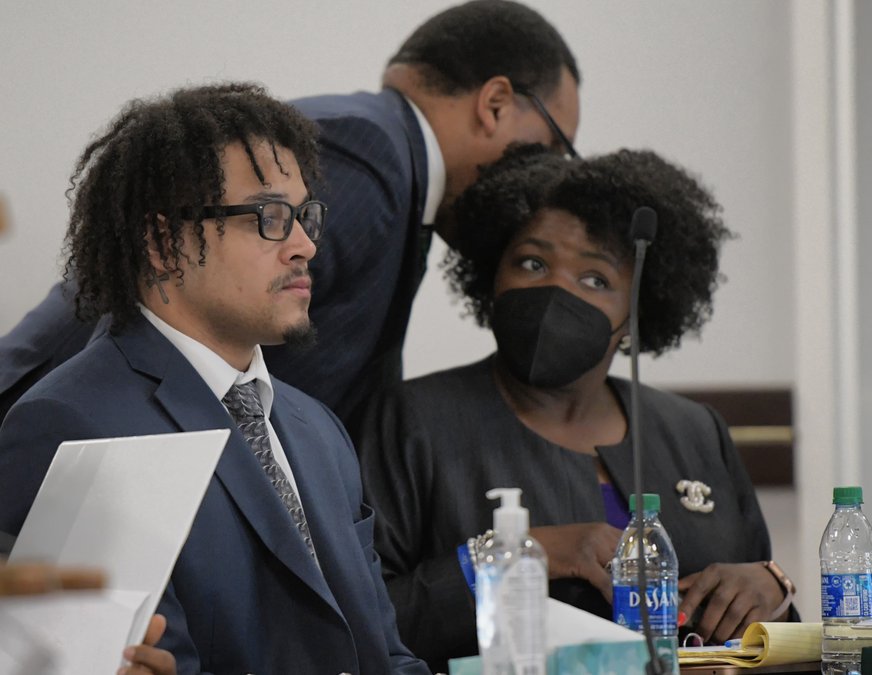
The second attempted hearing on Marc Wilson’s request for immunity from a murder charge for killing 17-year-old Haley Hutcheson in 2020 got underway Wednesday in Bulloch County Superior Court, where newly assigned Judge Ronald K. “Ronnie” Thompson kept things moving rapidly.
Nothing was decided yet, with the hearing allotted three days on the court calendar.
When Wilson, who was 21 then and is now 23, fired several shots from a 9mm handgun while driving his Ford Focus along Veterans Memorial Parkway, Statesboro’s bypass, shortly before 1 a.m. on Sunday, June 14, 2020, one bullet struck Hutcheson in the back of the head. At the time she was riding with four other teenagers from Claxton in a crew-cab Chevrolet Silverado pickup. She was in the back seat, in the middle, while Mason Glisson was driving, with Ashton Deloach beside him in the front passenger seat and Luke Conley and Marci Neagley in the back seat on either side of Hutcheson.
When the other teenagers realized that Hutcheson had been shot, they drove her to East Georgia Regional Medical Center, where she died a short while later.
That much has not been disputed, either at this hearing or previous ones, but the defense attorneys have argued that Wilson, who is biracial, and and his then-girlfriend who was riding with him, Emma Rigdon, who is white, had first been subjected to racially motivated aggression by teens in the pickup. That is the basis of the defense motion for immunity under Georgia’s version of a “stand your ground” law.
“Georgia law says we don’t have a duty to retreat, to pull over on the side of the road, to call the police, to do anything other than to stand our ground and to exercise that level of force, including deadly force, so long as you are justified in using that force,” Wilson’s lead attorney, Francys Johnson, said in his opening statement.
In fact, Wilson is seeking immunity from prosecution on five charges of aggravated assault – one for each occupant of the truck – as well as the one felony murder charge.
Under Georgia’s “stand his or her ground” law, the immunity question is to be decided by the judge alone, not a jury, and the burden of proof is on the defense, not the state as it would be in a trial. The standard to be applied is also different, preponderance of the evidence, not “beyond a reasonable doubt,” as Johnson explained.
Mistaken identity
He set out the defense narrative of a purported racist attack and also asserted that Wilson and Rigdon became the objects of that attack when intoxicated teenagers in the pickup, while stopped at a red light, mistook them for another young white woman and a black or biracial man they had seen that night at the Parker’s convenience store on Brampton Avenue.
“We think the evidence will clearly show that Marcus Wilson’s vehicle was being attacked by the truck occupied by the party. That party included the alleged victims, according to the indictment of the state” Johnson said. “The evidence will clearly show that the racial animus was exhibited by the party. It was one that they had held for a long time, one that was generally known.”
D.A.’s opening
But Ogeechee Judicial Circuit District Attorney Daphne Totten told the judge that this was only the defense team’s latest version of events, and not one borne out by the facts.
“What Mr. Johnson has just done is given the court a narrative of what he believes the facts are in this case, as of today,” Totten said in her opening statement “The narrative has changed in this case multiple times.”
She asserted that the sequence of events Johnson had described was “not the narrative and not the facts” of the statements Wilson and Rigdon had given to Statesboro Police Department Detective Travis Kreun and Capt. Jared Akins soon after the incident.
“Facts are really important, and part of what the court is going to do over the next couple of days is hear what the facts in this case actually are,” Totten said.
Witnesses so far
Kreun and Akins, who had been prosecution witnesses at preliminary and bond hearings, were called to the witness stand by the defense Wednesday. Other witnesses included Wilson’s parents, briefly, and Glisson, Deloach and Neagley.
The judge asked some witnesses, especially Deloach, direct questions of his own.
Conley, who was arrested by police on a misdemeanor obstruction charge – for inconsistencies in his story – back in 2020 before police identified Wilson as the suspect, again declined to testify on the basis of his Fifth Amendment right.
Wednesday’s session was punctuated by frequent brief conferences at the bench, with the four defense attorneys and two prosecutors talking quietly with Thompson. Several of these conferences started over things the defense attorneys wanted to introduce into evidence but the prosecutors wanted excluded, or concerns about witnesses.
“Come on, let’s go,” Thompson repeatedly exhorted the attorneys throughout the afternoon as he urged the defense not to repeat questions or witnesses’ answers and overruled some of the frequent objections raised by the prosecutors. He said he would allow some things to be offered into evidence and decide later whether to admit or exclude them.
He recessed the hearing before 4:30 p.m., to resume at 9 a.m. Thursday. If the judge does not grant immunity, Wilson’s case can proceed to a trial, where he could still use a claim of self-defense, but with the burden on the prosecution to prove his guilt beyond a reasonable doubt.