
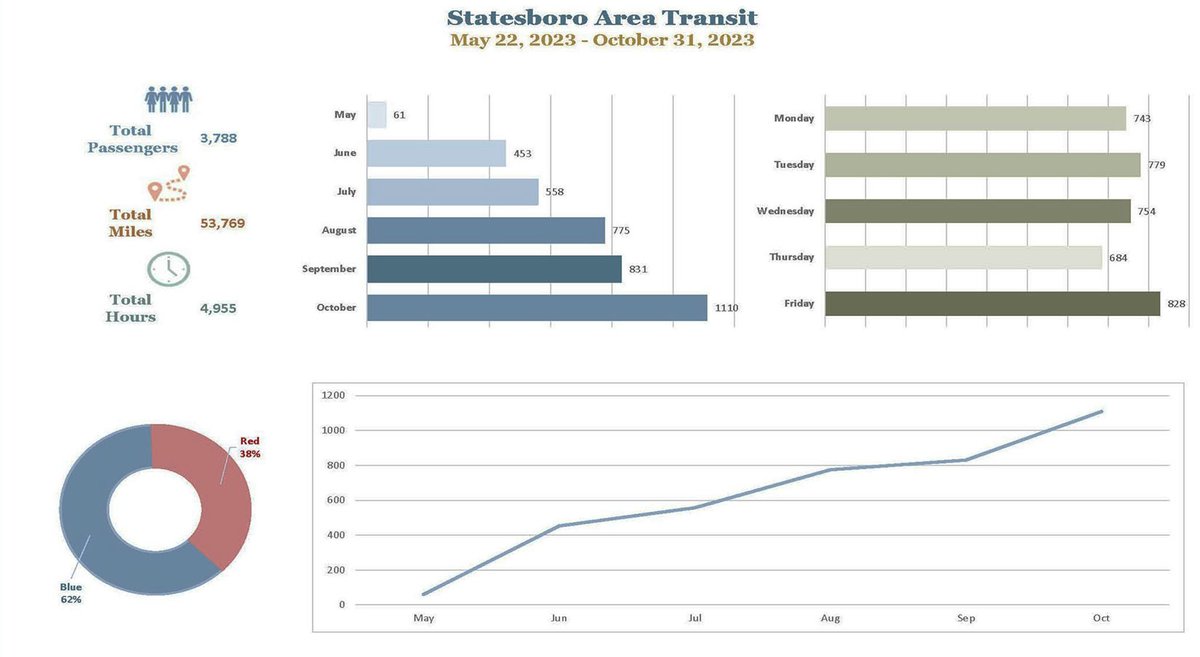
After operating just a few days in May and then attracting only 453 riders during June, its first full month in operation, Statesboro Area Transit saw its ridership grow each month, to 1,110 riders during October.
From the publicly-funded bus service’s first day of operation, May 22, through Oct. 31, a total of 3,788 passengers rode the four buses, according to the report delivered by Statesboro city staff civil engineer Kiara Ahmed to City Council during a Nov. 21 work session. (The same person riding a bus twice would count as two passengers, and so on.)
“We have consistently increased ridership,” Ahmed said. “So far we’ve had 3,788 up until October 31st. As you can see, the weekly ridership is pretty consistent. Friday is a little bit more popular than the other days.”
That was a reference to bar graphs in her slideshow presentation, which broke down the cumulative rider count not only by month but also by days of the week. Through Oct. 31, there had been 828 riders on Fridays, 684 on Thursdays, 754 on Wednesdays, 779 on Tuesdays and 743 on Mondays.
Hours and miles
Ahmed’s presentation displayed the total miles the buses were driven from May 22 through Oct. 31 and the hours of operation but did not relate these numbers to the ridership count.
But over the entire five months and eight days, the buses obviously averaged less than one rider per hour, since they operated 4,955 hours and there were 3,788 passengers. However, as she noted, ridership did increase each month. In October, when there were 22 weekdays and 1,110 riders, the apparent average was 50.45 riders per day or 4.2 riders per hour over the 12 daily hours of operation.
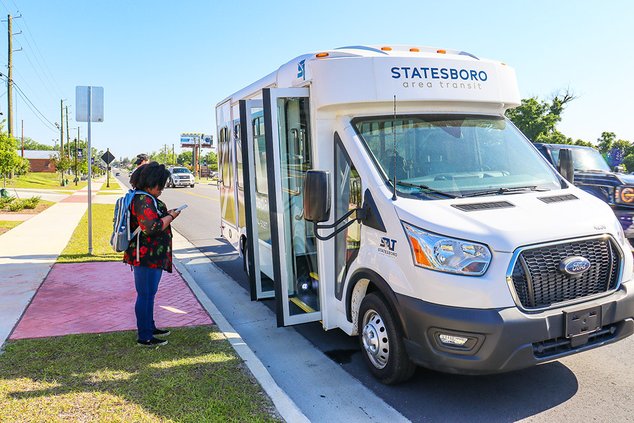
Each little bus can carry up to eight passengers and has a lift for a passenger in a wheelchair. The buses operate from 6 a.m. until 6 p.m. Monday through Friday only.
During their first 4,955 hours of operation, the buses traveled 53,769 miles, back and forth across Statesboro.
There are two routes, identified on maps as the Blue Route and Red Route. They cross in the middle of Statesboro, in the city parking lot across South College Street from the post office. The little sheltered bench there is the only stop shared by the two routes and serves as the transfer station.
Blue Route
The Blue Route runs generally north and south. From a loop that passes around East Georgia Regional Medical Center and the Market District as far as Veterans Memorial Parkway on the south end and back via Lanier Drive through the Georgia Southern University campus, the route follows Fair Road and South and North Main Streets to a north-end loop in residential areas.
Other bus shelters on the Blue Route can be found at the Cambridge at Southern apartments and Eagle Village student housing complex and on South Main at Midtown Market and near Tillman Road. Only four stops on the route have shelters, but there are 20 Blue Route stops in all, and the most popular are at the hospital and at Cambridge at Southern, Ahmed reported.
Red Route
The Red Route, from its western end at the Bulloch County Health Department on Denmark Street, runs mostly eastward to the Statesboro High School area, then southward along Coach Lee Hill Boulevard and southeastward along Northside Drive east to the Statesboro Mall, Walmart Supercenter and Lowes areas, making a loop to destinations such as the Social Security Administration office and the Statesboro Crossing shopping center.
Of the 20 Red Route stops, only the Health Department and transfer center have bench shelters, and the most popular stops on the route are the Health Department and the Walmart Supercenter, Ahmed noted.
The system is considered a “flex route” service because, with reservations made at least 24 hours in advance to 1-866-543-6744 or online, buses can pick up individuals at locations within one-fourth (0.25) mile of the routes.
Expansion ahead
City staff members are already planning for expansion of the bus service to eight buses in city fiscal year 2025, which begins July 1, 2024. A majority of Bulloch County voters in effect approved funding to expand the system when they reauthorized the countywide Transportation-Special Purpose Local Option Sales Tax, or T-SPLOST, for an additional five years in a November 2022 referendum.
Of the full, projected $72 million T-SPLOST revenue projected for the county and its four cities, the referendum proposal earmarked $3 million for Statesboro’s transit system from this fall through most of 2028. The $3 million is almost seven times the original $450,000 earmarked in the previous, 2018 T-SPLOST vote for the city to plan and launch a public transit service.
The city contracts the Coastal Regional Commission of Georgia to operate the bus service. After consultants conducted a feasibility study for the city in 2019, city officials found that they could not obtain the federal assistance needed to support the service without working with the CRC.
For most riders, the fare is $1 for a one-way trip and $2 for a round trip, but fares supply only a small fraction of the operating revenue.
How it’s funded
For current fiscal year 2024, Statesboro Area Transit has $316,500 in capital expenses budgeted, including equipment and supplies. The revenue for this comes 80% from a Federal Transit Administration grant for rural transit, amounting to $253,200; and 10% from state matching funds, providing $31,650; and another 10%, or $31,650, local funding.
But for the year’s $214,200 in budgeted operating expenses, the shares are 50-50, with $107,100 federal funds and $107,100 required local money. So, the city has budgeted $138,750 from T-SPLOST for its share of capital and operating expenses.
Then, for fiscal year 2025, the city expects to have a full $600,000 of new T-SPLOST revenue – one-fifth of the $3 million expected over five years – available for the transit service.
With the planned addition of two more buses on each route, the fiscal 2025 capital expense projection is $257,418, covered by $205,934 in federal funding, $25,742 state funding and another $25,742 local funding.
But with the expansion, rising fuel and labor costs are projected to drive operating expenses up to $821,955, half from the federal funding and the other half, $410,977, from local funding.
The CRC has submitted the request for the bus expansion for fiscal year 2025, Ahmed said.
More shelters
“Now for program improvements, we want to look into adding bus shelters at popular or requested bus stops,” she said. “We also want to, hopefully, install those by FY ’25. We’re probably looking at FY ’24 for the installation.”
City staff has received citizens’ requests for bus benches or shelters at three sites and requests for nine additional stops, plus 12 complaints, “which we’ve been diligently working on resolving,” Ahmed said.
“We also want to look into adding additional stops with additional buses or improved route efficiency in the future,” she said.