Really, the city law amendment enacted by a 4-0 vote of the Statesboro City Council this week could allow “local distilleries” in any appropriately zoned area of town. But it has been described as being sought by “local investors” who want to put “a micro distillery downtown.”
When a public hearing was held with the first reading of the ordinance on Sept. 2, nobody spoke in opposition. At that meeting, the three council members present voted 3-0 to approve the first reading, sending the amendment forward to the second reading Tuesday, Sept. 16.
As long as a proposed ordinance isn’t significantly changed after the first reading, no formal hearing is required at the second reading before a council vote for final approval. But the council’s agenda always designates a time for public comments on agenda items soon after the beginning of a regular meeting.
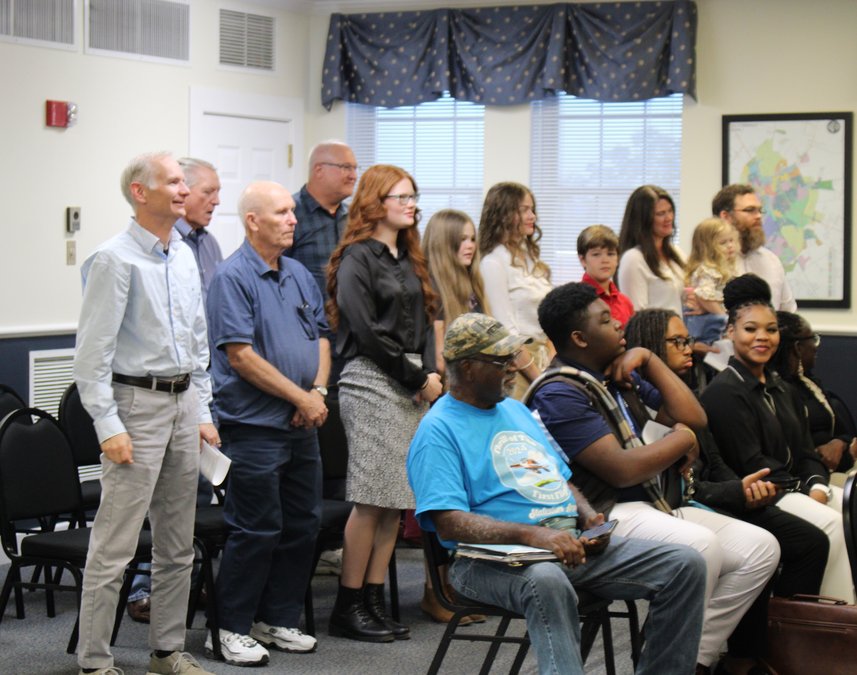
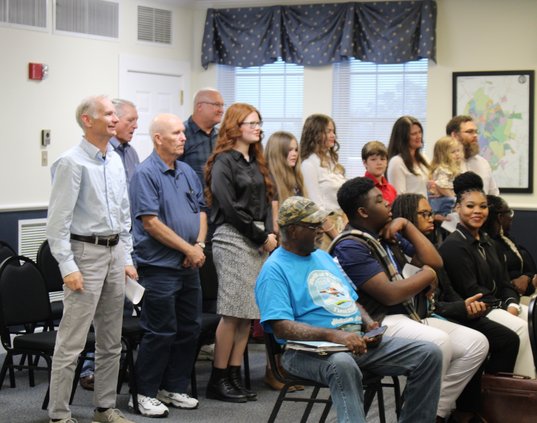
Two men signed up and spoke against the distillery ordinance at that time, and as shown later when they stood up, at least 11 or 12 people – including several children – were there as a group expressing concern.
Greg Calloway said he was there to “respectfully and strongly oppose” the ordinance amendment to allow a distillery.
“This is not about being against business. Indeed … I’ve seen in your previous councils you’re trying to rejuvenate our city, and I see that effort and I love it and I appreciate it,” he said. “It’s about protecting our community’s character, though, and the public safety.”
He noted that he is a father of five children, who were there with him and his wife, and he talked about how they enjoy aspects of community life, including music lessons and theater events of the Averitt Center for the Arts.
“Our downtown is a community hub, and this distillery will fundamentally change it from a family-friendly destination to one that’s focused on high-proof alcohol consumption, bringing in tourists specifically for that,” Calloway said.
He referred to “studies from Johns Hopkins University” finding that “access to hard liquor is strongly linked to violent crime” more than is “general access to beer and wine.” He also noted other research by an organization called Counter Tools that linked an increase in off-premises alcohol sales to higher incidence of violent crime.
Before that point in Tuesday’s meeting, Mayor Jonathan McCollar had, with the council’s support, issued a proclamation recognizing September as National Recovery Month. Calloway noted this and that leaders from Statesboro’s recovery community were present.
“I see the irony there and I want to urge you to vote ‘no,’” he told council members. “Vote ‘no’ on this amendment for our town, for our fiscal responsibilities, for our community.”
Atlantic City comparison
The other speaker, Michael Spacek, called himself a “Yankee” who has lived here for 17 years, and said it would be important for the council to first understand the ordinance’s impact on the community and its youth. He said he would use the example of another city with a population surprisingly similar to Statesboro’s – Atlantic City, New Jersey.
Although famous for its seaside boardwalk and a skyline that includes several large hotels and casinos, Atlantic City has been in population decline. It now has about 38,500 people, according to Worldpopulationreview.com. Meanwhile, Statesboro has grown to about 35,000.
“Over 30 years ago or so, one might have thought it intriguing to visit Atlantic City for the adult entertainment, boardwalk and nightlife. It’s enticing,” Spacek said. “What about today? It’s most likely not on the list of preferred destinations. What attraction is there today? I hate to say it, but it’s mostly crime.”
Atlantic City’s total crime rate, he said, is more than 300% higher than New Jersey’s statewide rate.
He also referred to “Las Vegas, AKA … Sin City” as “losing its allure and luster … because gambling, alcohol and sex bring along with (them) crime.”
Spacek quoted a verse from Proverbs and said he would rather be doing something else, such as praying in church, but that this was an important issue. He asserted that he would “gladly pay extra” to enjoy a family-friendly place like Mill Creek Regional Park rather than see the city promote alcoholic beverages or gambling as revenue sources.
Ordinance amendment
Working through the agenda, the mayor and council arrived at the ordinance amendment about 20 minutes later.
“What it would do is add a new definition and license classification to Chapter 6: Alcoholic Beverages,” said City Attorney Cain Smith.
That chapter of Statesboro Code of Ordinances already defined a “local brewery” with a specific reference to state law.
But a distillery is a different type of beverage manufacturer, including at least one still to produce distilled spirits such as vodka, whiskey or gin. A circa 2017 state law, Official Code of Georgia, Annotated 3-4-24.2, allows what Smith and the new ordinance section call “local distilleries.”
Ordinance 2025-09 would actually allow a single business to function as both a brewery and a distillery. It defines “local distillery” as “an establishment in which malt beverages and distilled spirits are manufactured, subject to the barrel production and sales limitations prescribed in O.C.G.A. § 3-4-24.2 and 3-5-36.”
The first of those Georgia laws allows “a licensed distiller to sell up to 750 barrels of distilled spirits per calendar year to individuals on such distiller's licensed premises for personal use.” The second law section refers to breweries.
One provision of the new ordinance, specific to Statesboro, would require that a distillery that sells drinks to consumers “derive at least 40 percent of its total annual gross food and beverages sales from the sale of prepared meals.” Package sales of alcoholic beverages for off-premises consumption would be exempted from the formula.
Council comments
District 5 Councilmember Shari Barr said she wanted to see “how many folks showed up … because they’re concerned about the ordinance.” About a dozen people, seated together in two rows of the audience, stood up. Barr said she appreciated “folks showing up because they care about what’s happening here.”
Councilman John Riggs had the most to say of any council member.
“I appreciate y’all coming, so much. I’m a Christian myself,” Riggs said. “I’ve been on City Council for quite a while, and I am pretty sure that I have never voted to approve any pro-alcohol ordinances ever, and I have voted against all of them, and that includes the referendums, the countywide referendums, but that excludes approving the specific alcohol sale (licenses) to businesses.”
With regard to council actions, Riggs may have been thinking of the 3-2 vote on June 15, 2021, to place the referendum for allowing liquor stores in the city limits on that November’s ballot. He and Barr cast the two votes against putting the question to voters at that time.
But after a majority of referendum voters approved allowing liquor stores and the council debated its way through the enabling ordinance and its rules, Riggs voted “yes” in the council’s 4-0 adoption of that ordinance on March 1, 2022, as seen in the Statesboro Herald’s story from that time.
“I want y’all to know that I do have renewed confidence in our law enforcement and ordinance officials …,” Riggs continued Tuesday. “Now we have a full complement of the best officers in the world. I have complete confidence in both of these departments.”
So he said he is confident that the city of Statesboro can address any issues that may arise from the local distilleries amendment.
“After much thought and prayer over this. … I’m in favor of it,” Riggs said.
District 2 Councilmember Paulette Chavers made the motion to approved the ordinance, and Riggs seconded it. It passed 4-0, with District 3 member Ginny Hendley absent. She owns a pub and abstains from voting on alcohol issues anyway.
But will it happen?
Whether some entrepreneurs will actually establish a micro distillery in downtown Statesboro in the near future remains to be seen.
During the September 2 meeting, Allen Muldrew, executive director of the Downtown Statesboro Development Authority, said the project would occupy a corner, “taking in a building that’s been underutilized, probably for 20 years.”
City sources identified one specific corner property in the downtown area. But when the Statesboro Herald spoke to the property owner Friday, he said the previously interested party had not, at this point, moved forward with an offer to buy the building. Both the current owner and city officials have declined to identify the intended investors.