
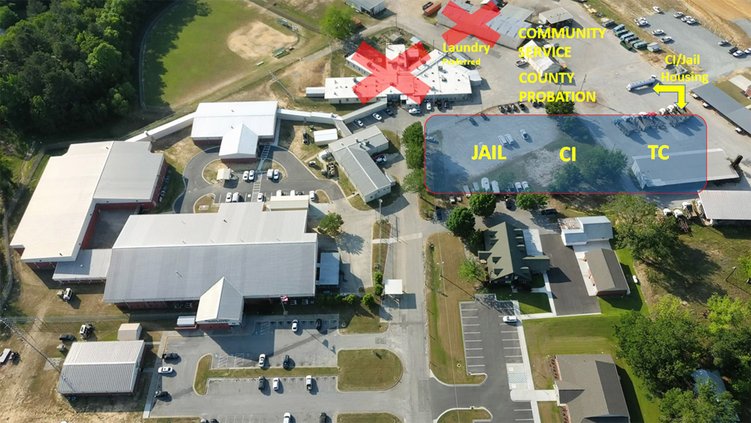
Sheriff Noel Brown and Bulloch County Correctional Institution Warden Randy Tillman now propose a shared expansion of the Bulloch County Jail and replacement of neighboring BCCI plus the addition of a transitional center for state inmates in the final months of their sentences.
To be clear, BCCI – which is a prison, owned and operated by the county but housing state inmates – would continue to operate as such but would have new dormitories and headquarters inside the three-part shared facility.
Suggested to have about 750 beds and be expandable, this new portion of the Bulloch County Law Enforcement-Public Works Complex would be built on the grounds of the Sheriff’s Office and Jail and BCCI off U.S. 301 North. After it is built, the correctional institution’s existing 160-bed dormitory buildings, including the oldest portion built in 1946 as the Bulloch County Public Works Camp, could be torn down to make room for future buildings or parking.
Tillman outlined the shared proposal, also involving the county’s Public Works Department, with a slide show March 22 during the Bulloch County Board of Commissioners’ two-day budgeting retreat. The Statesboro Herald talked to him, Sheriff Brown and Chief Deputy Bill Black briefly that day and interviewed them further last week.
“That’s us, the Sheriff’s Office, working with not only our county commission but our warden, to try to bring together something that will work for all involved,” Brown said.
Expansion of the jail to accommodate a growing county population has been a topic of discussion and occasional controversy among Bulloch County officials throughout Brown’s tenure. First elected in 2016, he took office in early 2017 followed closely by discussions for adding more jail “pods,” or dormitory cell halls, to relieve crowding.
By spring 2018, this evolved into a county proposal to close BCCI, end its contractual commitment to house state prisoners and use its dormitories for county jail and possibly federal inmates. But that idea was abandoned by fall 2019, at least in part because the sheriff could not guarantee that enough local inmates would be willing to serve in work details to meet the needs of local government agencies.
Inmate workers
Many residents of the county jail are awaiting trial and not available to work, while others, remaining here right after sentencing, are unwilling or have few skills, Brown and Black explained.
But state inmates, serving longer sentences at BCCI, supply much of the county Road Department’s workforce. Others provide labor for other county departments, performing tasks from office cleaning and basic maintenance of buildings and grounds to moving voting equipment. At times they also assist the city governments.
This “public works” aspect is also part of the reasoning behind the suggested addition of a transitional center.
Transitional centers – such as a state-operated one at Claxton – house state inmates in the final months of their sentences while they receive counseling and work at jobs with public or private employers outside the facility. They receive modest pay, a portion of which goes to the transitional center as rent.
Tillman, BCCI warden since August 2018 but whose 37 years in corrections also included a tenure as the Georgia Department of Corrections’ director of prisons, said there are other reasons to have a local transitional center.
“Keeping in mind that 95 percent of the incarcerated people in Georgia are going to come home – they’re gong to be our neighbors – so, do we want them to come home getting off the bus with a $25 debit card, which is what the state gives them now, and one set of clothes?” Tillman said.
“Or do we want to bring a select few that meet the criteria back to this new transitional center, give them a job, give them some more counseling classes, routine drug tests, they go to work, they come back to spend the night, their money comes to us, they pay room and board …,” he said, “and hopefully they’re much better citizens when they do go home.”
State inmates would arrive at the center in the last 15-18 months of their sentences, and with 30-50 beds, it would serve Bulloch and neighboring counties, he said.
Sheriff Brown proposes coordinating this program also with the county Probation Department to supply transitional, probationer and community service labor for local government agencies.
This plan “kills several birds with one stone,” Brown said. “It will not only help our Recreation Department, our Public Works, our 911. It helps out most everybody in county government with the fact that you will be able to supply them some type of worker inmate.”
Jail ‘full’ at 80%
Bulloch County Correctional Institution is operating at full capacity, with 160 inmates, all men. It would not expand, but would instead have all its sleeping quarters and headquarters replaced. One area that might be preserved is the relatively newer kitchen with which a contracted food service, employing BCCI inmates, serves both BCCI and the county jail.
As part of their conceptual master plan, Brown and Tillman suggest creating a shared laundry, operated by inmate labor, to serve both the jail and the C.I. They currently have separate laundries. Other suggested features of the plan include a coroner’s office and morgue and an expanded public works shop and equipment area.
Unlike the C.I., the jail housing would be expanded, not replaced, by the proposed addition. Brown talks about adding a 500-bed jail pod, and a roughly 750-bed addition, minus 160 beds for the C.I. and about 50 for the transitional center, would accomplish that.
By adding to the existing facility, it would also create about a more than 900-bed jail.
The existing Bulloch County Jail officially has 466 beds. But a correctional facility, and especially a jail with dormitories for men and women, is operationally full at 80-85% capacity, Tillman said.
If a jail has two 50-inmate female dorms and receives 51 women, 49 beds are lost to receiving male inmates, Black explained. Other beds can be lost to the need to keep inmates separate because they are co-defendants or gang members, become violent or have a mental health diagnosis, Brown said.
In the past few weeks, the Bulloch County Jail has held 351 inmates in-house, while 21-22 others are held for Bulloch on contract by the Jenkins County Jail. That’s 75% of capacity in-house, and the Bulloch Jail would be at 80% theoretical capacity if the inmates held in the neighboring county were returned.
Brown, elected to a second four-year term in 2020 and planning to seek re-election again next year, said he wants to see the county update its facilities and build for future needs.
Future needs
“We want to work for a vision to where whoever may come in in years to come – we’re talking five, 10 years down the road; nobody knows what may happen to me …,” he said. “We want to make things look better. We want somebody to be able to walk in and be able to see in front of them instead of behind them.”
He said he realizes that the growth in criminal justice needs has also created demands on the courts, such as for expansion of the Judicial Annex, that the county must also address. But Brown notes that the county’s population was growing long before Hyundai Motor Group just last year announced the construction of a massive factory in the region, leading to other industries coming here.
“It’s sometimes sad and it hurts me to say now we’re playing catch-up, but taxes in the future, if the millage rate goes up by the county commissioners, this is not the fault of the county commission, it’s not the fault of any department in the county government or any of the four constitutional officers …,” Brown said. “It’s really the fault of the growth we’ve had since about 2000 and nothing was done about catching up, and now, guess what, we’re trying to catch up.”
Planning and cost
But the sheriff’s and warden’s concept is far from a final plan, so County Manager Tom Couch suggested that the architectural and engineering firm Goodwyn Mills Cawood, or GMC do what he called “a preface to a pre-design study” on the concept and site. The Board of Commissioners unanimously approved a contract Tuesday for GMC to do this preliminary work for $33,000.
“Then we’ve got to figure out how we’re going to end up paying for (the overall project) because, I mean, everything is needed, desperately, now,” Couch said last week. “But a C.I. and a transition center and a … morgue, and trying to decommission other buildings like the old C.I., it’s a big program, and I have no doubt it would be tens of millions of dollars.”
Pressed for a more precise-sounding guess, he said it wouldn’t be surprised if the cost reaches $50 million.
With the population growth now occurring and the needs and requests of various agencies, the county government may have to look beyond the next Special Purpose Local Option Sales Tax referendum, in 2024 or 2025, and also consider a separate, general obligation bond referendum, Couch said.
“That’s why we’ve got to figure these things out because whether it’s judicial complex, an indoor recreation center or a jail pod/transition center and all the other stuff, these are significant and large expenses that we’re going to have to work into our financial model. …,” he said. “They’re things we have to have and the public expects.”