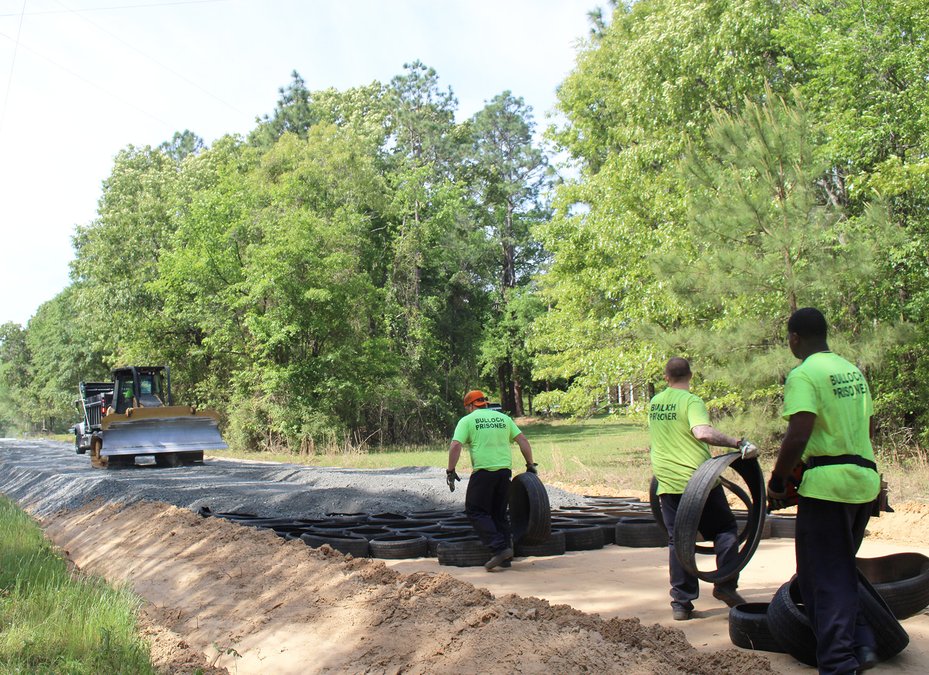
“Cylinders” of tires, their treads previously worn down from rolling over highways and roads, became part of the structure of a half mile of Bulloch County dirt road this week in a $250,000 state grant-funded pilot project.
County officials said that the Tire Products Grant from the Georgia Environmental Protection Division, or EPD, more-or-less completely covered the cost of the project along a 0.58-mile, often previously washed-out portion of Five Chop Road.
“Well, really this is about saving money for the county,” Chairman David Bennett of the Bulloch County commissioners told reporters. “We got a grant from the state for $250,000 to come out here and use these recycled tires that they’re now calling cylinders to interlock, basically, and hold the aggregate, the rock, in the road.”
Some definitions are in order here. The road base structure being created is called Mechanical Concrete, marketed under trademark by Century Road Solutions, which reportedly holds a patent on the process. “Aggregate” is the chunky or fine solid material used in a mix for making concrete, but in this case it’s simply crushed rock, in other words, gravel.
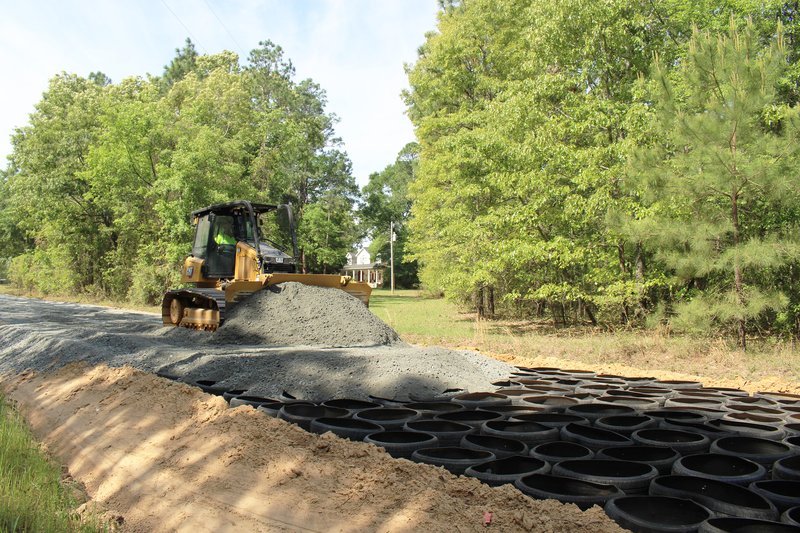
The “cylinders” are old tires with the sidewalls removed by Liberty Tire Recycling, which is furnishing them for use in Century Road Solutions’ process. The process involves linking these cylinders of generally steel-mesh reinforced rubber to form a matrix with the holes up and then filling all the cylinders with the aggregate.
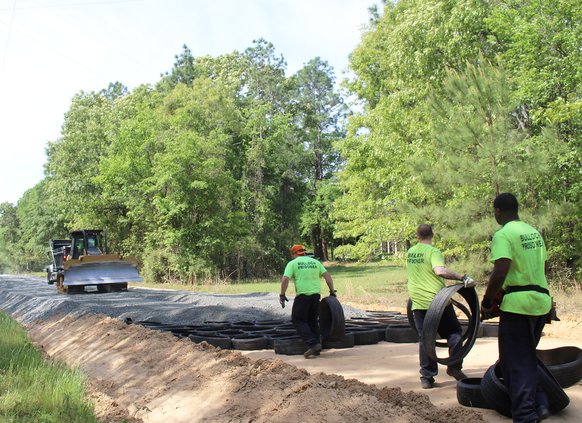
Here, inmates from Bulloch County Correctional Institution – the county-owned prison that houses Georgia Department of Corrections inmates under contract – were removing the tires from the back of a truck, rapidly laying them in a scooped-out, channel-like section of the road and stapling them together with a big staple gun.
Then, a bulldozer plowed into a pile of gravel deposited by a dump truck further up the road and scooted the gravel forward so that it fell in and filled some of the expanse of tire cylinders. The operator apparently knew just where to stop so that the advancing gravel fill supported the dozer without going too far and squashing unfilled cylinders. Later, the dozer would spread more gravel on top and help to compact it.
County staff had invited local news media to meet Bennett and representatives of Century Road Solutions and Liberty Tire Solutions, as the county’s “grant partners” Wednesday morning, April 8, near the intersection of Five Chop and Mill Creek Road.
600+ dirt road miles
Bennett said he saw several positives for the county.
“One, it’s thinking outside the box and trying something new, working with the state; they’re funding this project for us so that it’s at no expense to the taxpayer,” he said.
“And what we’re really excited about is, with us having as many miles of dirt roads, 638 miles of dirt roads in Bulloch County that require a lot of maintenance,” Bennett continued, “if you can come out here and put this down and you don’t have to work on that as much … that saves the taxpayer money.”
While the dump truck and bulldozer were in use nearby, he noted that these and the motor graders than routinely plow the dirt roads all require diesel fuel, for which he cited a current price of around $5.49 a gallon.
The Statesboro Herald asked for a comparison of the tire-reinforced aggregate process – apparently $250,000 for a little over half a mile, so the equivalent of nearly $500,000 per mile in this trial run – to actually paving a mile of road.
“Paving a mile, the cost right now is about $1 million a mile,” Bennett said. “We’re looking at there’s some economy of scale that goes with this as you start spreading this out and doing more, it gets a little bit cheaper.”
The state offers similar grants every year, and Bulloch County’s leadership plans to continue to apply for them and “use this same method in places where we know that we have challenges maintaining our roads,” he added.
Inmate workforce
Instead of contracting out the work as typical for paving projects, the county was using inmate labor. BCCI inmates are regularly deployed by the county for basic road maintenance and in some county building renovations and cleanup work.
“One of the good things about this, though, is like many other projects that we do here in the county, we’re using inmate labor to do it, and that inmate labor, you know, that’s an expense that we’re not having to pay out to have extra hands,” Bennett said.
History of process
Also interviewed on site, Century Road Solutions CEO Mike Getz said the Mechanical Concrete process was first applied to a road reinforcement project 15 years ago in coal country.
“The first one was a coal-mining road in West Virginia,” Getz said. “It’s a mile long, they were repairing it weekly because 300,000-pound trucks, 80 a day were going down it, tearing it up. We stopped it for six days, built a mile road with Mechanical Concrete in six days, 15 years ago, and today it’s still like brand new.”
In that project, after this process was used for the road base, the coal road was paved, he acknowledged. So far, the pilot project on Five Chop Road just has compacted gravel, but no tar or sealant. The purpose of the buried tire cylinders is to hold the base aggregate in place, thus “mechanical” concrete.
“You can put asphalt on it, you can put pavement or nothing on it,” Getz said “You have three options.”
Asphalt is petroleum tar, used to bind aggregate in typical paving projects. Often when people say “asphalt,” they mean the combination of the binder and aggregate.
Century Road Solutions’ first Mechanical Concrete road project in Georgia, one in Meriwether County, used only “a wrap, like a covering to keep the dust down,” said Getz. “It’s almost like asphalt, but it’s just a real thin layer.”
Bennett said he had talked to some Meriwether County commissioners and heard the repurposed tire process had been used there “with a good deal of success.”
Lots of scrap tires
Also interviewed in the roadside press conference, Doug Carlson, vice president for asphalt products at Liberty Tire Recycling, said the company collects and processes about 10 million scrap tires annually “in and around Georgia.”
He works primarily with the asphalt rubber material or asphalt-concrete mix, which are more widely established. Liberty has a rubberized asphalt plant in Jackson, Georgia, supplying the state Department of Transportation about 3 million pounds of material for highway paving projects annually, he said. For the asphalt mix process, scrap tires are ground to a fine powder and the steel is removed with magnets and the fiber vacuumed out, leaving only the powdered rubber.
The process being used here, which he called “tire cylinder Mechanical Concrete” is relatively new for his company, with maybe about 20,000 tires repurposed this way so far, Carlson estimated.
“But there’s a lot of dirt roads in Georgia that need improvement, and this technology fits in very nicely,” Carlson said. “So hopefully someday, my angle is that if we have a chance we can cover this with some rubberized asphalt. That’s what I would do.”
County Engineer Ron Nelson, who heads the county government’s engineering office, was asked if the county has plans to top this road segment with a coating or pavement. He said that will be up to the county leadership, such as the commissioners.
Bennett indicated that county officials also hope to interest Georgia Southern University researchers in the pilot project. The university’s Civil Engineering & Construction Department has research programs on asphalt use and road maintenance.
“We’d like to partner with them and have them study this as well, and if we find that this is effective and beneficial, it’s something that we’ll continue on,” he said. “Of course, we’re going to try to get every bit of state money that we can to do it because that’s funding that doesn’t have to come from property taxes.”