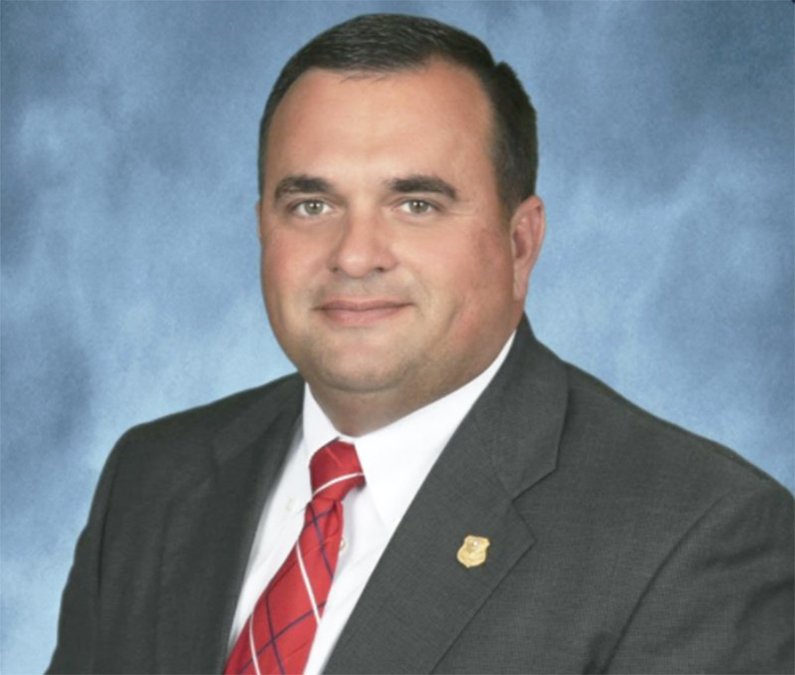
GBI Special Agent (292) Tracy Dale Sands passed away this past Saturday morning, August 30, 2025, at his home in Glennville. The unofficial cause of death was sudden cardiac issue. Tracy was 54 years old and a legend in investigative law enforcement in Tattnall County and Southeast Georgia.
The news of his death circulated rapidly, and shocked friends asked each other if they were aware of any pre-existing conditions. All said that they knew of no medical issues, and virtually everyone said that Tracy was looking forward to retirement. Former GBI agent Cyrus Purdiman, who worked with Tracy in the Statesboro office, stated that he thought he might have been suffering from indigestion, but added, “In our business, indigestion is common.”
Major Kevin Keyfauver of the Tattnall County Sheriff’s Office said that he saw Tracy a few days ago, and he looked healthy as a horse.
“I think he would have liked to have his retirement clock speeded up, but other than that, he was the same Tracy that we all know and respected.”
When asked about Tracy’s contributions to local law enforcement and Tattnall County, one theme became evident. He was the consummate professional who studied and learned the requirements for success in his profession and passed them on to generations of new law enforcement professionals.
“He had the skills of a highly intelligent investigator, and he was a teacher,” Major Keyfauver said. “Early in my career, we worked out of the same office. I literally sat directly across from him, and it was a case of the student learning from the professor. He was really good at what he did.
"He stressed the accuracy of the investigation and documentation when trying to take a criminal off the street. I have been in interrogations where he was just listening, and he would call me outside and say, ‘Ask him about this or that,’ and it would be something that would trip the suspect before he realized it. If we had all the law enforcement personnel who he taught the fundamentals and techniques of investigation in one gathering, I don’t know how much space would be required to house them. I know we will have a lot of good investigative agents in the future, but there won’t be another Tracy Sands. He was a perfectionist, he believed in what he was doing, he knew what he was doing, and he trained a lot of good people how to do it. We will miss him.”
Many years ago, this writer witnessed a drug search at the Tattnall County Alternative School on the old Reidsville High School Campus. As a member of the Drug Task Force, Tracy was in charge of the search instigated by suspicions that an 18-year-old student was dealing. Nothing was found on the premises, and during a recorded interrogation, the individual answered every question with a distinct smugness that seemed to increase as the interview progressed. Tracy proceeded with a calm demeanor, and, finally, he said softly, “Take off your shoes.”
The smugness evaporated. Tracy reached in the shoes and removed two sizable bags of marijuana. The accused individual’s eyes were the size of quarters as Tracy said softly, “You have the right to remain silent…”
Throughout the years of my association with Tracy, I sensed that there was no such thing as “idle conversation.” He always seemed focused and listening, intently.
As Special Agent in Charge at the Statesboro Office, Cyrus Purdiman said he sometimes had complaints from attorneys that Tracy had not provided investigative details to them in a timely manner.
“That was easy to defend. I’d tell them right up front that if they were supposed to have evidence at a certain time from Tracy Sands, they received it before or on time. Some agents might be late. Sometimes I might have been late, but not Tracy. He would have it done on time; and it would be complete. He just didn’t operate like that.”
Former Sheriff of Evans County, Randal Tippins, said that Tracy was just the best he’d seen.
“He was an honorable man, but he was serious about getting criminals off the street. When he was working undercover with the Drug Task Force, local drug peddlers liked to get the buyer out of his/her vehicle and away from it when making a sale. It was better to remain inside where the transaction could be recorded easier, so John Edwards called me and told me he needed a wheelchair. When I asked why, he said Tracy wanted it. Randal came up with one, and Tracy hauled it around in the back of his vehicle for several months. He told the drug dealers that he had bad knees and couldn’t walk and pointed to the wheelchair. It worked. They nicknamed him Crip. Several times, we walked into court and you’d hear them say, “There’s old Crip. Wait a minute. He ain’t crippled; that joker lied to us!”
Randal recalled a recent murder case after he retired, and he tried to get in touch with some of his old street contacts to help get some information. A day or two later, he found out that Tracy had been assigned the case, and he called off his efforts.
“I didn’t worry about it again; I knew it would be taken care of.” It was.
“I remember how Tracy was so meticulous in documenting all evidence. Lots of times I’d say, ‘we have enough.’ His answer was it was impossible to have too much.”
Perhaps no one was closer to Tracy than John Edwards, a retired Statesboro GBI Crime Scene Investigator who has authored several books on crime investigation. John was kind enough to provide specific details of Tracy’s career. The following is a partial list of quotations from those details.
“Tracy started his law enforcement journey as a Georgia Southern University intern with the Tri-Circuit Drug Task force, and when hired as an agent, he worked his way up to assistant commander,” said Edwards.
“Next, he was promoted to his lifelong career as a Special Agent at GBI in Statesboro where he developed a reputation as one of the finest investigators in the state. I talked to him many times about pursuing a supervisory role, but he would rather shape the world around him at the investigatory level.” (Specifically, he didn’t want to shuffle paperwork and sit behind a desk. He preferred to participate at the level where he thought he could do the most good.)
“As a result, he mentored and trained many young agents, teaching the dynamic strategies and complex tactics of the investigative process.
“He instilled in them the importance of following the law, respecting the courts, and doing the job right.
“He trained them that case preparation began the moment they stepped out of their vehicles. Most of all, he taught them how to think.
“His professionalism, humility, kindness, competence, and sense of service set him apart.
“He called me last week to talk about the high-profile murder trial that had resulted in a conviction. I could hear the sense of duty in his voice and feel the pride resonating from him, a feeling we all share when we wear justice like a precious robe.
“Tracy earned awards for his tremendous efforts in investigations with the GBI. His insight was instrumental in the publication of two books, Inside the minds, Innovative Criminal Investigations and Homicide Praxis, where his expertise was shared with law enforcement nationwide. I am honored, blessed, and thankful to have known him well,” said Edwards.
In the eyes of Tracy’s peers, Major Kevin Keyfauver said it precisely.
“There won’t be another Tracy Sands.” We all were safer as a result of his dedication, and his friends and associates are better for having known him. Godspeed Tracy Sands.
Ronald E. McCall is a writer for the Journal-Sentinel newspaper, a sister paper of the Statesboro Herald.