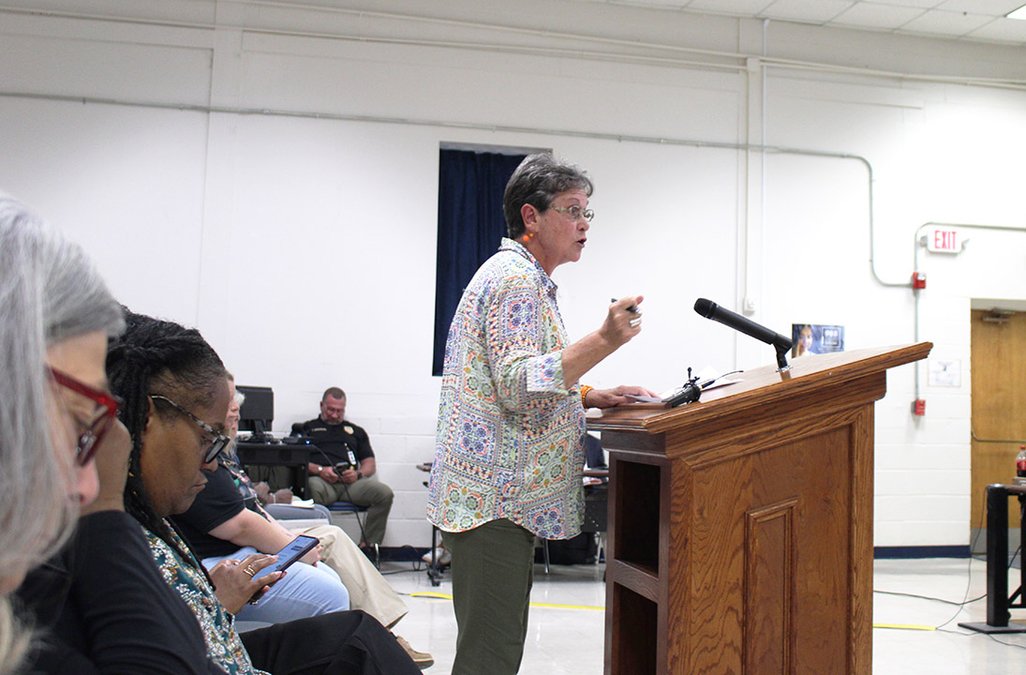
It was unusual to hear “Please raise the millage rate” spoken as a public comment during a meeting about taxes in Bulloch County.
But that phrase was voiced several times as most by far – but not all – of the 25 people who spoke to the Board of Education during Wednesday evening’s special meeting indicated they preferred a property tax increase to eliminating around 125 teaching jobs and closing the Transitions Learning Center, or TLC, alternative school. That majority of speakers appear to have got what they wanted when the eight-member elected board voted 5-3 near the end of the almost three-hour meeting to increase the school maintenance and operations millage rate roughly three mills, to 10.4. But legally that was “tentative” rate adoption, with the board now required to have three tax increase hearings, slated for Thursday, Aug. 14, at 12 noon and then Aug. 21 at both 9 a.m. and 6 p.m., before a final vote, slated for the Aug. 21 board meeting.
A projection of what the rate hike would cost “average” individual taxpayers appears at the end of this story.
Also, for context, the board’s Thursday meeting began at 4 p.m. in the William James Educational Complex, which is shared by the TLC and the Bulloch County Schools central offices, and TLC personnel and teachers from other schools made up a large segment of the crowd.
Additionally, board members reported receiving many texts, emails, calls and, at least some them, face-to-face conversations from community residents about the proposal. Board Chair Elizabeth “Liz” Williams said she appreciated everyone who had shared their thoughts.
“After I looked at all the communications and I have listened and reflected on what was said, I concluded that the conversations I had gotten fall into one of three categories,” she said. “There are people who support a 3-mill increase with rationales of how a lack of the increase will impact the classroom and ultimately the children. That’s one category.”
The second group she identified consisted of “those who do not support a millage rate increase because the taxes keep going up around them and it’s creating a financial strain.”
Her third category “would be those who support a millage rate increase, and they have the same rationale as Group 1, but they’ve also indicated that there’s a need to eliminate some positions and some costly supports,” Williams said. “We are challenged as a board to find a balance between the millage rate increase and making the necessary cuts in our ’26-’27 budget year.”
Of the people who spoke to the board during public comments time, more than 20 seemed to be in Williams’ Group 1, with some hints of Group 3.
Instructional coaches
First to speak was Tracy Hartwell, one of 11 instructional coaches who had been informed that, although they have those jobs in the district through the current school year, then will not after next June 30.
“I urge our board members and our community members to envision how not investing right now in our school system will affect our community in the next five to 10 years,” Hartwell said. “This deficit has and will continue to require layoffs of teachers, paraprofessionals, intervention specialists and instructional coaches. This will increase class sizes, reduce differentiation and diminish the instructional quality, which is particularly going to affect students who need that extra support. …”
Whether the school district’s centrally based instructional coaches could see their jobs continued after this year because of the millage increase remains to be seen. Superintendent of Schools Charles Wilson noted that these positions were created with COVID pandemic-era federal grants and said the tax increase would still leave a need to cut $3 million or more in spending from next year’s budget. With 1 mill of tax currently netting the school district about $3.8 million, the 3 mills could bring in around $11.4 million, potentially reducing the predicted $15 million “deficit” of next year to under $4 million.
But by being put in effect this year, the tax hike could also reduce the $13.2 million budgeted to be spent from the school system’s carried-over general fund balance in fiscal year 2026 to about $2 million, leaving a reserve of around $35 million.
TLC speaks for itself
Kristina Staudt, special education teacher at TLC, was the first of several speakers representing that alternative-school program, which she said helps students who would otherwise be expelled stay in school and find paths forward and “a real chance to graduate.” She gave several anonymous examples.
“A student permanently expelled in eighth grade is now set to graduate … this January. Another who came to TLC behind in credits caught up and graduated with their cohort. A student who came to TLC in ninth grade with a lifetime expulsion and years of trauma finished high school and graduated,” Staudt said. “A disengaged eighth-grader found their smile again and returned to their base school stronger, ready to re-engage. …”
She concluded her remarks, “Please, raise the millage rate, invest in our students’ second chances, protect our program.”
Roughly as many citizens who were not school employees as school personnel spoke, including some parents, grandparents and a few citizens describing themselves as “school advocates.”
Dr. Lavonda Jones spoke on behalf of the Bulloch County NAACP.
“It is our position that the district needs to continue to provide the same level of support to all of our students,” she said, and asked the board members “to be bold and be courageous, support a modest millage rate increase.”
Jennifer Davis didn’t mention that she is president and CEO of the Statesboro-Bulloch County Chamber of Commerce, but identified herself as the mother of a son who recently graduated from Statesboro High after receiving valuable support from the SHS “village” and who will soon be attending Georgia Southern.
“As such, as a resident, I will always support investing in our school system, even decades from now,” Davis said. “As a member of this Board of Education, your responsibility lies in the improvement of schools and the academic achievement of all students. Your role is not to kick the can down the road, putting jobs and programs in limbo to represent the vocal minority.… We want to know that our schools will be funded responsibly, today – not six months or a year from now.”
Statesboro City Manager Charles Penny said he was speaking to the board as a citizen and Bulloch County taxpayer.
“Schools determine if people want to live in our community, and tonight you will make a financial decision that determines if our school system remains competitive with the rest of the region,” he said in part.
Those opposed
Only two of the community speakers were more or less clearly opposing a tax increase at this time.
The clearest “no” came from Lawton Sack, one of the co-founders of the Bulloch Action Coalition.
“I come here tonight asking you to set aside emotion and look at the facts,” Sack said. “Madame Chair, I actually fall into a fourth group. I am somebody that is for keeping property taxes low, but over the last two years I’ve worked with this Board of Education and elected officials at the state to find solutions, and I have committed to do that.”
He said he is currently working with Sen. Blake Tillery, R-Vidalia, chair of the Georgia Senate Appropriations Committee, and other state legislators “to find solutions to these cuts that have been made, but we need time to be able to do that.”
By “cuts” he was referring to Bulloch County’s loss of a portion of its state school funding this year. But this was not the result of any statewide cut. As Wilson and Chief Financial Officer Alison Boatright explained last spring, the Bulloch County Schools’ state equalization grant decreased by $5.9 million because of the county’s increased wealth as seen in rising property values, which also contributed to a $2 million increase in the district’s required 5-mill “fair share” as the value of a mill rose. Meanwhile, the school district staff projected a $1 million loss in local property tax revenue to the House Bill 581 tax relief legislation.
Sack said the local Board of Education “is sitting on $46 million of taxpayer money” and that he believed these fund balances or reserves allowed a least a year, or he believed “two, maybe even three,” to find solutions without raising the tax rate.
Three of the board members themselves were in the “no” camp, opposed to altering course for a millage rate increase this year, after they had approved the fiscal year 2025-2026 budget in June with a built-in presumption of a rollback from last year’s 7.932 mills to 7.446 mills. That “rollback rate,” sufficient to counteract inflation in average property values in the year’s tax assessments would have averted tax increase hearings.
“We approved the budget, we voted on it unanimously and approved it, and we told the taxpayers we were doing one thing. Now we’re coming back and changing it,” said District 7 board member Lisha Nevil, a retired teacher. “I personally have a big problem with that. I feel like until last Thursday night (July 24) we had a budget set and that we had told the taxpayers what we were doing, it was just a matter of voting on it (the rollback millage rate). … I am not in any way, and I resent the (insinuation) that anyone that goes against the grain of what’s been being said does not care about children.”
Board member Jay Cook made the motion for the increase, seconded by Donna Clifton, and members Glennera Martin, Maurice Hill and Williams joined in voting “yes.”
Board members Lannie Lanier, Jennifer C. Mock and Nevil voted “no.”
A mill is 1/1000th the assessed value of property, with most in Georgia assessed at 40% of market value. So a 3-mill hike would be $300 added tax on $250,000 worth of non-exempt property.
Boatright cited slightly different values to state that the increase in tax will be approximately $349 on an “average homestead property” (market value $300,000) and $325 added tax on an “average non-homestead property” (market value $275,000).