

Tens of millions of people across North America witnessed the moon block out the sun during a total solar eclipse Monday.
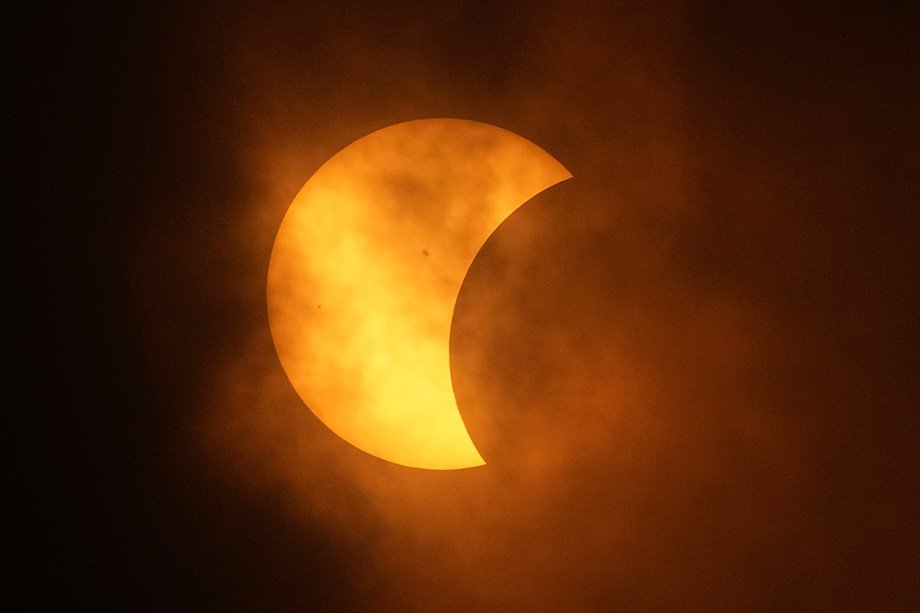
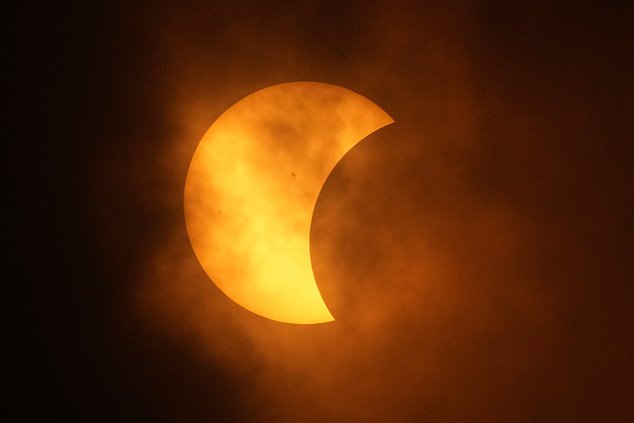
While the Statesboro/Bulloch County area was not in the direct path, the eclipse reached about 70 percent coverage here at 3:07 p.m. Monday afternoon. And unlike in August 2017, when thick cloud cover obscured the 97-percent pinnacle of the eclipse in the area, Monday’s skies were clear, allowing locals to enjoy fully the viewing of the partial eclipse.
In Statesboro, the eclipse began at 1:49 p.m., peaked at 3:07 p.m. and ended at 4:22 p.m. Area residents could be seen coming out of their offices at various times to follow the 78-minute trek of the sun being blocked by the moon.
On the Georgia Southern University campus, viewing glasses that were safe to use to look directly at the eclipse were handed out to any students or others who wished to view the eclipse.


The path of total darkness — where the moon lines up perfectly between the Earth and the sun, blotting out all sunlight — crossed parts of 15 states: Texas, Oklahoma, Arkansas, Missouri, Illinois, Tennessee, Kentucky, Indiana, Ohio, Michigan, Pennsylvania, New York, Vermont, New Hampshire and Maine.
The peak spectacle of total darkness in each lasted for about 4 minutes, 28 seconds — a 115-mile-wide path that sliced across the continent. Most of the rest of the continent outside the path of totality viewed a partial eclipse, including the Statesboro/Bulloch area.
Total solar eclipses happen somewhere around the world every 11 to 18 months, but they don't often cross paths with millions of people.
In fact, National Air and Space Museum curator Teasel Muir-Harmony said: “This may be the most viewed astronomical event in history.”
The U.S. last got a taste in 2017, and won’t again see a coast-to-coast eclipse until 2045, which will stretch from Northern California all the way to Cape Canaveral, Florida.
The next total solar eclipse, in 2026, will occur along the northern fringes of Greenland, Iceland and Spain.
But the next total eclipse that will occur in the Statesboro/Bulloch area won’t happen until 2052 – March 30, 2052, to be exact.
North America won’t experience totality again until 2033, with Alaska getting sole dibs. Then that’s it until 2044, when totality will be confined to Western Canada, Montana and North Dakota.