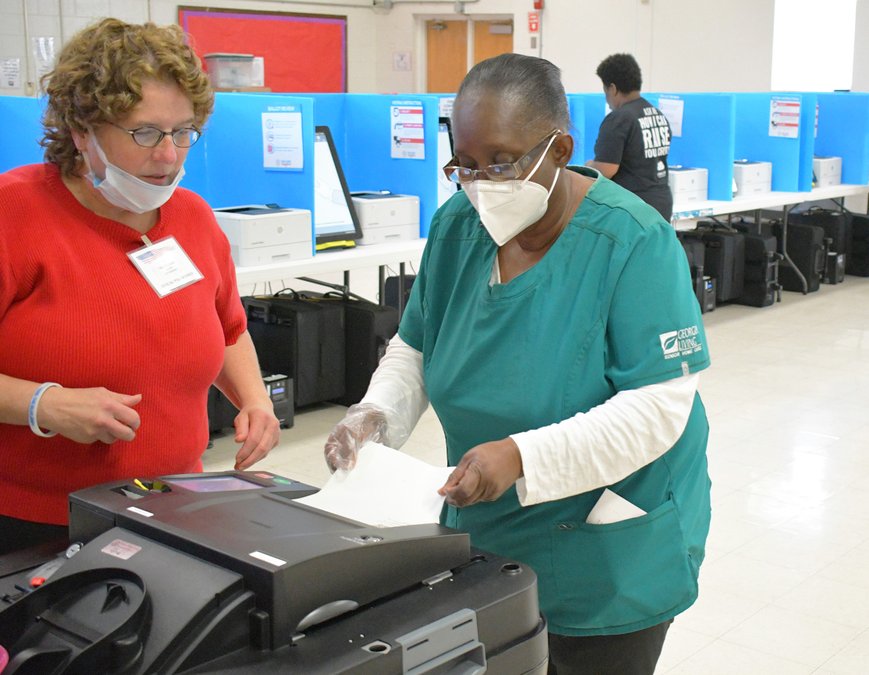
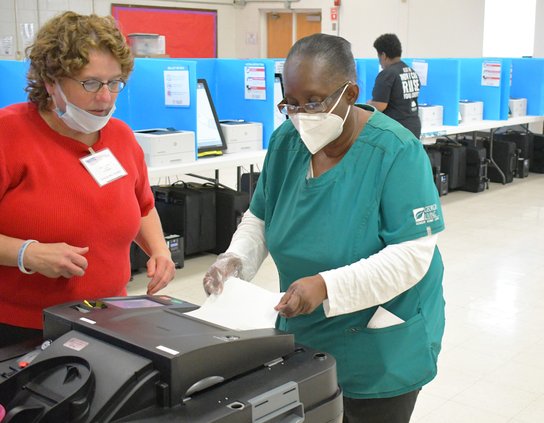
Become a poll worker
Go to securevotega.com/pollworker-signup/
Or call Bulloch County Elections Office: (912) 764-6502
Election Day is still more than three months away and Shontay Jones, election supervisor for Bulloch County, is focusing on making voting easy, efficient and secure for Bulloch’s approximately 45,000 registered voters.
But Jones and elections officials across Georgia and the nation are all facing a similar stumbling block – a shortage of poll workers. Bulloch simply needs more people to staff its 16 precincts on Election Day, November 8, Jones said.
“Bulloch County, like other counties in Georgia, is experiencing poll worker shortages greatly,” she said. “Without them there would be no election day voting. We must support and applaud the work they do and what they endure to carry out this process, as they are very underappreciated.”
Jones said 86 workers staffed the polls for the May 24 primary election when about 7,500 people voted in person
During Georgia’s last gubernatorial election in 2018, about 11,000 Bulloch County residents voted in person on Election Day, November 6 of that year. Jones expects at least that many on Nov. 8, and probably more. She said the county will need 30 to 50 more poll workers for Nov. 8 in addition to the 86 that worked on the May primary.
“With the last couple of elections, we have had poll workers to commit, then call out because of health, surgeries or family reasons,” said Jones, who became election supervisor in July 2021 and has worked for Bulloch elections for 23 years. “So having more than enough to me would always be the goal because you never know when you will get a call from a poll worker saying I cannot work (election day), but you know the election must go on in spite of.”
While Bulloch County and many election offices in Georgia and the U.S. have always had to work hard to recruit enough poll workers, the task has become even more difficult since the COVID pandemic struck in March 20 and amid the controversy of the 2020 presidential election.
Jones believes a combination of factors have contributed to creating the shortage.
“COVID had a lot to do with the shortages as most of the poll workers statewide were aged and caused understandable concerns as a vulnerable population being exposed to COVID,” she said.
“Also, COVID put a freeze on in-person contact with regards to hiring new poll workers. And currently COVID is still very present in different variants. But I also think for some it made people value their families more and not wanting to commit to everything that goes into preparing for an election, let alone the possibility of four to six elections in a General Election year.
“Then you add the threats, speculation and theories that are centered around the elections. Now, you have new laws and voting procedures that changed and everything you do and say is under a microscope.
“That is a lot to absorb for anyone, especially when all these things mentioned are beyond our control and is open to an individual’s own perception.”
Andrew Pelt is retired military and he became a poll worker for the 2018 election. He is now the poll manager for the Bay Precinct in Pembroke. He said he decided to become a poll worker for a number of reasons.
“I like being around people and I was looking for some more knowledge about the local electoral process,” he said. “To me, it’s more about civic duty. Somebody has to do it. I know some people are hesitant because some have accused us of rigging things. Well, we can’t rig anything. I’ve trained with the system. We can’t do anything like that. We just go do our jobs.”
Becoming a poll worker
To serve as a poll worker, you must be 16 years of age or over and able to read, write and speak English. You must be a resident or employee of the county where you serve as a poll worker or have permission from your county’s election office. Poll workers are hired and trained by Georgia’s 159 counties. While pay rates vary by county, poll workers generally earn about $60 – $140 per day.
All hiring and staffing decisions are made by the individual county. For anyone interested in serving as a poll worker, online applications are available at securevotega.com/pollworker-signup/. Also, you may contact the Bulloch elections office in person at 113 North Main St. or call (912) 764-6502.
Finding more poll workers
Jones said she has had discussions with Bulloch Board of Elections members, colleagues around the state and her staff about ways to attract more poll workers, but she doesn’t see any easy solutions.
“Being a public servant takes the will to want to serve under unforeseen circumstances,” she said. “In my experience, there are benefits when you see everyday people you know. (You can build) a trust or fellowship at a precinct and sometimes brings about a calm or a mutual respect for the task at hand.”
Pelt agrees with Jones.
“You have to really want to be a poll worker and be there as someone who wants to help the voting process and the voters who come out,” Pelt said. “It’s an important role, but you have to want to do it.”