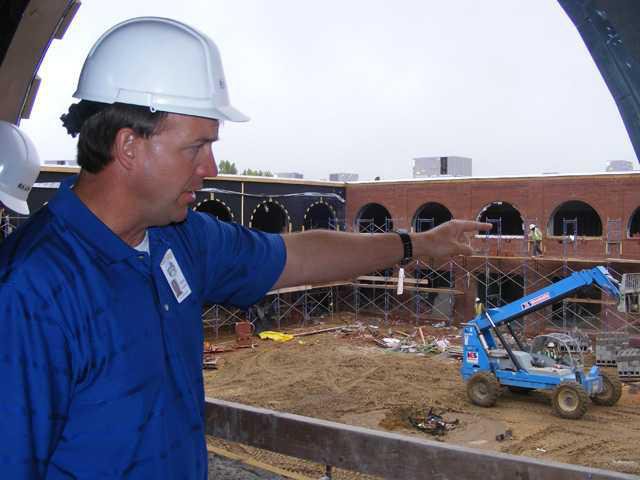
If all goes as planned, with fair weather and a favorable fire marshal, Metter Elementary School and Metter Intermediate School will move into a new $32 million megaschool for prekindergarten through eighth grade when classes resume in August.
Metter Middle School will join them after Christmas break, pushing enrollment in the 270,000-square-foot, two-story building past the 1,600-student mark. An elevated walkway will link the massive new complex to the Metter High School building, completed 12 years ago. So Candler County’s school system, with more than 2,100 students, will occupy a single campus, on a curve of Georgia Highway 129 just south of Interstate 16, as of January.
At this point, the Pre-K-8 Educational Complex is still very much a work in progress. But the portion for Pre-K-5 is obviously closer to being done than the grades 6-8 middle school portion, which has yet to get a complete roof to stop rain from drizzling through the metal decking.
A news release at the school system’s website, www.metter.org, cited rain as a reason for the Candler County Board of Education’s decision in March to split the scheduled move into the school. The previous plan had been for all the grades to move in this summer.
Weather remains one of several factors that could interfere with the move-in by prekindergarten through the fifth grades for the Aug. 8 start of school. Derek Smith, senior project manager for RA-LIN and Associates, noted that 2 more inches of rain fell in two days last week.
“I’m very confident that if we have the weather that we anticipate this time of year that they will move in, that we will be able to put them in school, with a caveat: I have no control of what the good Lord does,” Smith said.
He observed that rain in the past year has far exceeded the average and that RA-LIN has brought the work this far in 13 months on what was planned as a 21-month project. RA-LIN, based in Carrollton, is both project management firm and lead contractor for the complex, designed by James W. Buckley & Associates of Swainsboro.
“We are working six, seven days a week to get those kids in school from Pre-K through 5 on the elementary side for the start of the school year,” Smith said.
But he acknowledged that other factors also remain beyond the company’s control. Before teachers and students may occupy even a portion of the building, the State Fire Marshal’s Office must issue a permit. This will require approval of a partition dividing the part to be occupied from the part still under construction, and assurance that safety systems work in the completed part.
Additionally, paving has yet to begin on access lanes to be added to Highway 129 in front of the school. The highway project was contracted by the county to a paving company, outside RA-LIN’s supervision.
Without those lanes, the school could be used with temporary access to the drives and parking lots whose construction RA-LIN will be completing on campus, Smith suggested.
Visiting the site Wednesday, Candler County Schools Superintendent Tom Bigwood and Assistant Superintendent for Student Services Fred “Bubba” Longgrear said they intend for prekindergarten through eighth grade to start classes in the new building in August, but they have a backup plan.
“We’re still planning on moving in, but if something were to come up and it’s not ready, we have a plan that we can move in later,” Longgrear said. “Our board and our community don’t want to sacrifice quality to get a couple extra months in a 40-year investment.”
While acknowledging that the school won’t look finished in August, Smith said he is confident that the entire project will be complete by the end of 2013.
“When it is finished, these people are going to have something that many, many, many people are going to be jealous of, because it’s going to be quite a facility here,” he said.
15 years to pay
The Pre-K-8 Educational Complex will be the biggest, most expensive public building in Candler County. RA-LIN’s contracts are for $29.3 million. But other costs, including wetlands mitigation, surveying, paving, athletic fields and the purchase and removal of some houses, bring the total to about $32 million.
Half the money comes from federal Qualified School Construction Bonds at interest rates less than 1 percent. These can be repaid in about 15 years using the county’s Educational Special Purpose Local Option Sales Tax. The currently authorized school SPLOST runs five years, so voters will be asked to renew it twice more to repay the bonds, Longgrear said.
The other $16 million or so comes from state school construction funding based on Candler County’s school enrollment and the age of buildings being replaced.
The current Pre-K-3 Metter Elementary on Lillian Street started out as a segregated school for black students about 60 years ago. Metter Intermediate, with grades 4 and 5, and Metter Middle, grades 6-8, share a complex on Vertia Street, a portion of which is almost as old.
Candler County’s school officials see advantages in a consolidated location.
“It’s cost effective, also for transitions between grade levels, and a better use of personnel,” Bigwood said. “Those are three good factors.”
Besides, some parents like the idea of dropping off and picking up children of different ages at one campus instead of driving to three different parts of town, Longgrear said.
Together but separate
Plans call for keeping the current school names, except that third grade will be reassigned from the elementary to the intermediate school. These schools will be on separate floors in the same wing.
Greater separation will exist between the lower grades and the grades 6-8 middle school. They will use the same cafeteria and media center, but with dividers and separate entrances. A mezzanine walk will join the lower school and middle school and be open for use by staff, but off limits to students most of the time.
“The overall design of this building was set up to keep the elementary from the middle as much as possible,” Longgrear said. “That was a concern we heard when the idea of a Pre-K through 8 first was mentioned.”
The mezzanine looks down onto the stage of the cafeteria, which will double as an auditorium seating up to 700. The complex adds two gyms and other athletic facilities to those already at the high school. The larger gym, the middle school’s, will seat 1,800.
The media center is designed with e-books and Internet in mind. It will have bookshelves, but they will be portable.
The complex is designed for more than the current enrollment. Currently, each of the lower grades will have a planning room for teachers. One large room is also being set up as an “innovative center for learning” but could become three regular classrooms if needed.
At current growth of 30-40 students per year, the system should have plenty of room for at least a decade, Bigwood said.
The 2012-13 school year ended May 17. Last week, teachers at the old Metter Elementary School tidied up but did not yet pack. They were waiting for word that the new building will be ready.
It’s a move that teachers, parents and students are looking forward to with excitement but also mixed emotions, Assistant Principal Lori McGowan said.
“We’re very family-oriented and have a real family climate, so you worry that once you move somewhere larger that some of that’s going to be lost,” she said. “But I feel like we have the faculty and the parents that will help us maintain that. I don’t think it will matter. I think we’re just going to get better, even with size.”