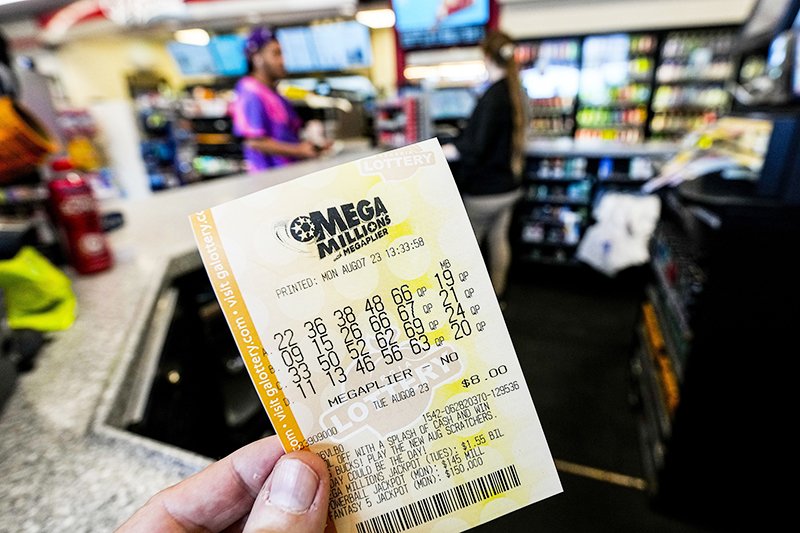

DES MOINES, Iowa — The Mega Millions jackpot for Tuesday night’s drawing climbed to an estimated $1.1 billion after no one matched the game’s six numbers Friday night, continuing a stretch of more than three months without a big winner.
The numbers drawn Friday were: 3, 8, 31, 35, 44, 16. The jackpot increased after a drawing for an estimated $977 million failed to produce a jackpot winner.
Also, a drawing Monday night in the Powerball game had an estimated jackpot of $800 million, which marked the first time the top prize topped $800 million in both games at the same time.
No one has won the Mega Millions jackpot since Dec. 8, a string of 30 consecutive drawings without anyone taking home the top prize. That has enabled the jackpot to slowly grow, week after week.
The $1.1 billion prize is for a sole winner who chooses to be paid through an annuity over 30 years. Winners almost always opt for a cash payment, which for the next drawing Tuesday night is an estimated $525.8 million.
A lucky player winning the $1.1 billion jackpot would take home the eighth largest in U.S. lottery history.
The Mega Millions prize ranks as the 10th largest in U.S. lottery history and is about half the size of the largest jackpot, a $2.04 billion Powerball prize won in November 2022.
It's no mystery why months have passed without a jackpot winner — the odds of snagging the big prizes are terrible.
For Mega Millions, the odds of matching all six numbers are 1 in 302.6 million.
To put those odds in perspective, lottery officials note that after a win when jackpots reset at $20 million, total ticket sales typically cover less than 10% of all the possible number combinations. As jackpots climb to $1 billion or more, sales increase dramatically but still usually cover only about half of the possible combinations.
That means, there is still a good chance no one will hit a jackpot.
Millions of people do win smaller prizes that range from $2 to $2 million. Players of both games have about a 1 in 4 chance of winning some kind of prize.
And, regardless of how large jackpots grow, the odds of an individual ticket winning never changes.
As massive as the jackpots are, winners should brace for much smaller payoffs than the figures advertised on billboards.
That's because the state lotteries that run the games promote the total payoff if the prize is paid through an annuity over 30 years. That figure is now roughly double the cash prize, which nearly all winners choose because they want to invest the money themselves rather than opt for a defined payout.
For Mega Millions, that means the $1.1 billion jackpot actually would pay out an estimated $525.8 million cash prize.
Those prizes will be subject to federal taxes, and many states also tax lottery winnings. There also is a chance that multiple players will hit a jackpot, which would then be split between the winners.
Mega Millions is played in 45 states plus Washington, D.C., and the U.S. Virgin Islands. Powerball also is played in those states as well as Washington, D.C., the U.S. Virgin Islands and Puerto Rico.
The Mega Millions numbers are drawn at a TV studio in Atlanta.