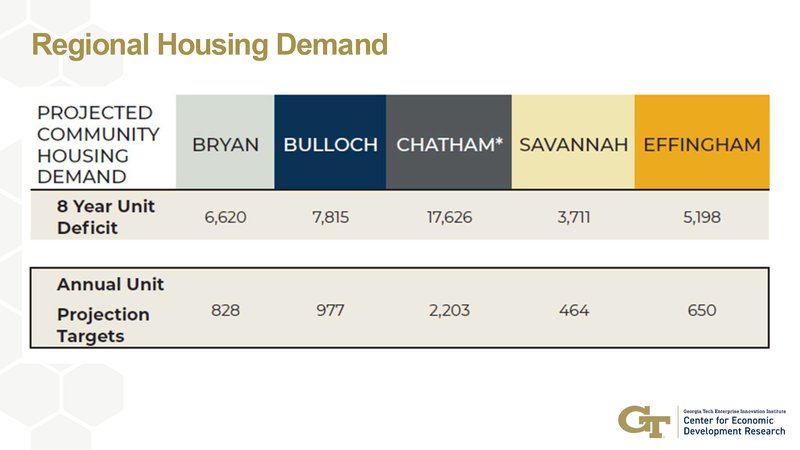
A study performed for the four counties that are home to Hyundai Motor Group Metaplant America and its key supply manufacturers suggests that Bulloch County has an eight-year "housing deficit" of 7,815 home units, resulting in a "target" need of 977 newly built units each year.
Developers' plans for houses, townhomes and apartments, as reported by Bulloch County and city of Statesboro development officials, could almost meet that need — in total number if not specific housing types — if all the planned units are actually built within that timeframe.
However, affordability is a serious issue. Bulloch's median household income of $53,675 as of 2022 would put a $160,705 home in reach of the median-income household, according to the researchers, but the median price of an average home sold in Bulloch County as of April 2024 was $307,700, and the average value of a home in Bulloch County was $207,272 as determined by the county tax assessors.
The Center for Economic Development Research, or CEDR, at Georgia Tech completed the $200,000 study of regional housing needs and demand for Bryan, Bulloch, Effingham and Chatham counties, as well as for the city of Savannah counted separately from Chatham, in March. Those four counties, being the members of the Savannah Harbor-Interstate 16 Joint Development Authority, and the city of Savannah together initially funded this Coastal Regional Housing Study, and their contributions were matched by a grant from the Georgia Department of Community Affairs.
Previously, a workforce study, funded in part by the Joint Development Authority and completed in the fall of 2023, projected that the region within a one-hour drive of the Hyundai Motor Group complex would fall 2,200 workers short of the needs of area industries by 2027.
"The workforce study is kind of what spurred this (housing study)," Betsy McGriff, project manager with CEDR, told the Statesboro Herald. "The workforce study said housing was going to be an issue as they needed to attract workforce, so then you have to figure out what that means."
Joint meeting at OTC
Bulloch's county Planning and Development Director James Pope worked with Statesboro City Manager Charles Penny and Bulloch County Schools Superintendent Charles Wilson to plan a joint city, county and school board information meeting held Wednesday evening, July 9, in the Jack Hill Center at Ogeechee Technical College. Some real estate agents, developers and other interested citizens also attended.
"The genesis of the study was, what was going to be the impact on housing from Hyundai, specifically, and the suppliers, and that's why, once that study was completed, I felt like the city and the Board of Education should also be part of hearing what the anticipated impacts are, according to Georgia Tech and somebody that studies this and makes the models for the state on financial impacts from industry," Pope said Thursday. "I felt all three boards would benefit, particularly with annexation disputes and things like that (occurring), we should all have the opportunity to hear it and ask questions."
Overall housing needs such as Bulloch's 7,815-unit "deficit" were calculated from each county's existing housing inventories and the ordinary population growth occurring before the Hyundai and supplier plant announcements, plus an estimate of the "residential impact" of the Hyundai plant.
"It's not just a Hyundai deficit; it's the growth overall, so it's like you were already in deficit with organic growth, and then this added on top of it," McGriff said. "So the annual production target here (in Bulloch) is almost a thousand units a year."
Hyundai's added impact
The Hyundai plant and its suppliers alone were projected to create 1,246 new jobs in Bulloch County, with a roughly $58,000 average wage and $562 million capital investment, resulting in 895 new households and 2,174 new residents. Alone, the Hyundai impact was forecast to add 582 students in kindergarten through 12th grade to schools in Bulloch County.
"Bulloch County is projected to grow by an additional 3 percent" because of the Hyundai plant, said McGriff, after noting that Bulloch and the rest of the region "already had strong organic population growth" prior to the Hyundai announcement.
During the meeting Wednesday evening, Penny and Statesboro's Planning and Development Director Justin Williams noted that about 4,500 housing units are either under construction or in various stages of permitting for developments within the city limits, including about 2,500 units "going vertical" this year. Pope was asked if a similar number of units are planned in the county outside Statesboro, but in an interview Thursday he gave a lower estimate.
In the unincorporated portions of Bulloch County, somewhere in the range of 3,000 to 3,500 housing units "have been entitled through zoning or through a subdivision process and are in some way working through that process of development," Pope estimates. That doesn't include units in proposed subdivisions that could still be denied a required zoning change, or one 400-unit planned development that was approved a few years ago but which he believes has been shelved by the applicants.
"We're still averaging about 375 single-family home permits a year," said Pope. "That's residential, single-family home building permits issued, and we anticipate that number to go up over the next two years because we know there are more subdivisions in the pipeline, but at the same time, if the economy turns down … those numbers (building permits) tell the true story."
In eight years, 375 home building permits should mean 3,000 new homes, not counting any multi-family developments or apartments, and not including any in the city limits of Statesboro, Brooklet, Portal or Register.
Now, Phase 2
When the Georgia Tech CEDR research team started work on the housing study about a year ago, it was expected to be complete at this point. But now a "Phase 2" of the study is beginning. It involves Bulloch and what McGriff called "the outer ring" of counties — Candler, Evans, Screven, Tattnall, Long and Liberty — still in the one-hour drive time from the Hyundai plant. It doesn't directly involve Bryan, Chatham and Effingham, so Bulloch is the one county included in both phases.
The Phase 2 study is funded by a federal grant obtained through the Southeast Crescent Regional Commission, at no cost to Bulloch County, Pope said. The county and Statesboro did pay shares toward the Phase 1 cost.
The CEDR team will work with county staff with an eye to improving the variety of housing types and the affordability of housing and potentially suggesting changes in building and zoning regulations.
"Really, the approach that we want to take is, growth is coming and change is scary, but what do you want your community to look like, and once we know that, then we can give you tools to help you do that, like if your code isn't what it needs to be, let us find those best practices," McGriff said.
County development staffs, she said, "are overwhelmed. They're just approving permits and doing their everyday job, and so this big planning piece is hard to do, when you're in the midst of your job."
The CEDR team should have some preliminary results of Phase 2 by the end of 2025 and have at least a draft of the final report by next spring, she said.