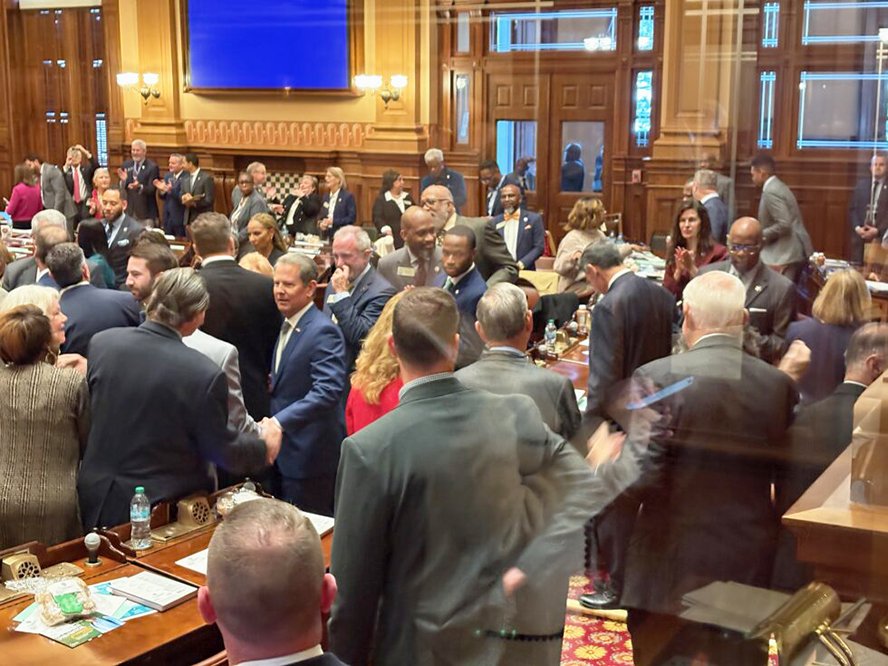
ATLANTA — Gov. Brian Kemp’s last budget proposal would stockpile billions for any rough economy one of his successors might encounter while also asking lawmakers to return over $1 billion to taxpayers.
In his eighth and final state of the state address Thursday, Kemp said his budget proposal to the Georgia General Assembly will give average rebates of $250 per individual taxpayer plus a fifth of a percentage point reduction to the state income tax rate, lowering it to 4.99%.
Like perhaps every other politician, Kemp nodded to what is shaping up to be a dominant issue in the upcoming elections: affordability.
“The reality is too many of our citizens are still struggling to make ends meet each and every day because costs are still too high,” he said, speaking from the well of the Georgia House. “Groceries, rent, insurance, clothes for the kids, it all adds up to more than it used to.”
He said if lawmakers approve his rebate his administration will have returned over $7.5 billion in surplus funds over the past four years. Yet, the state would retain $10 billion in reserves, enough to run government for three months.
Kemp’s budget proposal spends money, too, on roads, on pay supplements, on retirement benefits and, for the first time in state history, on needs-based scholarships for higher education.
But there were no big gestures about the rising cost of health care at a time when many in the state are poised to lose their insurance as federal premium tax credits expire for policies under the Affordable Care Act, or ACA.
“We have been talking about expanding Medicaid year after year. And we know that the ACA subsidies have expired,” Rep. Carolyn Hugley, D-Columbus, said after Kemp’s speech. “There are cuts to Medicaid coming down to us from the federal government. That’s a real challenge, and I’m surprised that it was not mentioned.”
Hugley, who is the House minority leader, also said Kemp’s rebates would do little to help struggling families.
“They’re thinking about child care. They’re thinking about paying rent,” she said. “But a one-time 250 or a one-time 500, what is that really going to do?”
But even she had praise for Kemp’s proposal to infuse a needs-based scholarship fund called Georgia DREAMS with a one-time $325 million grant to serve as an endowment, something Democrats have been requesting for years.
On the House floor, after Kemp left, Rep. Al Williams, D-Midway, praised the governor for removing an abiding stigma around college funding for students from low-income families.
“This is the first governor since 1992 who has used the words ‘needs based,'” he said. “Thank you.”
The idea has also been floated in the Senate, where a bipartisan study committee recommended late last year that the state provide need based financial aid like 48 other states.
Kemp is proposing billions in other new spending, in addition to the nearly $1.2 billion rebate and the ongoing annualized $750 million cost of the income tax cut.
He didn’t mention it Thursday, but in a speech the day before at a state Chamber of Commerce event he revealed $2 billion in his budget request to relieve congestion on I-75 south of Atlanta and on Georga 316 from Atlanta to Athens. His budget also includes $350 million for local road and bridge improvements.
And Kemp would help state employees with their living costs by giving a $2,000 pay supplement to all of them, including educators and state public safety officers.
It will cost over $600 million.
State law enforcement would also get a retirement boost that would add about $5 million a year to annual budgets. The proposal would accelerate the annual increases in the percentage state match for each officer’s contribution to their 401(k) plan and lift the cap to 15% of salary from 9%.
Near the end of his speech, Kemp acknowledged that governors lose clout as they near their final hour, but he also noted the substantial power that Georgia governors wield through the line-item budget veto.
“For those of you who may think I’m a lame duck,” he said, “just remember I have a big red pen.”
It was a joke, and the lawmakers laughed and applauded. But it was also true. Lawmakers have nearly always given Kemp what he asked for.