Following from objections expressed earlier by the Board of Education, the Bulloch County commissioners voted last week to object to the city of Statesboro’s proposed annexation of 102 acres between U.S. Highway 301 South and Old Register Road that would be part of a developer’s plan for more than 1,100 housing units in a larger mixed-use development.
The moves by the county boards won’t necessarily prevent the annexation from occurring, but the commissioners’ filing could trigger a state-mandated arbitration process between the city and county governments.
Like all other recent Statesboro annexations, this one has been requested by the landowner or developer, in this case VSB Development LLC, and not initiated by the city. Across from the Tormenta FC Stadium and The Clubhouse, it’s adjacent to the Old Register Road Tax Allocation District, or TAD, which included the stadium, the Publix supermarket and Eagles Corner shopping center and other commercial developments just outside the bypass loop. But the city-established TAD is in the city limits, and the area proposed for annexation so far is not.
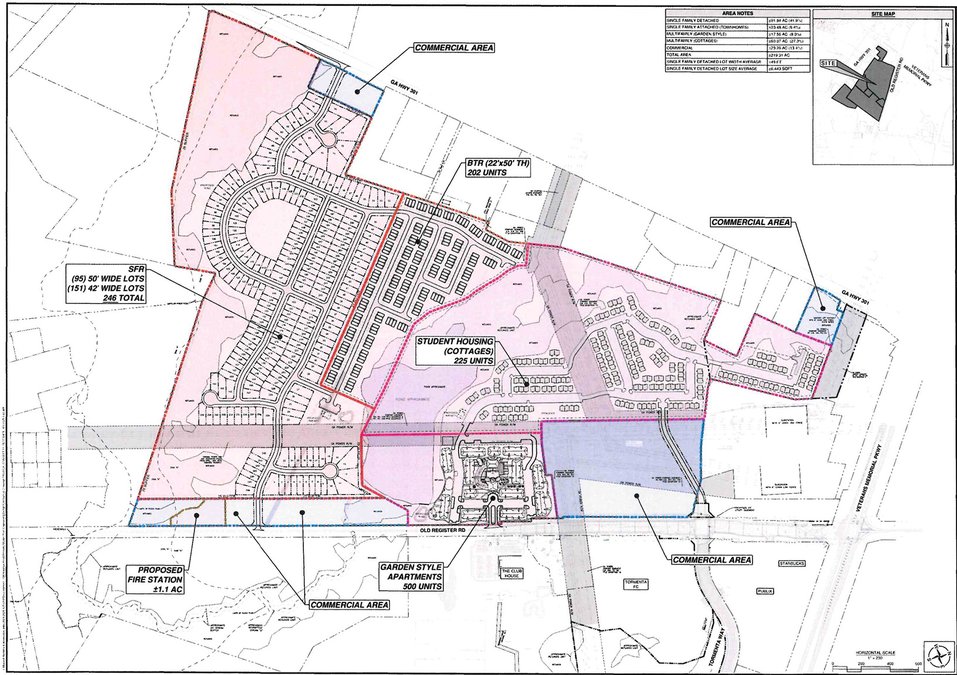
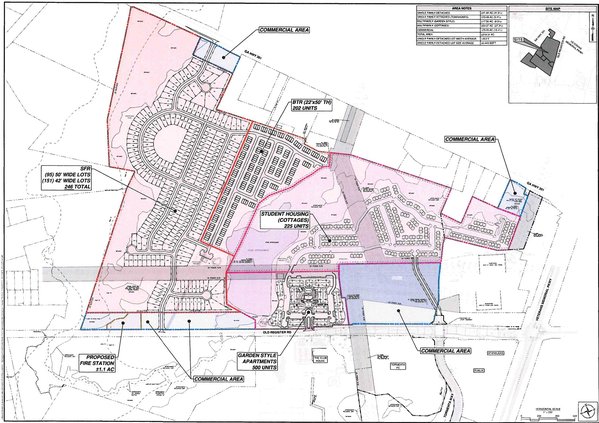
A map obtained from the city’s Planning and Development Department shows that the overall mixed-used development would include commercial areas near its corners – two on Old Register Road and two on U.S. 301 – in addition to a tract nearest the bypass with 225 units of student housing “cottages,” a “garden-style apartments” area for 500 units right off Old Register Road, and 202 townhome-style housing units in the middle, with interior streets connecting to those in an swath with 246 proposed lots for small single-family homes.
A portion of this land was already in the city limits. From the city’s separate maps of the requested annexation and proposed rezoning, the annexation appears to include most or all of the single-family home area and perhaps the townhome area.
A Georgia law requires city governments to notify the governing boards of the county and any affected school system within 30 days of acceptance of a petition for annexation. However, the law provides a more active role for the county government than the schools.
Statesboro’s development staff notified the Bulloch County Board of Commissioners and the Board of Education on or about May 12.
The Board of Education at its May 29 meeting approved both a resolution directly objecting to the annexation and another requesting that the Board of Commissioners object. Both resolutions were approved 8-0 with all of the school board members present.
After the resolutions were adopted, District 1 BOE Lannie Lanier asked for confirmation that the schools for this area would be Langston Chapel Elementary, Langston Chapel Middle and Statesboro High School. Chair Elizabeth Williams and Superintendent Charles Wilson said this was correct.
“Then capacity becomes a real problem,” Lanier said.

With its two separate resolutions, the school board was covering the bases since a state law provides a direct way for the Board of Commissioners to object but doesn’t do so for the Board of Education, despite the requirement that school leaders be notified.
So the first of the BOE’s resolutions appeared to be mostly a gesture. One of its preamble clauses states, “Whereas, to the extent the school district is entitled to the same rights to object to the annexation as have been conferred on the county, the Board of Education wishes to exercise such rights. …”
A little farther in, the board states its objection: “The Bulloch County Board of Education hereby objects to the Annexation on the grounds that the proposed change in zoning and land use and the proposed increase in density will impose costly infrastructure demands on the Bulloch County School District, and will constitute a material increase in the burden on the Bulloch County School District and have a significant financial impact on Bulloch County, including but not limited to exceeding the current classroom and staffing capacity of the schools servicing the proposed development area.”
The school board’s second resolution left out the “to the extent the school district is entitled,” clause and instead requested that the Board of Commissioners file an objection with the same wording about the impact on the school district.
Commissioners’ action
The commissioners then took up the subject at their June 17 meeting, with County Attorney Jeff Akins, who is a county employee, away, but attorney George H. Rountree of the Brown Rountree firm, who has represented the county in other matters, attending instead.
Whether the county government can object on the basis of the school board’s concerns is “sort of a gray area,” but the law leaves no doubt that “the county can object for matters that would impact the county, cost the county money, basically,” Rountree told the commissioners. “And the concern is that there would be road improvements necessary in that area, to handle the increased traffic.”
Commissioner Timmy Rushing said one specific concern is for traffic on Old Register Road where people “will eventually be wanting a roundabout down at Langston Chapel (Road), which could cost millions of dollars.”
Rushing noted that the county previously objected to an annexation on Beasley Road – that was in 2023 – and that this was eventually settled by the city agreeing to take responsibility for maintenance and improvements along the road, which had been partly on county and partly on city right of way. The Beasley Road agreement was negotiated locally after the Georgia Department of Community Affairs declined to appoint an arbitration panel because of a missed deadlines with the county’s filing and the city’s helping select the panel.
“If the city steps in and says they will accept responsibility for the road, then Mr. Rountree can tell you as an attorney, that’s pretty much all we can do,” Rushing told the commissioners and public last week.
Rountree did not reply to that. Chairman David Bennett said he understood the school board had “agreed to provide financial assistance for the arbitration.” Rountree said he understood the school leaders had offered to do this based on their concerns but that he didn’t know if the offer would stand for negotiations based on the county’s concerns about roads.

In its objection statement, the resolution the county commissioners approved on a vote of 6-0 first states the school board’s objection.
Then it adds, “The … Board of Commissioners hereby further objects to the annexation on the grounds that the proposed change in zoning and land use and the proposed increase in density will impose infrastructure demands on Bulloch County that will constitute a increase in the burden … and have a significant financial impact on Bulloch County, including but not limited to intersection improvements, road repairs and resurfacing, and substantially increased traffic.”
What county asked city
When Statesboro City Council met later evening of that same day, June 17, City Manager Charles Penny noted the school board’s and county commissioners’ pending objections. He also noted that county officials had been talking with city officials before the commissioners’ vote.
“They came to us and proposed that they would not object to the annexation if we would take responsibility for the roads,” Penny said, “and what we said to them was we would take responsibility for the roads that were associated with the annexation, but what the county commissioners wanted us to do was they wanted us to take responsibility for Old Register Road down to the intersection on Langston Chapel. That’s not a part of the annexation. So we told them to object, if that’s the way they felt.”
He added that city officials expect to be contacted by the DCA to establish the arbitration procedures “if the county would get it right this time.”
After the meeting, City Attorney Cain Smith said the had not received the county’s formal objection, which he said needs to be more specific than the resolution, and that it needs to provided to the city and filed with DCA by June 26, which is 45 days after the city’s notification to the county. As of noon Monday he had not received the objection.