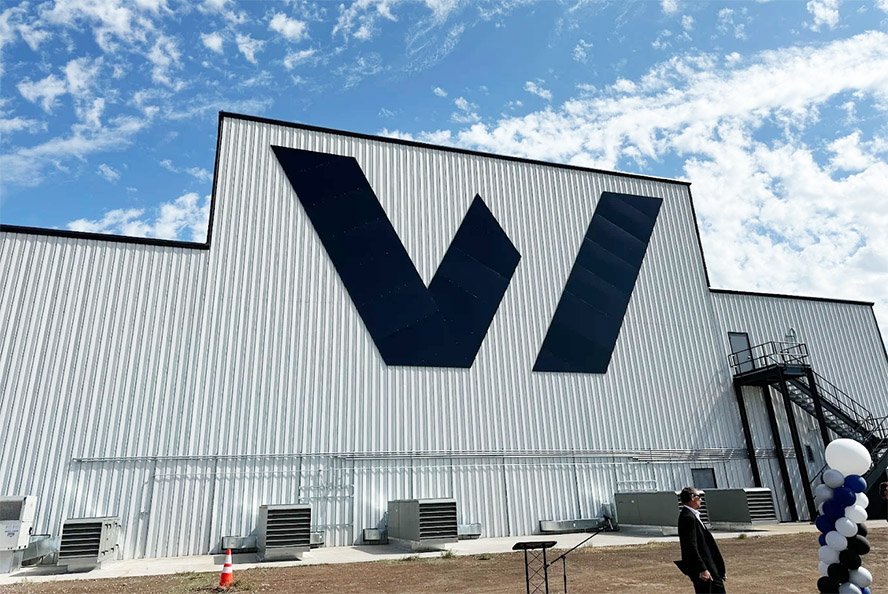
The Development Authority Board of Bryan County voted Tuesday to end all negotiations with Oklahoma-based Westwin Elements over its proposed nickel refinery in Richmond Hill.
The vote followed the removal of an agenda item that would have addressed the project. Bryan County District 5 Commissioner and Development Authority board member Gene Wallace introduced the motion before a packed audience opposed to the refinery.
“The concern for the safety of our residents and our environment far outweigh any potential benefits to our community,” Wallace said. “While we can’t stop the purchase, we have the right to pass a motion that we will not provide incentives.”
The Authority (DABC) confirmed it had communicated with Westwin since spring 2025 and had issued, then recalled on Aug. 6, a local incentive letter under the name “Project Patriot.” CEO Ryan Purvis wrote in an August email that Westwin remained interested in Richmond Hill and that CEO KaLeigh Long sought to attend an August DABC executive session, possibly with U.S. Rep. Buddy Carter, R-GA. Purvis added that Carter never attended any DABC meetings, pertaining to Westwin.
The board had also requested an Environmental, Health and Safety review by Ramboll, a global engineering and consultancy firm, after environmental concerns arose. The November 2025 report identified potential issues at the redacted proposed Westwin site, including contaminated soil and groundwater, wastewater generation, air emissions such as carbon monoxide and particulate matter, and possible stormwater contamination. Ramboll recommended submission of air permit data and noted Westwin would need state construction and industrial stormwater permit coverage.
Westwin’s Georgia EPD air permit application is in expedited review. Public comment closed Feb. 6. If the permit advances, a separate 30-day notice period will follow.
Westwin applied for a synthetic minor permit, for which the expedited processing time is about 95 days.
“Both of those timeframes do not account for the consideration of substantial public comments, which is likely for this application,” Sara Lips, EPD’s communications director, wrote in an email.
What does the DABC’s decision to end negotiations mean?
The DABC is a statutory board with the role of recruiting industry to Bryan County. Once an industry is settled in the county, the DABC partners with it to help ensure its success.
The DABC can recruit industry by offering incentives like tax abatements and tax-exempt industrial revenue bonds to help reduce project costs.
The DABC can operate under non-disclosure agreements in the case of protecting the trade secrets of private businesses, but as Bryan County Attorney Aaron Kappler said during a presentation to the DABC, Tuesday, these NDA’s shouldn’t be used as “blanket protection” to hide all information.
Westwin had planned to request the DABC’s financial support in paying all or a portion of the $230 million in costs of issuance of Tax Equity and Fiscal Responsibility Act (TEFRA) bonds, which are tax-exempt private activity bonds issued by local authorities.
With DABC and Westwin negotiations ended, no public incentives, tax breaks or financing are currently on the table.
Westwin did not immediately respond to requests for comment.
What’s next for Westwin?
Westwin may still proceed privately. Long has said the company will move forward with or without local support.
Even without financial support from the DABC, Long claimed the company has raised $90 million in start-up investment and has $750 million in potential financing lined up once it announces its site location.
The company hopes to purchase the former Caesarstone property in Belfast Commerce Park. That transaction could be affected by an ongoing, joint city and county, investigation into alleged leftover silica dust contamination from Caesarstone, which manufactured countertops.
Richmond Hill officials have said they cannot interfere with a private sale if zoning requirements are met. The Caesarstone property is zoned as a Planned Unit Development District
According to a 2024 Richmond Hill Unit Development Ordinance, a PUD has six purposes:
A. Provide for flexibility in development that will result in a better project for the developer, residents and users, as well as for the city, in general;
B. preserve existing natural assets, such as stands of trees, floodplain, open fields, wetlands, lakes, streams and the like;
C. Accomplish a more desirable and sustainable residential environment than would be possible through the strict application of minimum requirements of this code;
D. Encourage the utilization of open space and the development of recreational amenities generally located within walking distance of all living units;
E. Encourage the use of lands in ways which are most in accord with their character and adaptability; and
F. Encourage the efficient use of land by facilitating economical and suitable arrangements for buildings, streets, utilities and other land use features.
Industrial uses can be considered for a PUD area.
Richmond Hill’s I-1, or industrial district, “permits generally light industries such as manufacturing or processing of previously refined materials and other industrial uses that, when properly located, can be compatible with the character of the community and immediate vicinity,” according to this 2024 document.
Kappler said Tuesday that it is up to the Richmond Hill mayor and council whether Westwin’s intended use complies with that zoning designation.
Trip Addison, the DABC’s treasurer, said Westwin has pledged third-party environmental and safety monitoring, but he flagged key concerns.
Kappler noted Tuesday that Westwin’s proposed bond documents reference constructing sewage and solid waste facilities – a description he said conflicts with CEO KaLeigh Long’s claim that the refinery would not be a solid waste operation. If classified that way, Addison said, the project could require additional permits beyond an air permit, including an industrial stormwater permit.
Addison also urged Westwin to invest in hazmat equipment and training for the Richmond Hill Fire Department. He said this investment would provide an opportunity to strengthen emergency response countywide, particularly given Bryan County’s location along the I-95 corridor. He added that such investment could improve the department’s ISO rating and lower homeowners’ insurance costs.
He further called for Westwin to establish a roughly $5 million assurance bond to cover potential cleanup costs if the company leaves the site without proper remediation.
“I recognize Westwin’s desire to move forward,” Addison said, “but I also recognize the responsibility that must come with it.”