ATLANTA — Legislation to strip librarians of their criminal immunity from a law that makes it illegal to give "harmful" books and other content to minors is moving quickly through the Georgia General Assembly, after passing a House committee in a partisan vote Friday.
Conservatives and religious advocates have been pushing for years to revoke the librarian exemption from a 1980s obscenity law that makes it a crime to knowingly give a minor a visual, written or recorded work depicting sex or sexuality in a way that offends the "prevailing standards" of a community.
The Senate legislation that passed one of the state House's judiciary committees Friday would subject librarians in public libraries, schools and colleges to prosecution for violating that law.
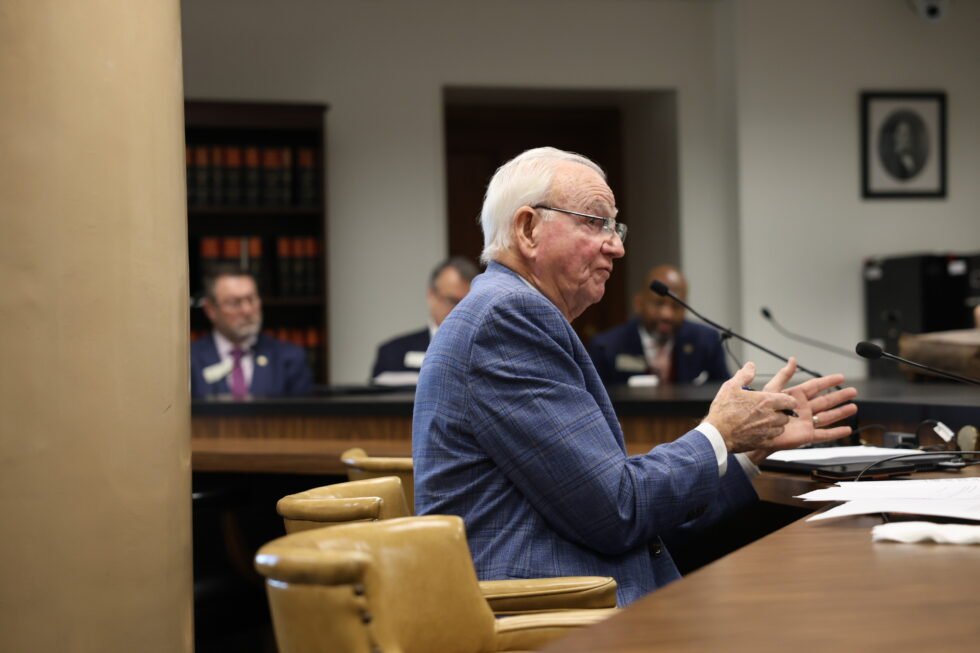
Sen. Max Burns, R-Sylvania, discussing Senate Bill 74 at the Georgia Capitol on Friday, Feb. 6, 2026. His legislation would expose librarians to jail for violating a decades-old law against giving "harmful" books and other such material to minors. (Ashtin Barker/Capitol Beat)
Previously, Senate Bill 74 sought to remove the librarian shield entirely. But amendments added Friday would only take it from librarians who fail to comply with their library or school board decisions concerning complaints about books and other materials.
"If the librarian follows what the governing board says, then that's it, the end," said Rep. Soo Hong, R-Lawrenceville, who based her amendment off wording suggested by a West Georgia library director at a previous hearing.
The bill passed 6-5 along party lines, with Democrats opposed.
Critics have long contended that the move to strip librarians of their legal protection is part of a strategy to scrub libraries of books about sexuality and gender orientation. SB 74 relies on a section of state law that includes sexual conduct as content considered to be harmful to minors. The law's definition of sexual conduct includes "acts of masturbation, homosexuality, sexual intercourse … ."
Rep. Shea Roberts, D-Atlanta, argued that SB 74, in conjunction with that existing definition, would lead to the banning of books "where two boys are holding hands."
Rep. Rob Leverett, R-Elberton, disagreed with her interpretation. "It's talking about sexual contact, contact involving, you know, our privates," he said.
Leverett also disagreed with Rep. Esther Panitch, D-Sandy Springs, who predicted that the bill, should it become law, would effectively become a book "ban" by encouraging extreme caution among library boards.
They would become "censorship boards," she said.
"When the choice is between keeping a challenged book on the shelf or exposing your libraries to prosecution, the book will lose every time," Panitch said, adding that one arrest and mugshot of a librarian who defended a controversial book would cause every library in the state to remove it.
Giving harmful material to a minor is a misdemeanor of "a high and aggravated nature," punishable by up to 12 months in jail and a fine of up to $5,000.
Leverett said the legislation was not a ban because it would only require moving certain books to age-restricted parts of libraries.
"That's a great difference," he said. "I would agree with you if we were talking about burning them or taking them out of the library altogether."
At a prior hearing this week, a member of the public commented against the measure by observing that a book for children had been attacked because it named male and female genitalia.
A Republican lawmaker shot back: "Is it the librarian's responsibility to teach my children what a vagina and a penis is?" The lawmaker, Rep. Charlice Byrd, R-Woodstock, said a parent should decide when to expose their child to such information.
The next stop for SB 74 will be the House Rules committee, which gets to decide whether to put the measure to a vote by the full House. The bill has already passed the Senate, in a party-line vote last year, the first year of this biennial session.
Should the House pass it with the new amendments, the Senate would need to agree to the changes before it would move to the governor's desk.
The main sponsor of the legislation, Sen. Max Burns, R-Sylvania, told the House committee members Friday that he supported their changes.