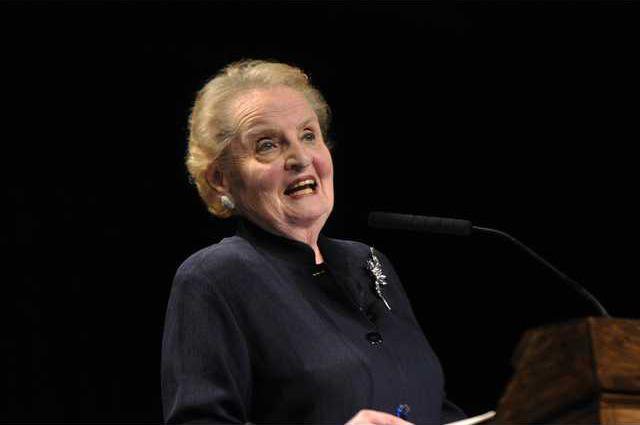
Last week’s attack that killed the U.S. ambassador to Libya and three staff members brought Madeleine K. Albright back to Aug. 7, 1998 — the worst day of her tenure as secretary of state under President Bill Clinton.
“The Kenya and Tanzania issues have very much come to mind in the last week because anybody who knows me knows I loved being secretary of state, except on Aug. 7, 1998, when our embassies in Kenya and Tanzania were blown up,” Albright told a mostly full Hanner Fieldhouse. “And we were trying to figure out how it had happened and what we could do about it.
“There are things in life I never, ever thought I would do,” she continued. “One was being in a cargo plane sitting with the coffins of the Americans that I was bringing home. I had fallen asleep and there had been a canvas curtain in front of me. And I woke up and, all of a sudden, all the coffins were covered with American flags and I was sitting in the middle of them. And I thought, ‘How could this possibly have happened?’ And it is something obviously that President Obama and Secretary (Hillary) Clinton are going through now with the tragedy in Libya.”
A situation that tragic, Albright told the assembled Georgia Southern University students, faculty and community members, can lead someone in her position to doubt or question herself.
She has a “good habit or a bad habit,” she said, of going back over the many decisions she has had to make.
“I do go over every decision I’ve ever made and try to figure out if it was the right thing to do or not,” Albright said. “I think that you have to be able to explain to yourself why something happened and try to figure out how never to have it happen again, even though you’re not always in control. But it’s not easy.”
This was part of an answer she gave to a student’s query about the criticism she faced for her handling of difficult international situations.
The attack on the U.S. consulate in Benghazi, Libya, which killed Chris Stevens, the U.S. ambassador to Libya, also came up during a roundtable with news reporters before her speech at Hanner.
Albright, who was appointed secretary of state by President Clinton in 1997, defended President Barack Obama’s administration’s handling of the crisis in general, especially the State Department under current Secretary Hillary Clinton.
“Generally what is so difficult to do, and I think they’re doing, is they have to continue to work and proceed and try to sort out not only what is happening in Libya, but also across North Africa and into the Middle East,” Albright told reporters. “And then they are dealing on an hour-to-hour situation with what the various consequences and effects are.
“What they are trying to do is obviously honor the dead but, also, to try to resist giving information that’s inaccurate,” she said. “Being pressed to give answers to something they don’t know yet, I think makes it difficult. But I think that they are doing the right thing. They have to sort out what really happened.”
Another key topic during both the reporters’ roundtable and the Hanner speech was Albright being the first female secretary of state. She quipped to reporters that she loves “being a role model. It’s the only kind of model I’m ever going to be.”
During her speech, she explained her pride in her pioneering position.
“I will never forget actually walking into my office right after I’d been sworn in on the seventh floor of the State Department,” Albright said. “I’d go down this mahogany hall that was lined with portraits of all my predecessors, all of whom were white men who either had beards or were clean-shaven. And I thought to myself, ‘When my portrait goes up, the walls will shake a bit.’ It did, in fact, a bit.”
It turns out that she started a run of female secretaries of state. She was succeeded by Colin Powell, but then by Condoleeza Rice and Hillary Clinton.
“There are those who now ask whether a man can be secretary of state,” Albright said, drawing laughter from the audience.
Staff writer Jeff Harrison contributed to this report.
Jason Wermers may be reached at (912) 489-9431.
Albright recalls '98 bombings
Former secretary of state compares violence to current Middle East crisis