As a veteran, I.W. Spence is in an unusual category, but having served means a lot to him and he has maintained a lifelong interest in all things military. This explains why he recently flew aboard a 70-year-old military plane — despite not having the opportunity to jump out.
Trained as a paratrooper for the Korean War, Spence served instead as an “adviser” carrying classified messages in Taiwan during a time of continued tensions between the United States and the then-new Communist government of mainland China.
Spence, a lifelong Bulloch County resident who will soon celebrate his 80th birthday, had tried to sign up for the Army when he was just 17.
“That was the only thing I ever wanted to do,” he says. “I wanted to go in the service from the time I can remember.”
A cousin the same age was able to get his parents’ permission to join at 17 and served in the Navy. But Spence’s parents said no. One of his older brothers, the late Ralph L. “Lit” Spence, had been seriously wounded in Germany in the latter days of World War II, and another brother, the late Lamar Spence, was already serving in ground combat in Korea.
But exactly one week after I.W. Spence turned 18 in December 1952 and no longer needed a parental signature, he joined the Army. Assigned to the 11th Airborne Division, he was sent to Fort Campbell, Kentucky, for training and then to Fort Benning, Georgia, for jump school.
Spence trained by jumping out of planes such as the Douglas C-47, a military transport derived from the DC-3 airliner. The paratroopers would line up and attach their static lines to a cable on one side of the plane. The cable deployed the main chutes when they jumped, the hand-pulled rip cord being only for emergencies.
As Spence likes to tell his children and grandchildren, the first time he flew on a plane he jumped out of it. Every time he flew, he jumped out, both at Fort Benning and later when stationed in Japan in the immediate aftermath of the Korean War. The first time he flew and didn’t jump, he says, was when the 11th Airborne’s deployment ended and the plane that flew him out of Japan touched down on Wake Island. The plane came in low over the water.
“Scared me to death,” he said.
So you might say, in those days, Spence’s preferred way to get out of an airplane was to jump out while it was still in the air.
He completed jump school just as the July 1953 armistice brought the Korean War to the stalemate conclusion it has remained in for 61 years, and so did not serve in combat. But hang on — there’s more to this story.
‘To assist and advise’
Having narrowly missed the fighting in Korea, Spence re-enlisted in 1955 and in February 1957 was deployed to Taiwan, where tensions remained high between the U.S.-allied Nationalist Chinese under premier Chiang Kai-shek, who had taken refuge on the island in 1949, and the People’s Republic of China, newly established on the mainland under Communist ideologue Mao Zedong.
Tensions were also high between the native Taiwanese and the nationalist refugees from the mainland, as Spence recalls.
“I tell you, the Taiwanese hated the Chinese seriously,” Spence said. “Of course, see, you would have too. They just came over there and took over their whole island.”
For the Taiwan deployment, Spence was assigned to the Military Assistance and Advisory Group. He still has his jacket with the “MAAG” shoulder patch, though now the slim-cut jacket won’t fit his grandsons, much less him.
“That’s what you had in Taiwan. You didn’t have a regular Army outfit in Taiwan,” he said. “We were all advisers.”
So the status of U.S. troops then assigned to “assist and advise” in Taiwan was similar to that of troops now deployed to assist the Iraqi Army and Kurdish Peshmerga in northern Iraq.
Spence’s role was as a “clerk/typist,” or executive assistant, to a ranking officer at the headquarters in Taipei. Although Chinese women were hired to do the routine typing, Spence typed any classified documents. Virginia Spence says her husband had top-secret clearance.
“He won’t tell you,” she said.
However, he did say he handled classified documents, both typing them and delivering them.
“I was a courier, really, there,” Spence said. “I was in Taipei, the capital, a big city, and so I would go from our headquarters all around every day to — I think there were eight or nine different headquarters, ours and the Chinese — and pick up classified documents and stuff like that, you know, move them around.”
His period of service placed him in Taiwan through what historians have labeled the Second Taiwan Strait Crisis, in August and September 1958. He recalls exchanges of artillery involving the Quemoy and Matsu island groups. The crisis began when People’s Republic of China shelled these islands, along the east coast of the mainland, in an effort to drive out the nationalist forces who remained there — and still do.
“They’d fire several rounds back and forth. … They’d kill a water buffalo every now and then,” Spence said, with a laugh.
But he also recalled that he visited some of the disputed islands.
“I went out there a time or two, but you didn’t stay out there,” he said. “Everything out there was underground. We’d keep a record of it, you know, how many rounds they fired, how many rounds we’d fire. Every day, you’d have to make up a report about it.”
Spence returned home to the United States in November 1958 and was discharged Nov. 14. One year later, Nov. 14, 1959, he married his wife, Virginia. They will celebrate their 56th anniversary this week.
Aboard the Memphis Belle
In September, the Liberty Foundation brought the “movie” version of the B-17 bomber Memphis Belle to Augusta Regional Airport. Built in early 1945, just before the end of World War II in Europe, this plane never saw combat but was painted and equipped as a replica of the wartime Memphis Belle — the first U.S. heavy bomber to be retired from World War II service with its entire crew surviving — for the 1990 movie, “Memphis Belle.”
After the Statesboro Herald published a feature story, photos and Internet video from a media preview flight, Spence’s son-in-law Lannie Lanier bought him a ticket for the last available seat on the Sept. 27 public flights. Of course, a B-17 wasn’t the sort of plane Spence flew aboard in the Army, but Lanier knew his father-in-law would love such a ride.
Spence even crawled into the nose of the plane, where the bombardier’s battle station, nearly surrounded by glass, offers an unobstructed view in most directions.
“That was a neat ride. It was a trip, you know. I just really enjoyed it,” Spence said.
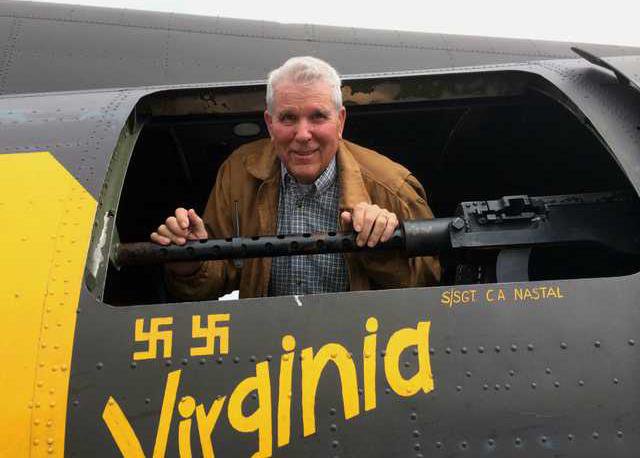
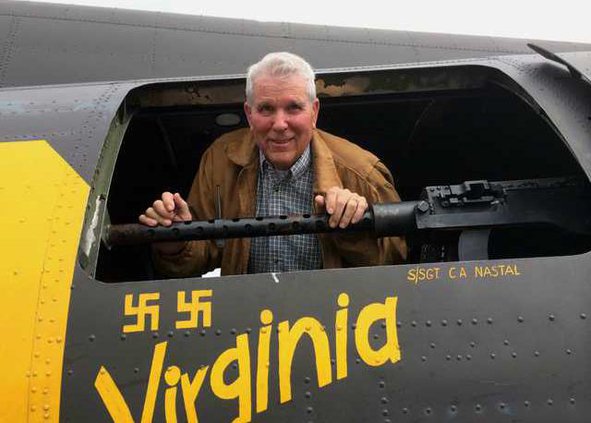
He also posed with a non-functional machine gun at a waist-gunner’s slot, discovering that he and a Memphis Belle gunner 70-plus years ago had something in common.
Whether for a wife, a girlfriend or the commonwealth, that gun post was named “Virginia.”
Al Hackle may be reached at (912) 489-9454.