

Savannah Avenue in Statesboro is known for having a few homes of manorial size and antiquarian splendor. But three neighboring houses along the avenue were literally ordered from Sears & Roebuck — prior to assembly and any later modifications.
For readers born in the last couple of generations, Sears from the late 19th through the mid-20th century was "the Amazon.com of their day" as Matt Hube put it in remarks Monday to the Bulloch County Historical Society. Hube, a local attorney, serves as the society's treasurer and occasionally researches and presents a program for one of its monthly meetings.
This latest presentation included some history of the retailer founded in Minneapolis in 1886 as R.W. Sears Watch Company and, after moving to Chicago, was incorporated as Sears, Roebuck and Co. in 1893 and began issuing large general merchandise catalogs in 1896. Across America, rural families far from major retail stores were soon buying clothing, household goods and hardware by ordering from the "Big Book" that in peak years weighed more than four pounds.
But "who knew before today, or before this program was announced, that you could buy a house out of a catalog from Sears? …" Hube asked. "But it was in fact possible to buy one from them and a whole bunch of other companies. They actually were not the first company to come up with this idea … and they didn't do it the longest. But they did it for three houses here."
Kit home industry
The first U.S. company to sell kits by mail order for assembling houses may have been North American Construction Company, which was founded by William Sovereign in Michigan in 1906, soon changed its name to Aladdin, selling about 100,000 houses that way by the time it stopped in 1983. That placed it top on Hube's list for number of houses. Other major players were the Gordon Van-Tine company, 1909–1947, and Lewis Manufacturing, 1913–1975, listed as selling about 75,000 kit homes each. Among other companies, Sears' general merchandise competitor Montgomery Ward also made the list, marketing about 30,000 houses from 1909 to 1931.
Sears, according to Hube, marketed kit homes from 1908 until 1942, selling perhaps 65,000 to 75,000. Nobody knows for sure how many, because the records were later discarded, he said.
Modern Homes catalog
Despite the dimensions of the Big Book, the homes were not sold in the regular Sears catalog. Instead, the company produced a separate Modern Homes catalog, with the home kits in it, and also advertised them in newspapers in major cities, Hube explained.
The first Modern Homes catalog, in 1908, had 44 house plans in it, ranging in price from $360 to $2,890 for an entire home. In the early years the plans and kits of building materials had model numbers. But these were later replaced by names such as the Alhambra, the Barrington, the Conway, the Starlight, and largest — a 10-room colonial-style home — the Magnolia.
Ultimately, Sears offered more than 370 different house designs, although some were marketed for only for a year or two and some didn't sell at all, while others became popular.
"So almost everybody could get one, in terms of your budget, in terms of your needs, how big was your family, how much space did you need," Hube said. "They offered one for just about everybody."
Sears, Roebuck and Co. even offered kits for duplexes, an apartment building, a two-story schoolhouse and a number of designs of barns.
But among the lived-in buildings, single-family houses led sales, and most of the kits appear to have been purchased by people who assembled the houses themselves rather than hiring builders, Hube said.
A 25-ton kit
"So, what did you get if you bought one of these?" he asked, and answered. "Well, you got a kit that weighed about 25 tons and had approximately 30,000 different parts included in it. So you would look through the catalog, you would decide what house do I want, you would write a check and you would send it through the mail to Sears…
"And at some point later, a box car or box cars would show up at the train station, and you'd be told, 'Hey, your house is here,' and you'd go down to the train station with your wagon and load everything up and take it back to wherever it is that you're putting your house up," Hube continued.
A different sort of big book, a detailed instruction book that referenced numbered boards and other parts, came with the kit.
"Hinges and nails and screws and roofing and flooring, and obviously the lumber to build the house" were included. "Everything you needed, except, if you wanted heat, you had to pay extra, if you wanted plumbing, you had to pay extra," Hube said.
After 1916, the lumber was shipped pre-cut, which supposedly saved about 40% on the time for construction, he noted. Building a house from a kit typically took about 90 days, according to the printed descriptions.
Savannah Avenue's 3
One historic Statesboro developer, the enterprising Joe Fields, is credited with building the three Sears, Roebuck and Co. homes that are still standing, reportedly in good condition, on Savannah Avenue after more than a century.
"We have three, and they are all right next to each other," Hube said. "They are 325, 327 and 329 Savannah Avenue. So, between 1917 and 1920, a guy named Joe Fields built these houses. The only one that I know for sure the date, 329 Savannah Avenue, was built in 1918."
Fields did a number of other interesting things as a Statesboro entrepreneur, as Hube noted. Back around 1890, Fields owned a local business called the New York Bargain Store. He developed a soda pop called Sea Island Ginger Ale. He also owned the Statesboro Opera House, also known as Fields Hall. In 1896, he leased a six-acre tract on Mill Creek to build a park, where Statesboro residents picnicked and horse races were held.
All three of the Sears homes he had built appear to have started from the same house plan, the Starlight model. Indoor plumbing was a luxury. The Starlight kit cost $424 without a bathroom but $1,543 with a bathroom, Hube noted.
His slide show included a marketing illustration of the Starlight as a single-story house with an attractive front porch and dormer in the front slope of the roof.
"One of them looks like that," Hube said. "The other two don't, from the outside. The dormer on the front is still eminent on one of the houses. The other two have been modified a fair amount."
The house at 325 Savannah Avenue is currently owned by LeAnn Ransbotham and Wesley Parker, but they now live across the street. They attended the Historical Society presentation.
"The interior on this house is still fairly original, and if you had the floorplan for the Starlight house, you would say, 'Yeah, this is that place," said Hube.
He had visited the house and called it "a very, very solidly built place."
The house at 327 Savannah Avenue is the one that best preserves the exterior appearance of Sears & Roebuck's Starlight model illustrations. Now owned by Daniel Alderson, it was previously owned by Debra Chester and her late husband Steve Chester.
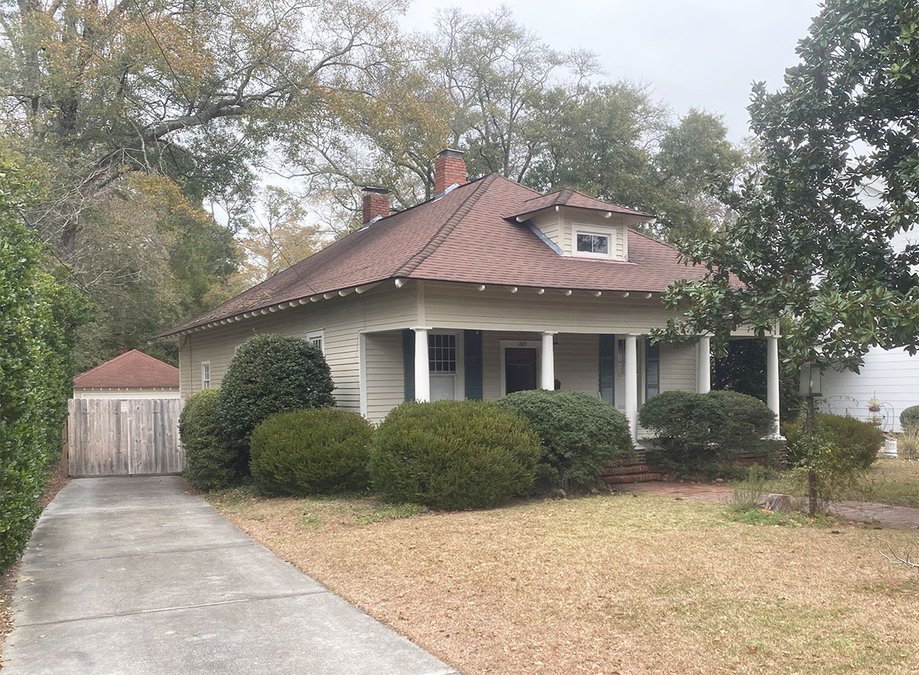
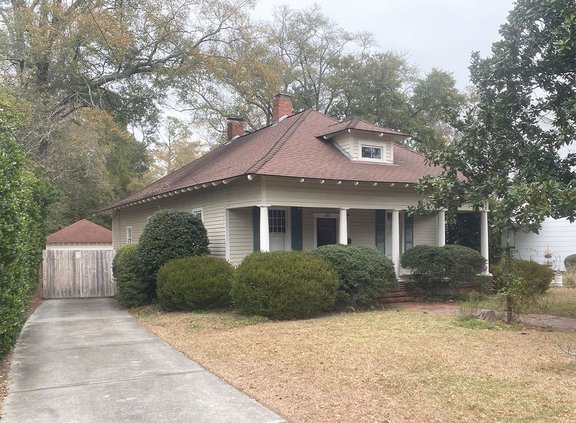
"You can see that dormer on the front that we saw in the Starlight plan. They added a den, upgraded the plumbing and electric, and Debra told me that 'It was the best-built house that I've ever lived in,'" Hube said.
Thomas and Perri Ann Dean are the current owners of 329 Savannah Avenue, and she had given Hube some books to look through on Sears houses and kit houses in general, helping with his research.
However, 329 now looks least like the original Starlight home.
"It likewise is very solidly built, but it has been so heavily modified that you would never in a million years believe that it started as what the other two started as," Hube said.
The house has had an entire second floor added, as well as additional rooms on the first floor, "but inside, if you know what you're looking for and know what the floorplan of the Starlight looks like, you can still see that those rooms still exist in that house," he said.