By allowing ads to appear on this site, you support the local businesses who, in turn, support great journalism.
Vision of Renaissance in Statesboro
A dog park, a classy creek bank and new life for old warehouses
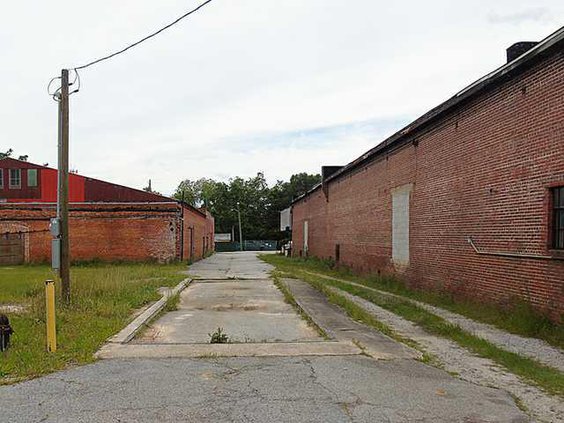
WAREHOUSE Alley before Web
This "before" view from the Renaissance Strategic Vision shows the Farmers Union Cotton Warehouse, left, and Hardware Warehouse, right, and alley as they are in 2015. - photo by Special/Carl Vinson Institute of Government

            Visions for three projects, from a long-discussed dog park to an ambitious transformation of an old warehouse block to feature loft apartments, a restaurant, greenspaces and a pool, emerged from a Georgia Downtown Renaissance study of downtown Statesboro this summer.
        In full, it's the Georgia Downtown Renaissance Fellows Program, supported by the Georgia Municipal Association, the Georgia Cities Foundation and the Carl Vinson Institute of Government. The program provides supervision and technical support for graduate students from the University of Georgia's College of Environment and Design to work on downtown development plans for Georgia cities.
        Three towns - Chamblee, Toccoa and Statesboro - were chosen for fellowships this year. The cities pay the students $8 an hour. Program staff members first made a one-day visit to see potential project sites identified by the Downtown Statesboro Development Authority and the city.
        Then Tianyi Jiang, a graduate student in landscape architecture, spent 12 weeks developing the concept plans.
        "What we do is we work with the community, we listen to them and we create their vision, not ours," said Danny Bivins, Renaissance Fellows supervisor for the Carl Vinson Institute of Government.
        He introduced Jiang when she presented her plans Aug. 20 to local people interested in downtown development.
        "I believe if these three projects are finished, it will add vitality to your downtown development," Jiang said.
        The colorful illustrated booklet from the Carl Vinson Institute actually shows the "Warehouse Infill" project first. It is the most speculative of the three, as it would require private property that has not been committed and sizeable private investment in building apartments and a restaurant.
        But Jiang discussed the other two projects, labeled "Dog Park" and "Bank Restoration" first. The banks to be restored are not financial institutions, but the banks of Upper Little Lots Creek downtown. These two projects are more likely to be publicly funded, as local officials acknowledged.

Dog park
        The proposed dog park site is on land now mostly vacant near the intersection of East Grady Street and the Bind Willie McTell Trail. This dog park has been under discussion for a couple of years, but Jiang's work provides a new level of detail.
        As she noted, local development and tourism leaders would like to connect the Statesboro Convention and Visitors Bureau's regional welcome center on South Main Street to the parallel McTell Trail.
        Jiang's design would do that by way of the dog park. Rough stone columns and a sign with the park hours would mark the entrance trail from the visitor's center to the dog park. On the other side, a foot bridge across the creek would link the dog park to McTell Trail.
        In this plan, the park would have two separate, fenced and gated areas where dogs could play unleashed. One would be for large dogs; the other, for small dogs.
Other park features would include drinking fountains for dogs and benches for their humans. A wooden platform seating area overlooking the creek and additional trees and landscaping are part of a proposed Phase II.

Creek bank restoration
         Upper Little Lotts Creek is part of Statesboro's storm drainage system. Portions are overgrown with invasive plant species so that the water channel cannot be seen, and the banks are eroding, Jiang noted.
        Her design would rehabilitate a triangle of downtown creek surroundings, from the intersection of two railroad tracks south to East Jones Avenue. The plan includes an inlet with a sediment control basin, a detention pond area with new plants, and an outlet area. In the inlet section, boulders would be placed at the toe of the lower banks. Behind these, willow trees would be planted as "live stakes" to control erosion.
        Invasive species would be removed and replaced with native plants in the "naturalized" detention pond area, from trees on the upper banks to submerged and floating plants in the edges of the pond. Small docks that people could walk on are shown in the illustrations.

Warehouse district
        The old, brick warehouse block that Jiang foresees transformed is between East Vine Street and Cherry Street, across from the Sea Island Bank drive-thru and not far from City Hall. On a 1922 map that Jiang cited, the block contained the Farmers Union Cotton Warehouse on the east, and west from there, a hardware warehouse and then a hay and grain warehouse. Galactic Comics & Games now occupies the front of what was the hay and grain warehouse.
        The other warehouse buildings are unused. The vision would turn most of the middle one into six loft-type apartments opening to small courtyards on the side alley. The front portion of this building would be a retail shop. The back area, behind the apartments, would become a pool and clubhouse for the complex.
        Jiang's plans show 11 more apartments in what remains of the Farmers Union Cotton Warehouse. The area in front on Vine Street is now a vacant lot, and there she pictured a new, two-story building. It would have a restaurant on the ground floor, with a patio for outdoor dining. Upstairs would be more apartments and a roof garden.
        A park-like square with trees and benches would fill the space between the new building and the warehouse apartments behind it.
        Meanwhile, Galactic Comics would stay where it is, but the back portion of the hay and grain warehouse would become the office and gym for the neighboring apartment complex. Behind that would be a parking area.
        This portion is more a suggestion for what can be done downtown than a specific proposal for the East Vine property, said Allen Muldrew, Downtown Statesboro Development Authority executive director.
        "I think it gives us a vision of what our town can be, and I believe that these things could happen, whether it's there or somewhere else," he told those attending the presentation. "I have no doubt that this is what our community is going to look like as we go forward."
        Al Hackle may be reached at (912) 489-9458.