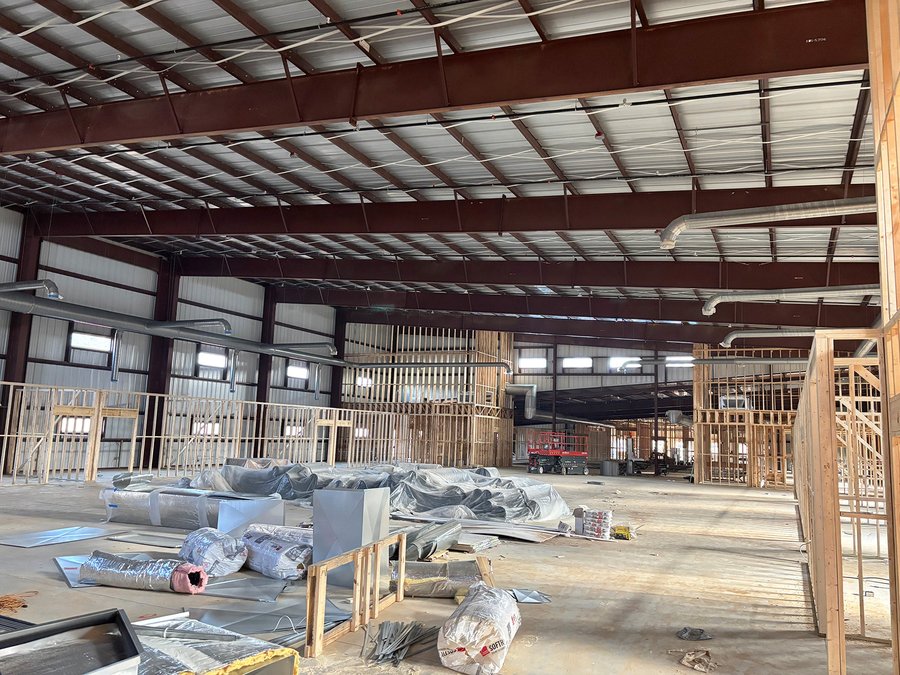
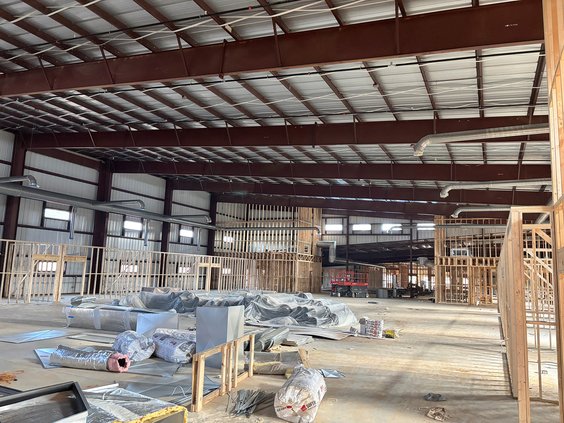
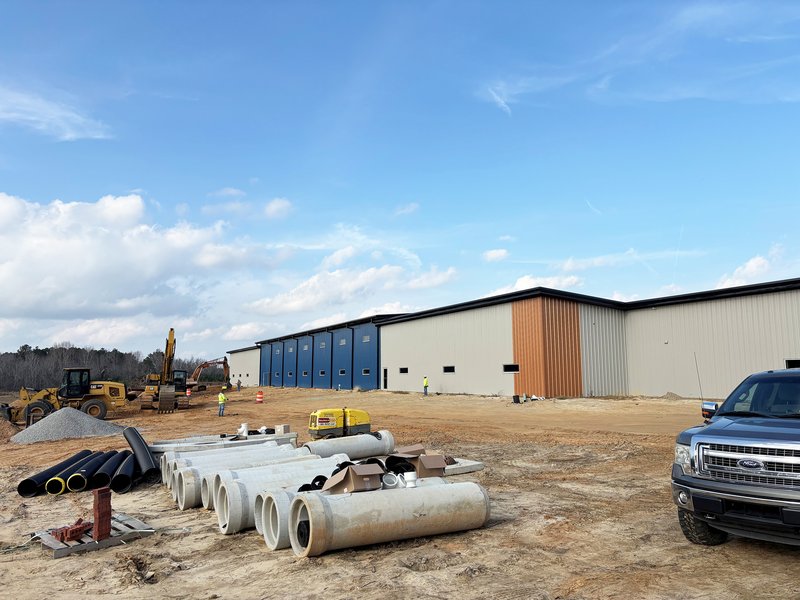
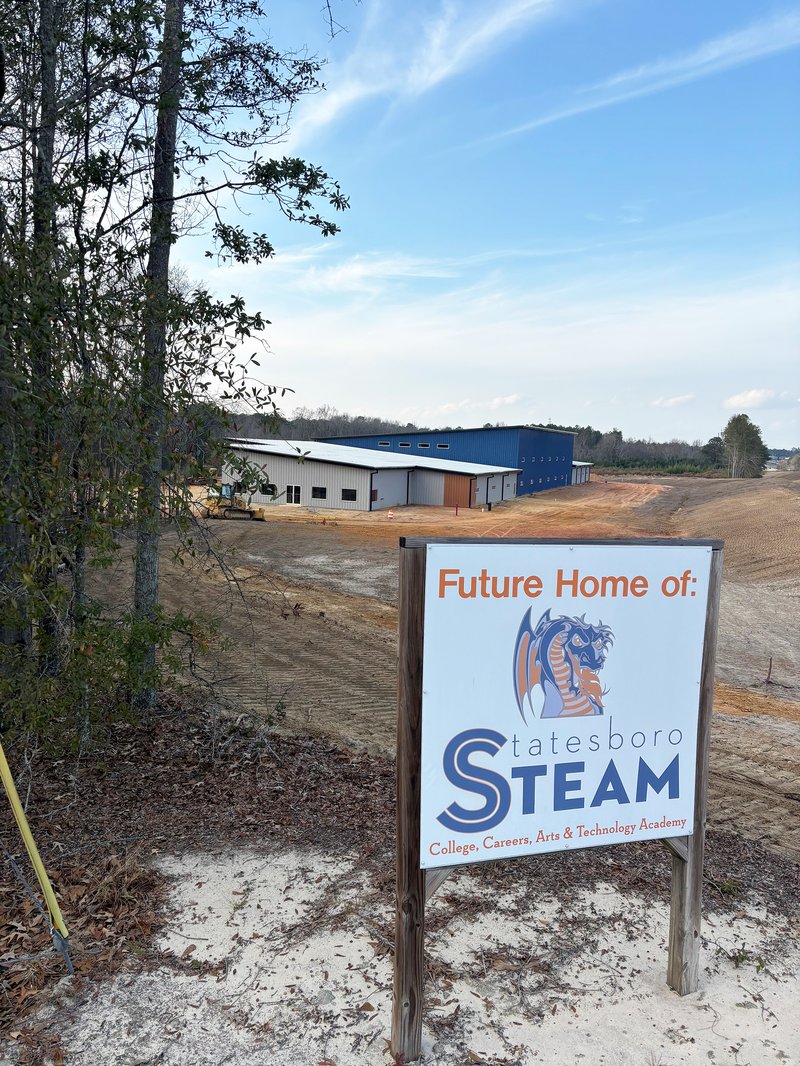
As drivers can see at the intersection of East Main Street and Veterans Memorial Parkway, the new home of Statesboro STEAM Academy has already taken shape. Corliss Reese, the charter school’s principal and superintendent, says the approximately $9 million steel-and-concrete building is on track to be completed this spring and open to students this summer.
Ten months ago, on Feb. 28, 2025, STEAM staff, faculty and board members were joined by contractors and some Bulloch County government officials for the groundbreaking ceremony. At that time, the scheduled completion date for the building was March 26, 2026. With two and a half months to go, Reese said that remains a valid prediction.
“We’re still on track,” he said. “It feels great to see the progress. The contractor that we have, he’s doing a great job of keeping things on schedule, moving, even checking in with us to give us an opportunity to preview things, make sure things are going well inside.”
Hawk Construction is the general contractor and main builder, with Mill Creek Construction also working on some aspects, such as the grounds work. Signs at the site have also identified EMC Engineering and some other firms with roles in the project.
Reese hopes to be able to start moving things into the building “sometime in the spring, early summer,” and “at some point be able to have a nice little preview for the community, a ribbon cutting ceremony and those kinds of things,” he said. Then it should then be ready for teachers and students to begin the 2026-2027 school year there, but with classes to start on a yet-to-be-announced day in August.
That signals an anticipated delay, since STEAM usually starts its school year in mid-July, earlier than most area schools.
The all-new facility will be the first building or campus that Statesboro STEAM, which opened in 2002 as the Charter Conservatory for Liberal Arts and Technology, has owned. For more than two decades now, the school has been growing inside a leased, former commercial building at 1718 Northside Drive East. It encompasses about 24,000 square feet.
So, the new 36,000-square foot building will be 50% larger. Designed to accommodate up to 415 students, it would allow the school to grow to at least the maximum number currently allowed under its state charter, 390 children and teens in kindergarten through 12th grade.
Actually, Statesboro STEAM has recently been adding one lower grade every year or so. After enrolling about 210 students in fifth through 12th grades for the 2024-2025 school year, the school added fourth grade, with just 15 fourth-graders, for the current school year, 2025-2026, but still has only about 210 students. The number of high school seniors varies from year to year, sometimes leaving more seats for lower grades, Reese explains.
Although an expansion down to kindergarten has been announced for the new building, STEAM will still add just one new grade, third grade, for 2026-2027. Reese expects that to bring total enrollment to about 250 students next term as the school continues phased growth toward its maximum.
“Next year we’ll start with third, have third through 12, and we’ll grow a grade down each year,” Reese said. “Right now we’re at fourth grade in this (the old) building, and then next year we’ll have another half of fourth grade and one half of our third grade.”
The current full name, “Statesboro STEAM College, Careers, Arts and Technology Academy,” was introduced with a new state charter approved in 2016. Of course, the STEAM part suggests an emphasis on science, technology, engineering, arts and mathematics.
Still ‘flexible’ spaces
One thing that won’t change with the new building is the use of free-form, adaptable learning spaces. The classrooms will not have traditional walls, instead, “utilizing movable partitions and post and beam elements to create flexible learning spaces that can be easily reconfigured,” stated a description released before last year’s groundbreaking.
“This design encourages collaboration and interaction among students and teachers,” it stated.
Anyone who has been inside the current Statesboro STEAM location while classes are in session knows this could also be a description of that older building and the academy faculty’s established methods.
The new building will be getting some refreshed technology, with Arista Networks, a California-based company, expected to donate all the networking and Wi-Fi equipment. That was announced last year by Stuart Gregory, business development director for Bulloch Solutions, also a partner with STEAM in this project, and Reese said this is still happening.
An outdoor learning area is also part of the plan.
Home games at last
But one really new experience awaiting the STEAM community at the new campus, which is on a 50-acre site owned by the school’s nonprofit corporation, is the ability to host home games in sports. The building includes a gym – the central, blue portion of the complex – featuring a full-size basketball court, volleyball nets and multi-sport flooring. Outside, there will be competition soccer and baseball fields and a track, as well as playgrounds.
The soon-to-be former, leased location has no gym or sport fields. STEAM has developed athletics programs over the years in basketball, soccer, track and cross-country, but had literally no home turf to host competitions.
“All of our sports teams travel to different places to play,” Reese said. “There closest thing to a home game is playing in Statesboro at somebody else’s gym.”
Longterm financing
In July 2024, the Bulloch County Board of Commissioners approved a request from the Development Authority of Bulloch County to issue up to $13 million worth of tax-exempt bonds on behalf of Charter Conservatory for Liberal Arts and Technology Inc. for the new facility.
But the actual cost to build and equip the new school has been limited to $9 million, Reese said. The nonprofit will have 30 years to repay the bonds, in scheduled annual amounts.
As a state-chartered school, STEAM receives direct state funding for its annual operations and maintenance under Georgia’s Quality Basic Education, or QBE, formula, based on its number of students. The school cannot charge tuition. Although its allowed attendance area is Bulloch County, STEAM operates under its own governing board, entirely separate from the Bulloch County Board of Education.
As a charter school it receives no state capital outlay funding for facilities and has no share in local sales tax or property tax revenue. But it will use a portion of its QBE funding to repay the bonds, just as the school has used this funding to pay rent.
“So we just have to budget carefully and thoughtfully to be able to afford this,” Reese said.
Incidentally, 2026-2027 will also be Reese’s 20th school year with the academy. While in the role of superintendent under the charter, he is also “principal” in the old-fashioned sense of chief teacher. As one of the school’s 28 current faculty members, he teaches fifth-grade science, math and English-language arts.