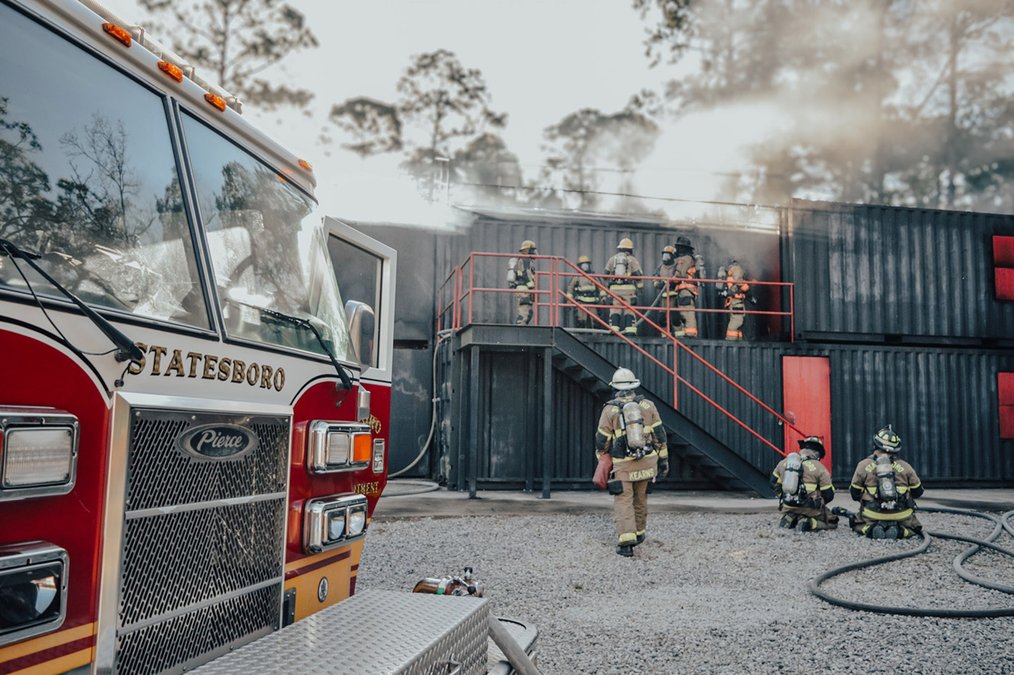
The city of Statesboro will host a meeting at 6 p.m. on Monday, Feb. 9, in the Council Chambers of City Hall to provide an overview of a fire service fee being considered as a possible future funding mechanism for fire protection services within the city limits.
The public meeting was announced in an email from the city Monday afternoon.
City staff members and a consultant brought City Council a framework at its Jan. 20 meeting for a fee to residents, businesses and nonprofits to fund the Statesboro Fire Department at its current staffing and expected growth and partly offset what would otherwise be a nearly 4-mill projected cost in property taxes.
One year ago, the council had approved a $60,000 contract with the engineering and planning consultant firm Goodwyn Mills Cawood, or GMC, to conduct a feasibility study for a fire service fee. It would be billed to all or almost all city service customers within Statesboro, including tax-exempt properties.
The Feb. 9 meeting will include a presentation explaining what a fire service fee is, why the city is evaluating the option and how a fee could be structured and applied. City staff and representatives from the city’s consulting firm will be available to answer questions and receive public input.
A longstanding intergovernmental agreement under which the Statesboro Fire Department provided service to areas of Bulloch County outside the city limits within five miles of the SFD’s two fire stations ended June 30, 2025, and an expanded Bulloch County Fire Department now serves all areas of the county outside Statesboro.
So, the city no longer receives a share of the county’s fire service property tax millage. That share was previously about $2.5 million, while the city government in the final year also transferred about $1 million of its own property tax revenue to its fire fund.
“The impact of the county’s decision to discontinue our fire district was like $2.5 million financial impact, and even at $2.5 million, we were still having to subsidize the operation of the Fire Department out of the general fund,” Penny told council members at the Jan. 20 meeting, “and so … to try to mitigate that … revenue shortfall, we need to look at a more equitable way to fund the fire service, so the fire service fee is a way to do that.”
Need for the fee
According to Monday’s release, the proposed fire service fee would be structured similarly to the city’s other service-based fees and would be based on property characteristics, such as building area and land use.
“The intent is to better align funding with the cost of maintaining readiness and emergency response across the community,” the release stated.
Fire Chief Tim Grams emphasized the importance of transparency and fairness as the city considers options.
“Fire protection is a core service, and we want to be upfront with the community about how it’s funded and why the city is evaluating a fire service fee,” Fire Chief Tim Grams said in the release. “A fee structure can be a more equitable approach than relying solely on property taxes because it focuses on service demand and the costs of providing readiness and response, rather than property value alone.”
At the Jan. 20 meeting, Ed DiTommaso from Goodwyn Mills Cawood showed a chart of the Statesboro Fire Department’s budget from fiscal year 2021 through FY 2026. DiTommaso said the cost has “essentially doubled over the past five years,” from $3.54 million in 2021 to almost $8 million this year.
“A lot of that has to do with staffing up to maintain the population growth the city has seen over that period of time,” he said.
Proposed fee structure
The fees would be based on rates for three different kinds of property: residential, “non-residential” and undeveloped. The “non-residential” category would include not just commercial buildings, but all types of buildings, except single-family homes, DiTommaso said.
For “residential” structures, in other words single-family homes, the basic rate would be 1 cent per square foot, from a minimum monthly charge of $5 to a maximum charge of $25. The rate for non-residential buildings would be 2 cents per square foot, from a minimum of $5 to a maximum of $300 a month. Fees for undeveloped areas would range from $5 up to $200 a month.
According to GMC’s summary, the average residential fee would be $23.25 a month, totaling $279 a year. The average commercial fee would be $141.58 a month, or $1,687 annually. These were compared to a 4-mill property tax hike that might supply the same amount of funding to the Fire Department but cost about $400 annually when applied to a $250,000 market-value property, $640 on a $400,000 property, or $960 a year on a $600,000 property.