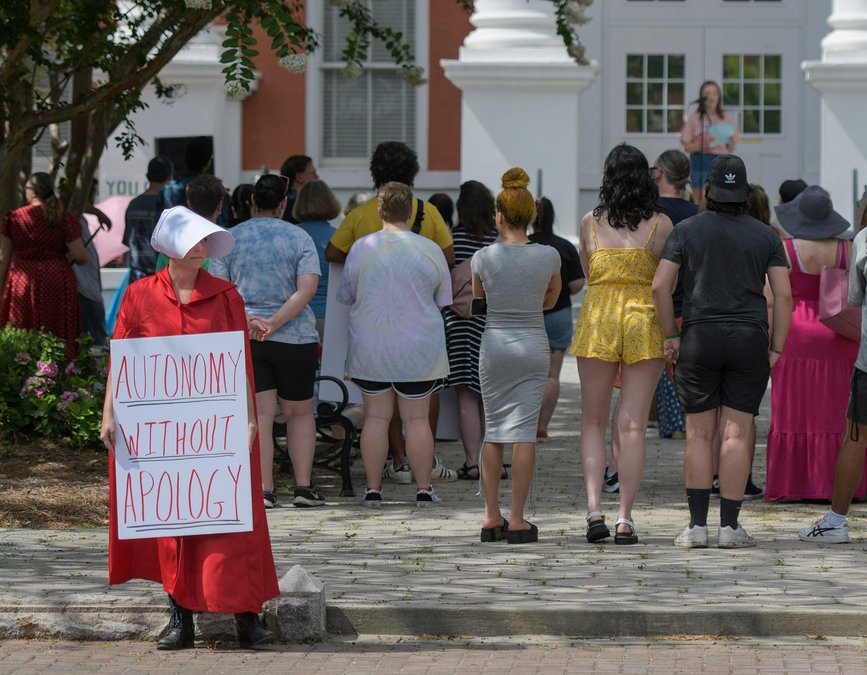

Of course, participants in Rally for Roe 2.0, which drew nearly 100 individuals to the Bulloch County Courthouse grounds Saturday afternoon, were protesting against the recent 5-4 U.S. Supreme Court decision overturning the 1973 Roe v. Wade ruling, which had made abortion legal nationwide for 49 years.
But warning of a broader loss of bodily autonomy and privacy rights, speakers also voiced sadness and anger about other recent rulings and foreboding about where the court’s conservative majority may be headed on issues such as same-sex marriage and contraception. Three organizations – the Young Democrats of Georgia Southern University, the Students with Disabilities Advocacy Group and the Madeline Ryan Smith for Georgia campaign – sponsored the rally.
In fact, the first Supreme Court decision that emcee Shay Paulk mentioned in her own remarks was not Dobbs v. Jackson Women's Health Organization, the June 24 decision reversing Roe, but one in a different case entirely.
“It is a dark and frightening time in the United States,” Paulk said. “On June 23rd, the Supreme Court ruled that the Constitution provides a right to carry a gun outside the home, extending concealed carry protections federally. This comes in the wake of two major tragedies in Buffalo, New York and in Uvalde, Texas as a result of gun violence.”
She observed that the 2nd Amendment case, in which the court by a 6-3 vote overturned some states’ longstanding restrictions on permits to carry firearms, came as Congress was advancing the most significant gun violence prevention legislation in almost 30 years.
“It was a political decision,” Paulk said.
On June 28, the court ruled that the Environmental Protection Agency could not dictate that electrical power generation be shifted from one source to another.
“This will impact the EPA’s ability to address climate change within the United States,” Paulk said. “It was a political decision.”
Then, she noted the June 24 ruling reversing Roe v. Wade.
“Five people, three of which were appointed to the Supreme Court by a president who lost the popular vote, have effectively acted to end protections for something for which 61% of Americans support in almost all, or most cases. …,” Paulk said. “Make no mistake, this was a political decision, and they will not stop at this.”
Other rights next?
She mentioned Griswold v. Connecticut, a 1965 Supreme Court decision that prohibited states from banning the use of contraceptives by married couples, and Obergefell v. Hodges, the 2015 case that legalized same-sex marriage nationwide, as having been based in the court’s previous reasoning that there was a constitutional right to privacy, as in Roe v. Wade.
Paulk, a Georgia Southern graduate student in political science, noted that Justice “Clarence Thomas in a concurring opinion wrote that these cases should be evaluated.”
The new Supreme Court decision does not ban abortion. But it returns the question to the state governments to decide. As Paulk noted, 13 states had “trigger laws” that now ban abortion in most cases. Georgia did not have a trigger ban, but a 2019 Georgia law could now be allowed to take effect, prohibiting abortion after about the sixth week of pregnancy.
Protest chants
She introduced four chants and led them at intervals through the rally, calling “My body!” for the crowd to respond, “My choice!” and at other times, ““Bans off!” for the reply “Our bodies!” … “Ho ho, hey hey!” “Our choice is here to stay!” … “What do we want?” “Choice!” “When do we want it?” “Now!”
Elisabeth Malloy, a former Democratic Party of Georgia community organizer who attained a political science degree from Georgia Southern in 2020, started on a general note and then took her remarks in a very personal direction. She noted that surveys show a larger majority of Americans “think abortion should be legal in at least some cases,” and said that makes them “pro choice.”
“I could talk about the dangers of living under a legal regime in which medical abortion is illegal, where more desperate people will inevitably attempt to end their pregnancies and could be targets of prosecution,” Malloy said.
But speaking from a personal standpoint, she said she had grown up in an abusive environment and saw a college education and political activism as a way out. Then she became pregnant at 19 and chose to have an abortion.
“It doesn’t matter what medical decisions I made with my doctor, because the reality was, it was my right,” Malloy said. “It was my right to direct my life in the way I chose for it, and I had the ability to do so, and I no longer do. That abortion saved the trajectory of my life.”
In the four years since she has worked on successful campaigns of candidates for local and national office. Malloy encouraged rally attendees to support organizations that will help women find access to safe abortion.
Madeline Ryan Smith, Democratic candidate for Georgia House of Representatives in District 158, and Jill King, who is secretary of the Young Democrats of Georgia, president of the Students with Disabilities Advocacy Group and Smith’s campaign manager, were two of the rally’s lead organizers. They were interviewed before speaking from the courthouse steps.
“A lot of the messaging on the left is about abortion access … but it’s much more than that,” Smith said. “It’s freedom of choice, bodily autonomy, keeping the government out of your doctor’s decision that you are making when you’re in your doctor’s office. So not only is it abortion, but also really is about equal access to everything, including a right to privacy.”
As Students with Disabilities Advocacy Group leader, King said, “When it come to making any sort of health care inaccessible, it becomes dangerous to the disability community, so that’s really why we’re here today, my organization, anyway.”
Paulk, Malloy, Smith and King are all women in their 20s.
A man, a minister
Blake Robinson is a young Georgia Southern student and one of the university president’s advisors on inclusive excellence. Identifying as “a gay, black man in America,” Robinson spoke of a push for the return of abortion rights as part of a long, continuing struggle for human rights.
“Let us live, let us grow as people to accept and love those who we wish to love,” he said. “This is the only true quest for all of us. We only wish to be treated equally, as members of the same human race.”
There were some older speakers. One was the Rev. Dr. Jane Page, pastor of the Unitarian Universalist congregations in Statesboro and Brunswick, and a grandmother. She said she was speaking out not in spite of her religion, but because of it.
“This anti-choice decision by the Supreme Court infringes on many of our deeply held religious beliefs,” Page said. “Access to abortion and the right to choose is an issue of gender equality, bodily autonomy, and religious liberty, all of which are long-held Unitarian Universalist religious teachings.”
She said that “curtailing reproductive rights will be felt most by people of color, young people, poor and working-class people, and those living in rural areas.”
Protestors carried signs with messages similar to those of the chants, some with more profane terminology or humor, several with diagrams of uteruses.
The “2.0” of the title reflected the fact that the Young Democrats held a “Rally for Roe” May 15, before the court’s final ruling. This time there was no sign of counterprotest, except possibly someone yelling, “I love babies!” from a passing vehicle. Some drivers honked their horns.