Drew Swanson, Ph.D., the Georgia Southern University history professor who previously detailed the re-establishment of Georgia's whitetail deer population, now stalks brightly lit Cabela's stores and dusky old magazines, scoping ideas for a book on the consumer culture of American hunting.
In fact, Swanson, who holds the title of Jack N. and Addie D. Averitt Distinguished Professor of Southern History, spoke to the Bulloch County Historical Society about his more deer-specific research two years ago, in June 2023. Monday, he was back for another Historical Society monthly luncheon to talk about a few major figures who from the late 19th through the mid-20th century helped build the U.S. hunting equipment and supplies industry into the $26 billion a year trade it now represents.
A subtopic of this tale is how, through a federal law dating from the 1930s, purchases of guns and ammo have funded wildlife conservation efforts, especially of game species.
"It's a book that I'm writing about hunters, about the things they buy and about wildlife conservation, in other words how consumerism is actually connected to the survival of a number of game species in the United States," Swanson said. "It's a project that began in a Cabela's store in Ohio."
For Georgia residents who aren't that familiar with outdoorsy gear shops, a Cabela's store is very similar to a Bass Pro Shops location, except that Cabela's was originally more hunting-oriented while Bass Pro gave more emphasis to fishing. They may have become even more alike, since, as Swanson noted, the Bass Pro Shops corporation bought Cabela's in 2016.
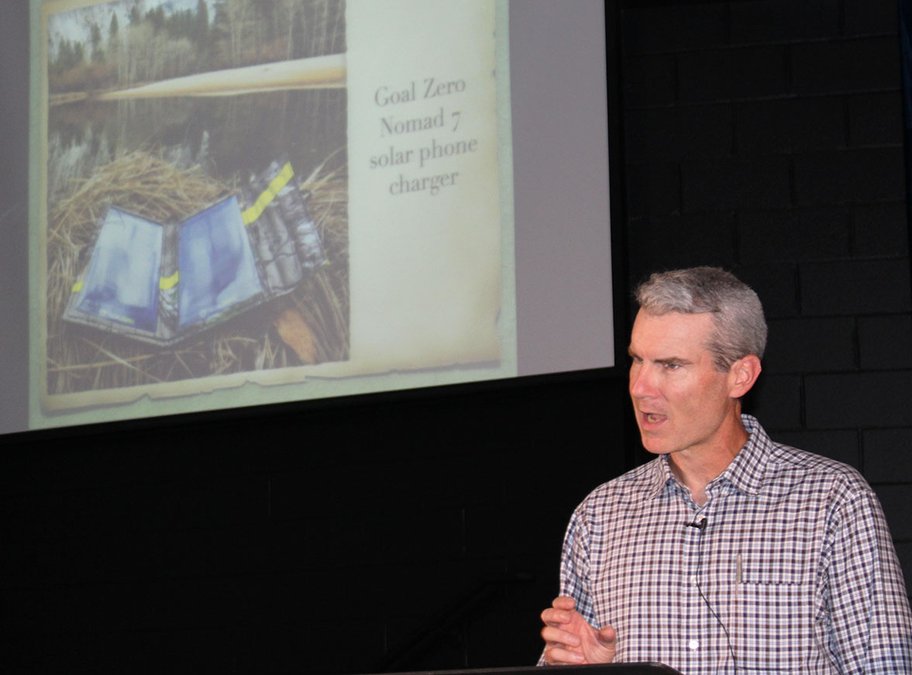
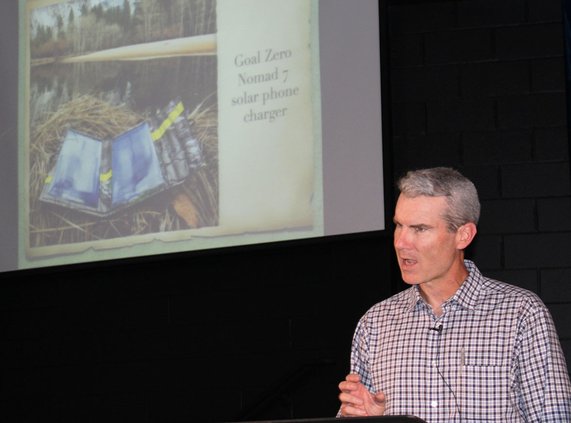
Sharing a slideshow photo of a folding solar panel he found in a Cabela's store, he noted that the product's function was to charge cell phones and similar gear while in the wilderness. The ad description proclaimed that the charger would help "keep you in touch while you get away from it all."
That apparent contradiction set him thinking how "our outdoor activities, whether hunting or fishing, camping, hiking become tied into the broad consumer culture" Hunters, for example, "go to the woods to get away from it all but they sure do take a lot of stuff with them," he said.
Citing a $50 billion estimate for the current annual value of American sporting goods sales, Swanson commented, "About $26 billion of that $50 billion is directly tied to hunting. It's guns and ammunition and similar things."
But that overall $50 billion does not include less directly connected purchases, such as a "jacked-up 4-wheel-drive truck" or a Bass Pro Shops branded credit card or other items he suggested are motivated by the pursuit of game-and-fish adventure and might double the value.
Reaching back for the roots of the industry, Swanson profiled three "characters" Swanson said might now be labeled "influencers" except that they lived decades before Tik Tok.
Kephart's breakdown
The first such influencer he singled out, Horace Kephart, "is sometimes called the dean of modern hunters and campers," Swanson said. Kephart, who lived from 1862 to 1931, actually started his literary life as an Ivy League-educated librarian, serving as director of the St. Louis Mercantile Library, in Missouri, 1890-1903, but meanwhile writing about his hunting and fishing trips.
"In the late 19th century, Americans were increasingly convinced that modern life was giving middle-class people nervous breakdowns," said Swanson. "In fact, they invented a term for it; they called it neurasthenia. If you had neurasthenia, you were being broken down by getting stuck at the office and not doing what people were meant to do."
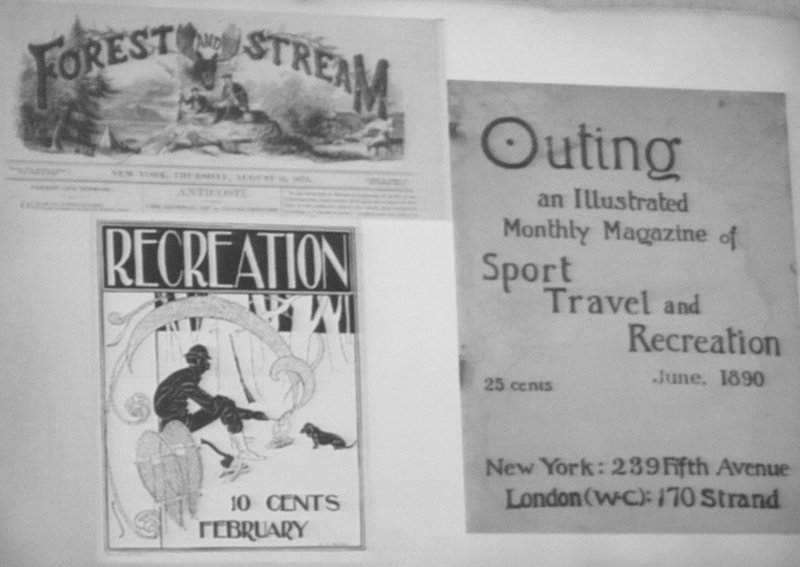
Trying to escape such a "case of the nerves," in 1904, the hard-drinking Kephart left his wife and six children and moved to the mountains of western North Carolina.
There, he began collecting stories from Appalachian people and writing about his and their exploits. One of his best remembered books is the memoir "Our Southern Highlanders," published in 1913, but he also published books about topics such as camp cooking and his preferred guns for hunting. Kephart became a key advocate in the establishment of the Great Smoky Mountains National Park and an early promoter of the Appalachian Trail concept.
But in his day, "he was known for writing about hunting, camping and the gear that was associated with them," Swanson said. "So the way that he fueled his stay in North Carolina, and his alcohol consumption, was to write prolifically for national magazines."
Kephart sold the idea of outdoor adventure "as manly, as masculine," but he also sold a lot of his favorite brands of "stuff," as "he wrote article after article about things that you should buy to get that deer, to catch that fish, to not freeze to death," said Swanson.
Eventually, Kephart marketed a "Kephart" sheath knife and his own brand of ammunition for a specific kind of rifle.
Dr. Pope, bowhunter
The second such influencer Swanson described was Dr. Saxton Pope, 1875-1926, who was born in Texas but graduated from medical school at the University of California, Berkeley, where he remained as a surgeon.
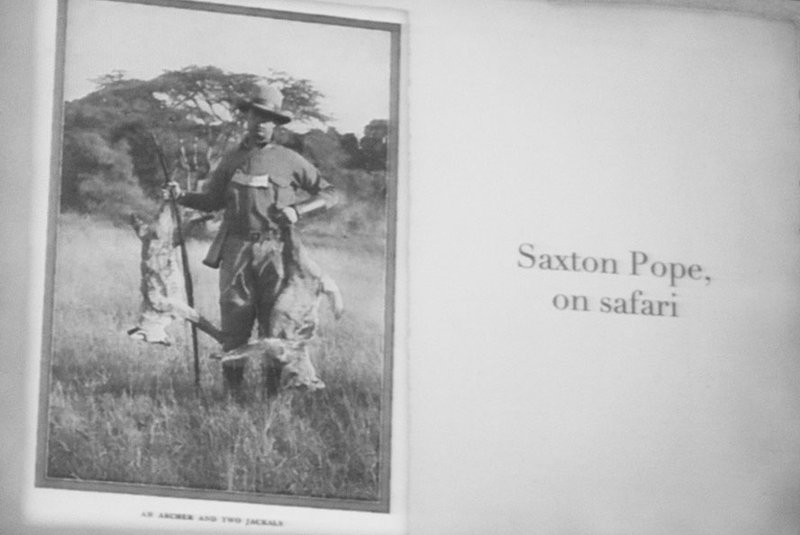
Pope took up bow hunting after befriending a Native American man named Ishi, purportedly the last unassimilated member of the Yahi tribe of California. "Adopted" by Berkeley anthropologists for their study of his culture, Ishi worked as a janitor at the university, and "the story goes that Yishi teaches Pope the dying art of Yahi archery," said Swanson.
As Pope published articles and books, he included instructions, with detailed drawings, for how to make arrows and other archery gear, convincing manufacturers to make the materials that would go into these. Swanson showed some of the illustrations. Pope eventually also recommended specific models of manufactured bows and other items.
It was with another hunting companion, Arthur Young, with whom Pope most famously went on bowhunting expeditions not only for bears, mountain lions and other large animals in the United States, but to Africa for animals such as wildebeest, zebra, leopards, even lions, the professor explained. The Pope and Young Club, the bowhunting organization named for them, still exists and maintains trophy game records.
Weatherby's magnums
The third such influencer Swanson talked abut was Roy Weatherby, 1910-1988, founder of the rifle, shotgun, ammo and scope company Weatherby Inc. Originally from Kansas, he moved to Southern California, where he first prospered as a car insurance salesman while developing his passion for gun and ammo design in his garage, as Swanson tells it.
Weatherby directed his inventiveness to making high-velocity, originally relatively small-caliber cartridges he called "magnums," and also designed specialized rifles that would shoot these. Eventually he owned his own factory and also teamed up with a Swedish-based international ammo manufacturer, Norma.
In Los Angeles, he had first become "custom gun maker to the stars," Swanson said, projecting a photo of Weatherby with Marion Morrison, better known as John Wayne.
Conservation funding
Saving for last what all of this has to do with wildlife conservation, Swanson talked first about the opinions of these influencers, and then about a law.
"Kephart, Pope, Weatherby, others like them, they all stressed the importance of preserving the nation's game population," he said. "In other words, they said the two things weren't mutually exclusive, right, just because you bought stuff, didn't mean you didn't care about nature."
The Pittman-Robertson Act, a federal law enacted in 1937, maintains an 11% excise tax on firearms, ammunition, and, by later amendment, archery equipment. The law requires that the revenue be distributed through the U.S. Fish and Wildlife Service to state governments for efforts in restoring and managing wildlife and habitat.
This goes mostly for conserving hunted species, as was the original intent, "although some of that money trickles down for nongame species," he said.
A similar law, the Dingell-Johnson Act, passed in 1950, created a similar arrangement for funding fish conservation projects from a tax on fishing gear.
"So about 75% of all the money that Georgia spends on outdoor conservation is tax money from consumers who go hunting and fishing, and that's before we talk about license sales," Swanson said.