
"If there is any time in my captivity I remember with pleasure, it is the time during that I worked at your farm with my comrades," former Wehrmacht warrior Bernhard Erbelding wrote from Kirkel-Neuhausel, Saar, Germany, to Sam Neville of Register, Georgia, in February 1947.
"We often spoke of you and remembered your benevolence and kindness," Erbelding continued. Local testimony reveals that the kindness involved Southern cooking served up at a big table on a farmhouse porch.
A little more than 70 years ago, from 1943 through 1945, World War II prisoners of war who were officially still members of Nazi Germany's and Fascist Italy's armed forces helped harvest peanuts and do other work on Statesboro area farms.
As a cache of rediscovered letters reveals, the captive Axis soldiers were so well treated by one local farm family that some of the men sent apparently fond remembrances - and requests for relief packages - from devastated Europe in the two years immediately after World War II.
The Bulloch County Historical Society dedicated a marker Thursday at the site of the POW camp in Statesboro, and called attention to the letters and the work of some Georgia Southern University history students.
The heavy, cast-aluminum marker with gold-leaf lettering, the 19th to be placed by the Historical Society, stands beside U.S. Highway 301 North, near the indoor Statesboro Flea Market.
‘A bit of ... mystery'
After two years of research, members involved in the project are now confident that this was the site of the actual prison camp, said Bulloch County Historical Society President Joe McGlamery. Georgia Southern University Museum Director Brent Tharp, also a society member, explained that determining the location took some detective work.
"This is a good example of a little bit of historical mystery," Tharp said. "We had a number of folks that responded to our request in the newspaper for stories, and others to come out and talk with us. We had some folks who remembered it at the airport. We had some who remembered it much closer to this location ..., some who even remembered it right downtown."
Each of these versions turned out to contain elements of historical truth, he said. Although the main camp was at the marker location, Army barracks were located at the airport, so people remembered troops moving in and out and training there. Meanwhile, the prisoners of war were taken to a holding pen downtown, near Hill Street, for farmers to pick up for work details.
Newspaper accounts, minutes of city meetings, and the oral histories all provided clues, and an aerial photograph of the area clinched the case, Tharp said.
The Statesboro camp, which held both German and Italian prisoners of war, was a subunit of a larger prison camp, on what is now Fort Stewart, then Camp Stewart. Another such satellite camp was located at Swainsboro. The Geneva Convention prohibited forcing prisoners of war to work, but those who volunteered received a measure of freedom outside the wire in exchange for their labor, Tharp said.
The camps were positioned to serve farmers seeking relief from the labor shortage created by the war effort. As is now stated on the marker, the War Department built the Statesboro camp to house about 150 POWs and American soldiers with the 475th Military Police Escort Guard Company. The Germans and Italians worked 12-14 hour days and were paid 40 to 80 cents per day in credits they could use to buy items at a camp canteen.
They pulled corn, picked up pecans, cut cane and helped with other farm jobs, according to Historical Society and GSU research. But the POW's help in the peanut harvest clearly made the largest impact on local memories, and the marker states that they harvested 57,000 stacks of peanuts in 1944 and 110,000 in 1945.
Leisa Vaughn, 26, a GSU graduate history student from Charleston, S.C., recently completed her master's degree thesis on German prisoners of war held in Georgia during both World War I and World War II. She focused on the prison camp here for the World War II segment.
Serendipitous find
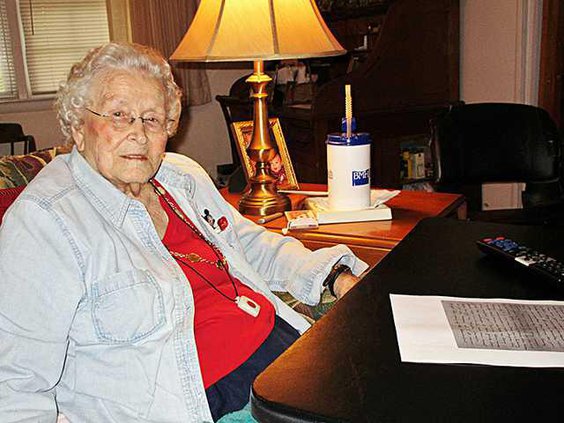
Meanwhile, a GSU senior undergraduate student majoring in history, Miranda Hazelwood, 22, who has lived in Statesboro 10 years, played a serendipitous role in the research. She and her friend Saralyn Neville, 23, found the letters while rummaging in a hall cabinet at the big, wooden farmhouse in southern Bulloch County that is home to Neville's great-grandmother, Naomi Neville, 101, and was the home of her husband Sam M. Neville, who died in 2001 at age 90.
The cache, now in the possession of the GSU Museum, consists of nine letters, written by five German soldiers, from prisoner of war camps in France and their homes in Germany in 1946 and 1947.
At first, Naomi Neville did not remember the letters. But she certainly remembered the prisoners of war who worked with her husband, helping to rack peanuts in 1945, and how she came to feed them every day.
In an interview Friday, Neville recalled that when the Germans were first brought to the farm, a meal consisting of big hunks of pork fat was sent with them from the prison. Consuming it would have been "like eating pure lard," Mrs. Neville reckons. She recalls that her husband figured this was seasoning meat from vegetables cooked to feed the American soldiers in the guard unit.
"Sam said, ‘I can't stand to see people work and not fed any better than that,' and I said, ‘Well, just bring them here and I'll cook dinner for them every day,' and I did, I cooked dinner for them just like I was cooking for my family," Mrs. Neville said.
Of course she doesn't remember details such as whether she made biscuits, but is sure she fed them meat and vegetables for each of the midday dinners.
"They sat there and they laughed and they joked. It didn't start out laughing and joking until we found out that we were friendly, and they were friendly," recalled her son Sam Neville Jr.
Now 78, he was 7 or 8 when the German soldiers ate his mother's cooking. Most of the time the Germans ate on the porch, sitting around a table in an area that has since been renovated to be part of the house, he recalled.
One day it rained, so they all ate indoors, Mrs. Neville said.
She and her husband were never afraid of the men, she said. A soldier with a gun accompanied them, but it was understood not to be a high-security situation.
"The guard was very lenient with them. ... They didn't have chains or shackles. They weren't locked together or anything," she said.
At the time, peanut harvesting involved placing the vines, or shocks, of peanuts on wooden racks to dry for a couple of weeks before they were run through a stationary mechanical picker. So the men were entrusted with pitchforks.
Perhaps contributing to the ease in the Nevilles' situation, by peanut harvest season in 1945, the war in Europe was over, the Allies having accepted the German surrender on May 8.
But the men were still considered prisoners of war. Being returned to Europe by troop ship to Le Havre, France, at least some of the men were then imprisoned by the French, who put them to work on postwar cleanup.
First, from France
So some of the earliest letters are on special stationery the French issued to prisoners of war. Two letters are in German. But Guenter Hoppe's message from Colmar, France, on Nov. 17, 1946 arrived at Sam Neville's place in English.
"I wish you and your family a merry Christmas and happy New Year," Hoppe wrote.
He explained that he had been a prisoner in France since March and added, "It is a pity that we could not remain in the United States, or return home."
Another former POW, Johannes Ruschke, wrote from Hamburg on July 1, 1947 that he had been released from a French prison March 15, 1946 and returned to find his apartment intact and his children there, but that his wife had died in July 1944.
"You can imagine how happy I was to be home. But on the other side I was very depressed. ... We have very little to eat. If we had at least something to smoke or some whisky to drink, but there is hardly anything. The cigarettes we are getting for a whole month, you would smoke on a day, it is so little."
Ruschke also wrote that he had not heard from "the other nine comrades," seeming to indicate that he was one of 10 Germans who worked for the Nevilles that season.
All the letters were addressed to Sam Neville, but Ruschke and others told him they were especially thankful for the kindness shown by Mrs. Neville.
In his February 1947 letter, Erbelding also wrote of the hardships his family was experiencing in Germany. Mrs. Neville responded with a package that included some clothing, and perhaps some canned food, she recalls.
"Receive many thanks for the nice package, especially, in the name of my wife and my boy," Erbelding wrote June 16, 1947. But in that letter, he also asked for other, specific things, including clothing and towels for a baby on the way, and suggested he would in return send stamps that might be of use to American soldiers stationed in Germany.
An assortment of 20 stamps from the Saar region was with the letters.
"These letters illustrate the relationship that was formed between German prisoners of war and the farmers who they worked for during their time in America," Vaughn said. "What we learned from these letters is that, in Statesboro, they left with a good view of Americans."
Herald reporter Al Hackle may be reached at (912) 489-9458.