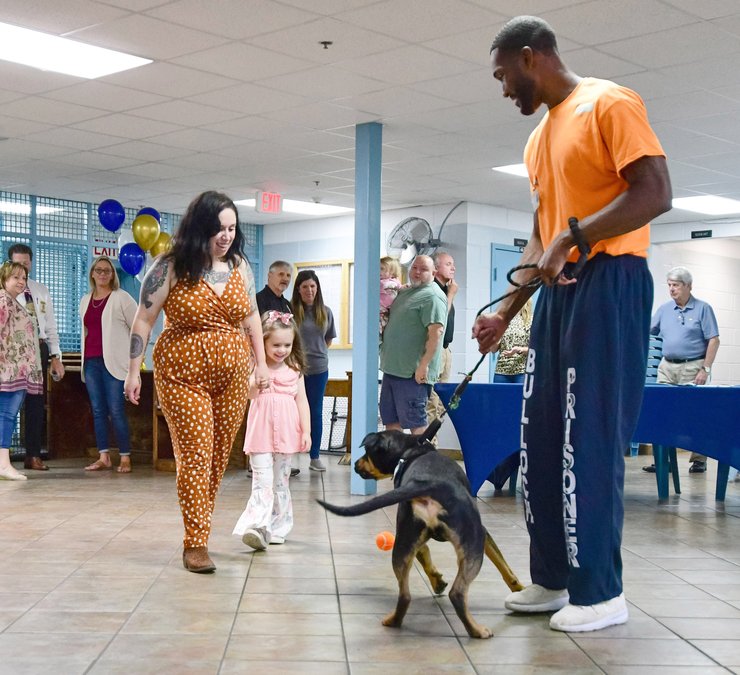
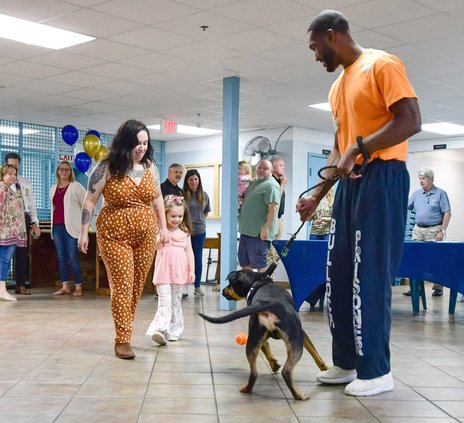
Chief, a 1-year-old Rottweiler mix still growing out of puppyhood, looked tongue-lollingly happy as an inner door of Bulloch County Correctional Institute locked behind him, the outer door swung open and he headed home with his adoptive family, the McBrayers from Pembroke.
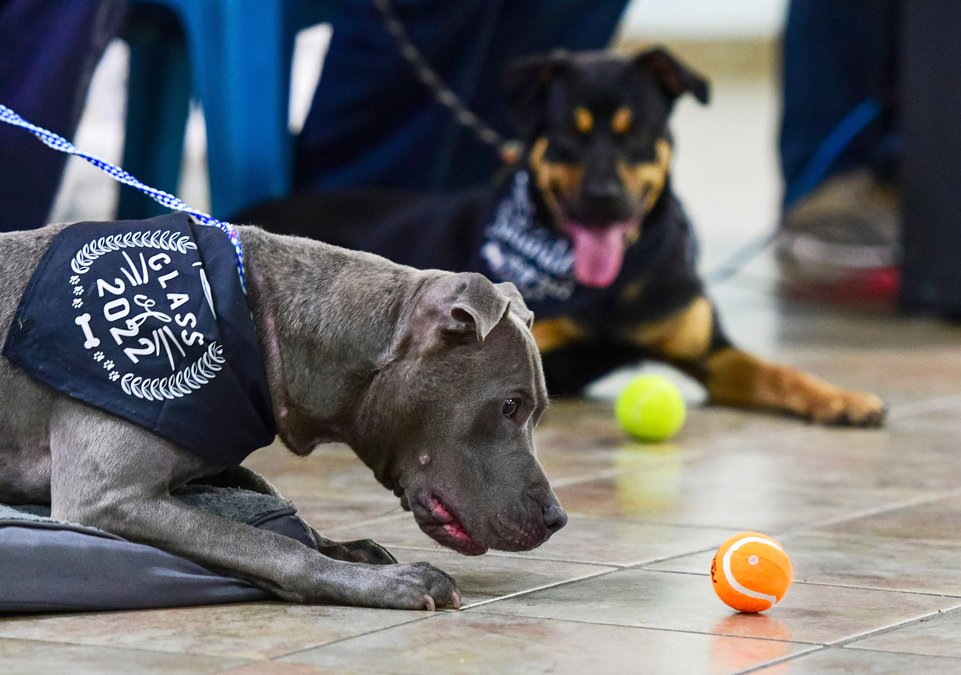
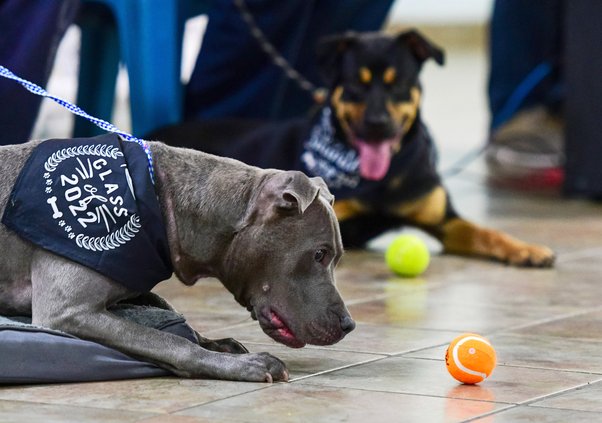
But King, a 2-year-old American pit bull terrier, seemed equally content to remain behind a little while longer with the three inmates who had taken such good care of him and Chief and trained them for the past two months. After all, those guys still had that tennis ball.
Chief and King, the first adoptable dogs trained in the Fostering Freedom program, a partnership between BCCI and Bulloch County Animal Services, showed off their skills and playfulness during the program's first graduation Friday morning.
In an interview, lead trainer Tyberious "Ty" Murchinson explained the process of preparing the dogs for adoption after they are received from the Animal Shelter.
"We get them in, and usually they have a lot of bad behaviors, or they're untrained and don't know anything," he said. "We bond with them over the course of about a week or so, and then we spend the next six or seven weeks kind of teaching them obedience commands, teaching them household behaviors. They walk around the dorm with us. They hang out with us in the dorm. We treat them like pets."
Brought experience
If Murchison sounds like he has been doing this for more than eight weeks, there's a reason. While held at another Georgia Department of Corrections contracted prison, privately run Jenkins Correctional Facility in Millen, he worked with Second Chance Greyhounds, a program that rehabilitates former racing dogs and prepares them for adoption.
"We got retired racing greyhounds, who surprisingly don't get any homelife or any socialization at all, and we took them from being tools to pets," Murchinson said.
In fact, he was with that program for five years, from 2016 to 2021. During that period, a change in attitudes about dog racing increased the number of former racing dogs available for retraining and adoption.
In the past, tens of thousands of former racing dogs were euthanized annually. But several states that hosted dog racing have been phasing it out. In November 2018, Florida voters approved an amendment that put their state's dog track industry out of business by 2020.
Murchinson, 30, who is serving a sentence for an aggravated assault 13 years ago and could be eligible for release in 2024, was transferred to BCCI in March specifically to work with the county-developed program here. Previously in civilian life, he worked for a hospital linen company.
"I never had any trouble maintaining jobs, I just never had any job experience, and then I got here and found animal rescue, and I guess you could say it's been my job inside," he said.
He said he definitely wants to pursue animal rescue work on the outside, even if it's only as a volunteer.
Blairsville example
Of course, Bulloch County's program isn't for racing dogs. It's for animals that arrive at the Animal Services shelter in the usual ways — either animal control personnel picked them up, or they were surrendered by owners or turned in by other people.
The most direct model for the program here was one at a state detention center in North Georgia, said Assistant County Manager Cindy Steinmann, who took the lead in bringing something like it to Bulloch County.
In existence for about a decade, the program at Colwell Probation Detention Center in Blairsville is operated by a nonprofit pet rescue organization in partnership with the state facility. Steinmann, BCCI Deputy Warden Jack Koon and Bulloch County Animal Services Director Wendy Ivey visited there last fall.
"When we went to Blairsville to see the program that they had, I thought that our animal shelter could benefit from that," Steinmann said. "We rescue animals. We're not necessarily a nonprofit, but we are trying to improve our euthanasia rate and become a no-kill shelter, so I thought that this would help carry out that mission."
The Bulloch County staff members made arrangements with the Georgia Department of Corrections to have Murchinson transferred so the pilot program could benefit from his experience.
Selected families
People wishing to adopt the dogs called Animal Services to express interest after information was posted on social media. Ivey said Animal Shelter Supervisor Barbara Diaz worked one-on-one with the prospective pet parents, answering questions and also asking a few.
"Whereas at the shelter we don't per se screen when they adopt, with this program, we want to make sure they do not return to the shelter, being that so much time and training has been put in," Ivey said. "So she just goes through and asks questions — what's their intention for the animal, what reasons do they have for wanting to adopt and to adopt through this program."
She noted that BCCI inmates have worked at the animal shelter about as long as she has, 17 years, assisting with cleaning and caring for the animals. So the new part is that some of the animals get to go to BCCI for training.
Inmates wishing to serve as trainers have to apply and meet certain criteria. For example, they cannot have animal cruelty charges on their records, and they must participate in the institution's education programs.
Inmate opportunity
Inmates who work in this program can earn on-the-job training certifications through Central Georgia Technical College in animal care and animal training. The county staff members hope to add a pet grooming certification, which will require some equipment.
"So we will have three certificates from the Technical College System of Georgia that they can actually take out on the street and get a job," said Koon, the BCCI deputy warden of care and treatment.
Four more inmates are now on a waiting list to become trainers, Steinmann said. The goal is to expand the program to train four animals at a time and continue it throughout the year.
King, the little blue pit bull, had also been slated for adoption Friday, but the person chosen to adopt him cancelled at the last minute.
So staff members were calling other people on their list. They hoped to find him a home by next week, then let the program take about a one-week break before starting again with more dogs.
But Chief left the building with Daniel and Tiffany McBrayer and their daughters Bentleigh, who's almost 5, and Ryleigh, age 18 months. At home they would be greeted by two other dogs and a cat.
"He'll be an awesome addition to our family," said Tiffany McCrayer. "So we're really excited to get him home and get him situated with his new fur siblings."