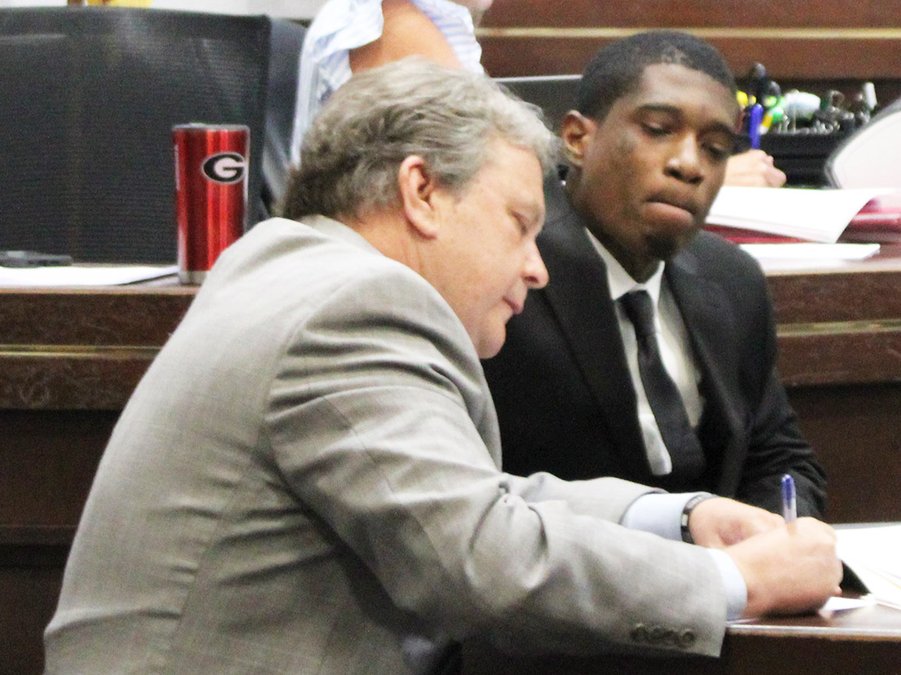
Standing before a judge in Bulloch County Superior Court on Tuesday morning, Anthony DeJarion Kent, 20, of Vidalia entered an “open-ended” guilty plea to all five charges against him for shooting Advanced Patrol Officer Joey Deloach of the Statesboro Police Department on April 16, 2024, and other crimes that evening.
The plea was open-ended because it did not result from a negotiated deal with prosecutors, and therefore carries no agreed-upon sentence. Instead, Judge Ronald K. “Ronnie” Thompson, who accepted the plea, has set a sentencing hearing for July 18, when he could hear witnesses or other evidence brought forward by the defense and prosecution. However, the sentence will be in the range of 10 to 40 years, the minimum and maximum for all of the charges, Thompson agreed with prosecutors from the Ogeechee Judicial Circuit District Attorney’s Office.
Those charges include aggravated assault against a peace officer, which carries a minimum sentence of 10 years and a maximum of 20 years; two counts of felony entering automobiles, each with a maximum sentence of five years; theft by receiving a stolen gun, for which the maximum sentence is 10 years; and felony obstruction of an officer, for which the maximum is five years, but which District Attorney Robert Busbee said would merge into the aggravated assault charge.
Otherwise, the charges could be made to run either concurrently, overlapping one another, or consecutively, added end-to-end.
A “peace officer” aggravated assault conviction carries a special 10-year minimum sentence, but its maximum is the same as for any other aggravated assault, 20 years, said Assistant District Attorney John B. Edwards Jr. The minimum sentence would be one year for aggravated assault of someone who’s not a law enforcement officer.
However, the judge could allow some of the sentence years to be served on probation, and the sentencing would leave open the possibility of parole later by the state parole board, as Public Defender Kirk Cheney noted. He and the circuit’s Chief Public Defender Renata Newbill-Jallow represented Kent through Monday’s pretrial motions hearing to Tuesday morning’s scheduled, but aborted, jury selection.
What would have been the second jury impaneled in this case was not needed, since the attorneys announced by 9 a.m. Tuesday that Kent was ready to plea. But Thompson said he was unwilling to accept the defense’s initial offer of an “Alford plea,” something like a no-contest plea that involves accepting the sentence without admitting the exact crime, on the most serious charge.
He then gave Kent a chance to reconsider the otherwise open-ended plea and attorneys a further opportunity to propose a deal. But they returned to the courtroom, and Kent pleaded “guilty” to all charges, one-by-one, by 10 a.m.
Since Kent was 19 when the crimes were committed, left school after ninth grade and had no previous felony conviction, Cheney suggested the judge might also consider “youthful offender” treatment and directing him to a facility with vocational training for part of his sentence.
“We’ll have a lot more to say at the sentencing hearing as far as any type of mitigation, and I think the court is aware that my client was shot also,” Cheney said.
As Newbill-Jallow had noted the previous day, the evidence showed that Kent and Deloach shot each other. One question the defense attorneys were preparing to raise, if the case had gone to trial and also in the suggestion of an Alford plea, was who fired the first shot. Kent’s injury was by all accounts much less serious, since he was out of the hospital, in jail and able to be interviewed by Georgia Bureau of Investigation agents before sunup the next morning.
If the case had gone to trial, a central part of the evidence would have been video, including video from officers’ body-worn cameras, from private car dash cameras and from a security camera in a restaurant parking lot. Thompson had been shown all of this during the motions hearing Monday and said most of it would be admissible if properly introduced with witnesses at trial.
A wide red line
The first video prosecutors had shown the judge, State’s Exhibit 1 as of Monday’s hearing, was from Deloach’s body-worn camera.
For background, around 10 p.m. on April 16, 2024, the SPD had received a call that an unknown person was in the parking lot of the Copper Beech complex on Statesboro Place Circle “checking” car doors. Eight officers initially set up a perimeter and started walking in to cover the whole lot, according to previous police statements.
In the body-worn camera image, the suspect in a car with its passenger-side door open was visible only for an instant as Deloach approached.
“Let me see your f…ing hands! Get on the f…ing ground!” the officer yelled.
Immediately after that, shots were fired rapidly, two semiautomatic pistols exchanging fire and sounding almost like a machine gun burst.
Backing up, Deloach trailed a wide, bright red line of blood, clearly visible on the pavement, for some distance.
“Shots fired. I’m struck in the leg!” he yelled to his uniform-attached police radio.
Breathing heavily, he fell to the ground.
Other police radio traffic and sirens could be heard.
At least two more officers arrived. One said, “Breathe! Joey, Breathe!” and Deloach replied “I’m breathing.”
Not everything was visible in the video, which lasted a little over two minutes, but it was around this time that Officer Nicholas Sparks-Hoskins reportedly applied a tourniquet to Deloach’s leg to stop the gushing of blood. Officers loaded Deloach into a patrol car and transported him to East Georgia Regional Medical Center.
Beyond the scope of the videos and hearing, Deloach was flown from EGRMC to Memorial Health University Medical Center in Savannah. He had received a wound from a bullet that struck the femoral artery in his left leg. After multiple surgeries and a nine-day hospital stay, he went home to continue his recovery before returning to active duty last September.
Using courtroom screens, prosecutors also showed a couple of brief videos from private car dash cameras in the Copper Beech parking area the night of the shooting. In one of these videos, the shots fired seemed countable, at least 10. One shot shattered a car’s window.
Edwards also showed still pictures taken from the video, and paused the video, to show the glimpse of the individual in the car door. His clothes and shoes looked like those Kent was wearing in other video clips from that evening.
These included brief video of someone, who prosecutors said was Kent, checking car doors, and later running, or walking quickly, through a parking lot at the Waffle House, as seen on a security camera there.
Treated and jailed
A somewhat longer video segment was from the bodycam of an officer who trailed the suspect from the Copper Beech complex through a wooded area to Brampton Avenue. When the officer emerged on the street, blue lights could be seen of a police vehicle, as other officers and sheriff’s deputies apprehended Kent. The video continued as officers attempted both to restrain him and render first aid. No blood was visible in the video, but he did reportedly have a gunshot injury to his right leg. An ambulance arrived to take him to EGRMC, where he was treated, released around 1:15 a.m., and transferred to the Bulloch County Jail.
There, at the jail, two GBI agents interviewed Kent less than four hours later, with a half-hour audio recording beginning at 4:39 a.m. April 17, 2024.
That audio was played for the judge Monday, but whether he would have allowed it into evidence for trial remained an open question, which now does not have to be answered.