The Bulloch County Board of Education has sailed into its fiscal year 2027 budget-setting work at a transitional time, with both Superintendent Charles Wilson and Chief Financial Officer Alison Boatright having retired Tuesday. March 31.
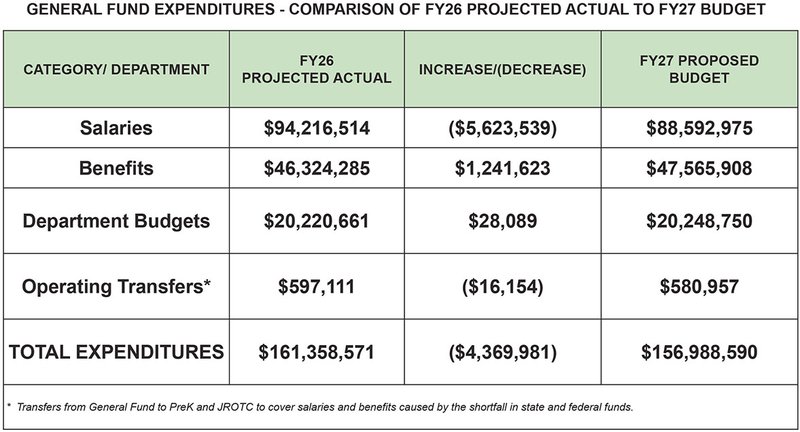
Boatright, with a presentation to the board during its Thursday evening, March 26, regular “work session,” launched the process with projections for spending and revenue. Among other things, she showed that the school district, after eliminating 23 “central office” positions and six other jobs, could have fiscal 2027 salaries totaling $5.6 million less than the currently projected actual 2026 salaries.
But those total general fund salaries (which do not include those of the school food service or federally funded programs) were originally budgeted at a little over $92 million this year. That was before a state-enacted $1,000 mid-year supplement to each custodian and $2,000 recent state-mandated and partly state-funded bonus to all school system employees added almost $2.2 million.
But the almost $88.6 million projected for general fund salaries in fiscal 2027 is still $3.4 million less the current year’s original budgeted salaries, a 3.7% decrease. The new fiscal year will begin July 1, 2026.
“We do have an elimination of 23 central office positions and six Resource Regulation Room program positions,” Boatright reminded the board members. “Resource Regulation Room is a special education program. That was a pilot, and it just did not work out. So that total reduction from elimination of positions is about $2.31 million for salaries.”
Some other reductions in budgeted salaries resulted from “normal variations,” such as temporary vacancies or lower salaries for less experienced new hires or replacements.
Last year’s reversal
One year ago the board had a goal not to raise the property tax millage rate, but then faced a sharp drop in state funding to the schools. The largest portion of the decrease was specific to Bulloch County, since steep inflation in local real estate prices triggered a decrease in the state school “equalization” funding Bulloch has received as a relatively poorer school district in terms of its tax base.
At one point last summer, Wilson and staff proposed drastic spending cuts to take place this summer at the end of the 2026 budget, including closing both the Transitions Learning Center, or TLC, alternative school program and the LIFE program and eliminating about 100 teaching jobs. The board eventually adopted an almost 3-mill increase in property taxes for school operations, and the resulting revenue saved the regular teaching positions and also kept Transitions Learning Center open.
What was cut?
But LIFE, or Learners Involved in Flexible Education, is being eliminated, and with it 7.5 (the equivalent of seven full-time and one half-time) faculty and staff positions. It was, to quote the school district’s webpage about the program, “a non-traditional high school for students in grades 9 to 12, who have a documented hardship which makes attendance in a regular school setting an obstacle.” Those hardships included medical or employment situations verified by a doctor or an employer, and the program was staffed for up to 40 in-person and 80 virtual-learning students.
The LIFE positions were counted among the 23 “central office” jobs cut. Some of those “central office” employees didn’t actually spend most of their time at the central office, but circulated to various schools. These include four SDI, or specially-designed instruction, coaches, four regular instructional coaches and a behavior specialist, according to Boatright and Assistant Superintendent of School Improvement Teresa Phillips, who were asked after last week’s meeting.
Many of those positions were created several years ago with federal pandemic and recovery grants, no longer is existence.
Two clerical positions were eliminated at the beginning of the year. Other positions being discontinued include those of a human resources director, one executive director and one assistant superintendent. Some of these are current vacancies not being filled.
As previously, announced, Assistant Superintendent for Business Services Brad Boykin, Ed.D., will become principal of Mill Creek Elementary School, and current Executive Director of Academic Support Kelly Spence, Ed.S., will be principal of Portal Elementary School, both beginning July 1. Wilson had reassigned these central-office staffers to school leadership positions with no plan to refill the central office vacancies.
Boatright said that, upon retirement, she would be succeeded by an “accounting manager” who would not immediately be CFO. But previously retired CFO Troy Brown has returned to assist for this month, and Boatright’s name was on an April 2 personnel recommendation memo as a possible part-time rehire.
Benefit costs rebound
While the budgeted saving on salaries was dramatic, the staff reductions appear to have reduced benefits costs – on retirement contributions and health insurance plans – for the fiscal year now ending but not significantly for the coming year.
Originally budgeted at $47.66 million for fiscal year 2026, general fund benefits costs appeared set to come in at about $46.32 million, or $1.34 million less, according to Boatright’s report. But she proposed a budget amount of almost $47.57 million for fiscal 2027, noting increased per-employee costs for health insurance and the Teachers Retirement System.
On the revenue side, she showed that the millage rate increase helped drive an almost $9.7 million increase in local tax revenue (mainly property tax and Local Option Sales Tax) to the school system in the current fiscal year, making the actual local funding total almost $66.9 million instead of the originally budgeted $57.2 million. State funding also increased by $4.1 million – with more than half of that being pass-through funding for the state salary supplements – to $90.6 million. So current-year revenue from all general fund sources is now projected at $161.1 million, not the earlier budgeted $147.1 million.
State funding unknown
However, in early estimates for the 2027 budget, Boatright used a “worst-case scenario” projection that Bulloch County could lose the remaining $3.93 million in equalization funding and that the state will not repeat the $2.5 million in mid-year supplements. For the fiscal year 2027 projection, disaster-related FEMA and GEMA funds and now-concluded state grants that totaled $615,285 were also removed, for a more than $6 million reduction, to $84.5 million in total state funding, and total local and state revenues of $155.4 million.
But interim Bulloch County Schools Superintendent Richard Smith, during his first Board of Education meeting in that role Thursday evening, April 2, suggested that the state funding situation may not be that bleak.
As he noted, Thursday was also the last scheduled day of the 2026 session of the Georgia General Assembly.
“We have not yet received revenue numbers from the state …,” Smith said. “Today is the last day of the legislative session. One task they have to do is pass the budget.”
He had talked to an official, who he named, at the Georgia Department of Education who said state funding numbers should be available to Bulloch school officials “hopefully by the time we get back from spring break,” Smith said.
That means by Monday, April 13.
Smith said he had heard questions about the previous week’s projections.
“We made those projections based on last year’s numbers,” he said. “We took the equalization earnings that we had last year, which was about $4 million, and we zeroed that out, just because that’s something that we don’t have a real solid way to identify what that’s going to be for this year. I in no way expect it to completely disappear from us.”
Phillips during Thursday’s meeting gave the board detailed projections for “departmental” budgets, made up mostly of non-payroll costs for supplies and contracted services and software.
The working timeline for the budget process calls for the board to review all the information during its April 23 work session, review and approve a tentative budget May 14 and then advertise it for possible final adoption of the budget June 11.