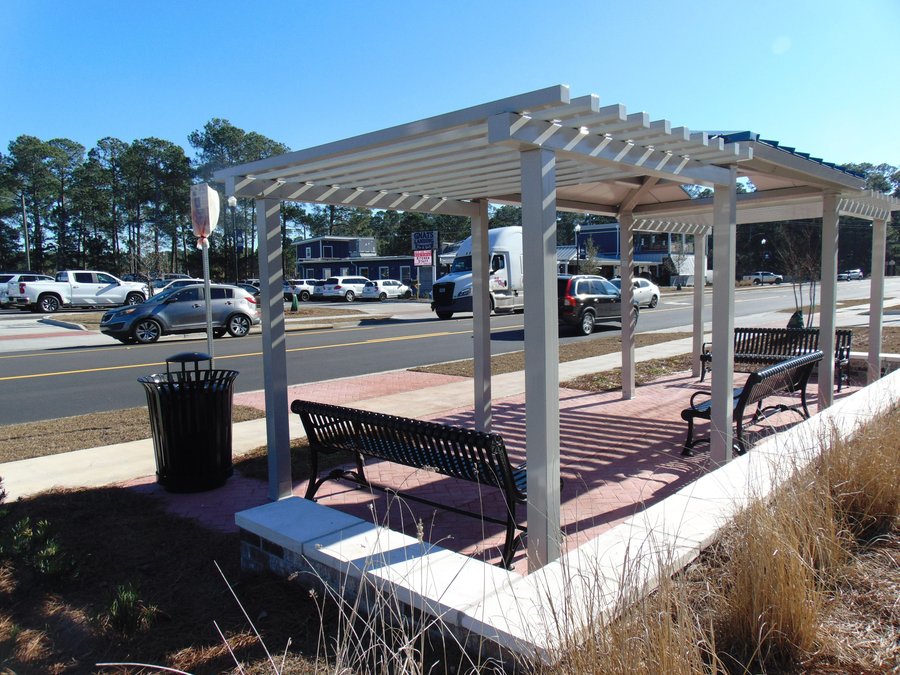
Phase 1 of the Blue Mile streetscape – sidewalks, street lamps, bus shelters, drainage improvements, resurfacing of about a half-mile of South Main Street – is now “substantially complete” and cost less than originally budgeted, Statesboro Public Works and Engineering Director John Washington reported last week.
This phase of the longer-term project covers the southerly half of the Blue Mile, also known as South Main and as part of U.S. Highways 301 and 25 – from Tillman Road near the original Georgia Southern University entrance north to the Fair Road Intersection.
Washington delivered an update during the mayor and council’s 4 p.m. public work session before the Dec. 20 City Council meeting. In an interview afterward, he acknowledged that “substantially complete” does not mean totally complete, since Georgia Power is still expected to remove power poles and establish underground service on the east side of the highway segment, the side where Uncle Shug’s on Main and Gnat’s Landing are located.
However, Washington said the expense of the remaining power cable and pole work was included the total Phase 1 cost figure that he reported to the elected officials.
“The estimate was approximately $5.4 million,” he told the mayor and council members. “Our total contract after a few change orders and other items was $4.12 million, so we came in under budget, came in on schedule.”
“Value engineering” changes to optimize the effect of the infrastructure installed for the amount of money spent continued while the work was underway, Washington reported. He said the city “actually had to add some” street drainage elements that were not part of the Georgia Department of Transportation’s original design to ensure the storm drains worked the way the city engineering staff wanted.
Limited state funding
In 2020 the Georgia DOT awarded Statesboro $1,193,000, or 70% of total cost, whichever was less, for street drainage improvements included in the Phase 1 project. But the overall project remained in the city’s control, with the rest of the funding coming from the Transportation Special Purpose Local Option Sales Tax, or T-SPLOST, and the city’s fee-supported Public Utilities Department.
The $4.12 million contract cost included “all the telephone, power, all the water, sewer, (city natural) gas, telecommunication (cable)” relocation as well as the streetscaping, Washington said.
As shown in a Statesboro Herald story from February 2021, the original construction estimate was $3.8 million, but the city also had to budget for relocation of non-city-owned utilities.
After the Georgia DOT required that, as part of the project, businesses or other property owners with signs standing within the state’s 100-foot-wide right of way had to move them out of that right of way, the city also set aside “at least $100,000” to assist business owners with the cost. To qualify, they submitted sign company cost estimates for review by city engineers.
Along the street
Washington noted that the completed work places the new sidewalks farther from the roadway. The street itself was resurfaced but not widened.
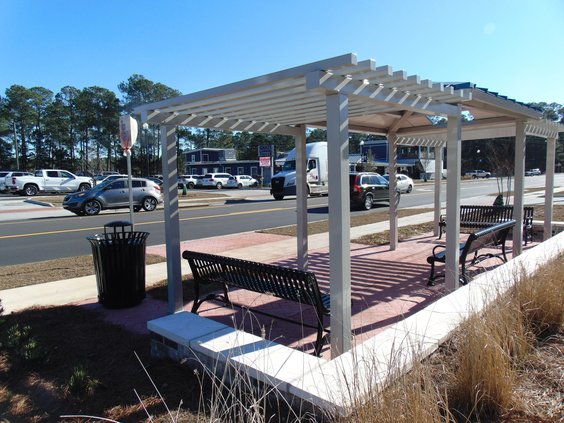
In addition to newly planted trees and landscaped islands, the streetscape includes two new “pocket parks,” one larger than the other, with sheltered benches. These can serve as bus stop waiting areas for the new Statesboro Area Transit system, which has been planned by the city in cooperation with the Coastal Regional Commission but has yet to roll.
The new, decorative streetlamp poles with banner holders, now displaying blue Georgia Southern University banners with the Eagle emblem, were “provided by cooperation with Georgia Southern to give Downtown Statesboro the ‘college town’ presence,” states a summary in the city slideshow. The university paid for the lamp poles and the city paid to have them installed, Washington explained.
After the meeting, the Statesboro Herald asked whether one portion of the project has really been completed, since wooden power poles remain up along the eastern edge of the highway, in front of businesses previously required to move their signs. Placing utility lines on that side of the street underground and removing the poles, in favor of a few larger poles to the west of South Main, was a stated objective of the plan.
“Georgia Power is supposed to be getting back to me. …,” Washington said last week. “We have a business owner that wanted to put a transformer on their business property. They finally got that taken care of and have acquired the easement they needed, so now the power company can go forward.”
But the cost of the power pole removal was included in the $4.12 million.
“We’ve already paid them for the work, they just haven’t done it yet,” he said.
Phases 2 & 3
Next up, Phase 2 of the project, estimated to cost more than $5 million with the city committed to provide $1.5 million for property acquisition, would extend similar improvements up South Main Street from Fair Road to the Grady Street intersection. Washington said he is ready to move forward with planning for Phase 2 in 2023, but Georgia DOT has given it an estimated timeline of 2025-2027.
Phase 3, also with an estimated $5 million construction cost, would complete the project from Grady Street up to East and West Main Streets. The estimated timeline is 2026-2028.
Planning for these two phases is complicated by the fact that the right of way narrows to 50 feet and sidewalks abut long-established buildings, Washington noted.
Interconnected with the streetscape plans, the DOT has a majority state-funded plan to convert the Fair Road-South Main intersection to a roundabout, also at an expected cost of about $5 million-plus and projected construction date circa July 2026.
Blue Mile history
Washington’s update included a timeline tracing the Blue Mile streetscape project back more than a decade to the formation of the South Main Street Revitalization after a 2012 community planning retreat hosted by the Chamber of Commerce. The separate, but related Creek on the Blue Mile plan grew out of the same effort.
The overall vision in 2017 won Statesboro a $1 million third prize in the national, industry-sponsored America’s Best Communities redevelopment contest, following a $100,000 finalist prize and $50,000 quarterfinalist award.
The Blue Mile Foundation and Downtown Statesboro Development Authority later spent more than $1.3 million buying parcels of land for the Creek on the Blue Mile project and potential resale.