
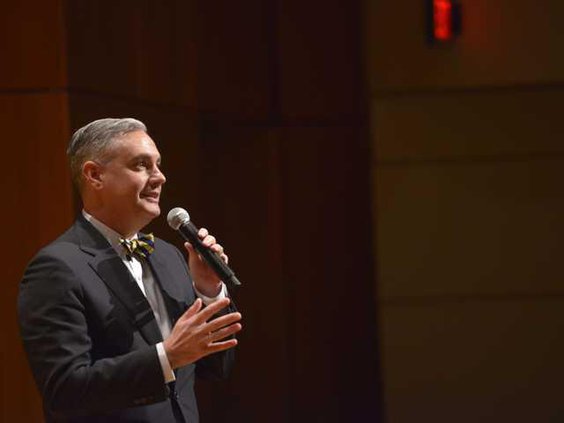
Dr. Timothy C. Caboni, one of the five Georgia Southern University presidential contenders invited to speak on campus, made a point of not laying out his vision for the university's future.
"I'm not going to tell you my vision - I'm not going to fall for that trap - of what Georgia Southern should be in the next decade," Caboni said Monday evening. "That's something we're going to have to build and work on together."
About 150 people attended the forum held in the Carol A. Carter Recital Hall to introduce Caboni to the university and wider community. Of the five candidates invited by the Presidential Search and Screen Committee, Caboni was the first to visit campus. The four others will be appearing in similar three-day visits, each including an open forum plus a faculty forum, through March 11.
The visits are part of the search to name a permanent successor to Dr. Brooks Keel, who was president of the university from January 2010 until he left last July to become president of Georgia Regents University in Augusta, now renamed Augusta University.
Kansas vice chancellor
Caboni is vice chancellor for public affairs at the University of Kansas, his job since June 2011. He holds a doctorate in higher education leadership and policy from Vanderbilt University, a master's in corporate and organizational communication from Western Kentucky University and a bachelor's in speech communication and rhetoric from Louisiana State University.
Having begun his visit on Sunday, Caboni said he was smart enough to know that if he laid out a plan Monday for about five things he planned to accomplish at Georgia Southern, this would probably be the last time he would ever be seen here.
Instead, he proposed to share some opportunities he sees for the university and to describe the kind of president he would probably be.
"The university presidency has changed during the past 20 years," Caboni said. "It has really evolved into an outward-facing role. Attracting resources and investment is key, developing relationships, articulating a vision, a shared vision that we develop together, to every constituency you can imagine, is how I envision the role of president."
The opportunities he would explore with input from others, he said, would include continuing to enhance the university experience for undergraduate students, building more graduate programs in chosen fields and expanding research in a similarly selective way. In choosing what graduate degrees to offer and how to grow in research, he said, the university cannot do everything, but should find a niche that is unique in Georgia.
"In the next year we have to decide as an institution who we are today, what we want to be in the future, and how we're going to get there," Caboni said, "and a crucial question in that is, where are the places we want to build graduate programs and why do we want to build them, what's the marketplace demand, ... the workforce demand."
The university, he said, should also seek to build research and graduate programs in ways that attract "not just investment, but partnerships from the community, from industry, from donors who want to invest and support the institution, from alumni who care about this great university."
Caboni repeatedly referred to the university president's role in fundraising. Perceived needs he had heard about already during his visit include graduate student stipends, facilities, student financial aid and more space.
"All of those things require money, resources," Caboni said. "That's the president's job, to figure out how you develop relationships, partnerships, how to grow the foundation, to do fundraising, to generate voluntary support that will help deal with compression issues for faculty."
This last point refers to the use of outside funding to reward and retain professors with things such as endowed chair positions. Caboni also referred to fundraising as a means to help keep college affordable for students.
"Affordability is a huge issue," he said. "We have to make sure that we continue to be available to all students who can benefit from a Georgia Southern experience, and generating the scholarship dollars to do that."
Regents to decide
The Board of Regents of the University System of Georgia assigned the campus-based search committee to name three to five semifinalists that committee members consider qualified to be GSU president, without ranking them.
Dr. Stephen Vives, the biology professor who chairs the campus committee, said members plan to deliver the three to five names by mid-March to the Special Regents Search Committee, chaired by Regent Lori Durden of Statesboro. The entire Board of Regents will vote on the selection of the new president, with a target date of July 1 for the new head of the university to be in place.
Meanwhile, Dr. Jean Bartels, previously GSU provost and vice president for academic affairs, continues as interim president, and has said she is proud to be the university's first woman president in its almost 110-year history. Caboni referred to Bartels by job title several times, saying he would work closely with the provost in discerning the university's future.
Herald reporter Al Hackle may be reached at (912) 489-9458.